As the digital landscape continues to evolve, businesses are increasingly turning to artificial intelligence (AI) technologies to enhance their operations and drive financial growth. According to a report by Frost & Sullivan, a staggering 89% of organizations believe that AI and machine learning will be instrumental in boosting revenue, improving operational efficiency, and enhancing customer experiences.
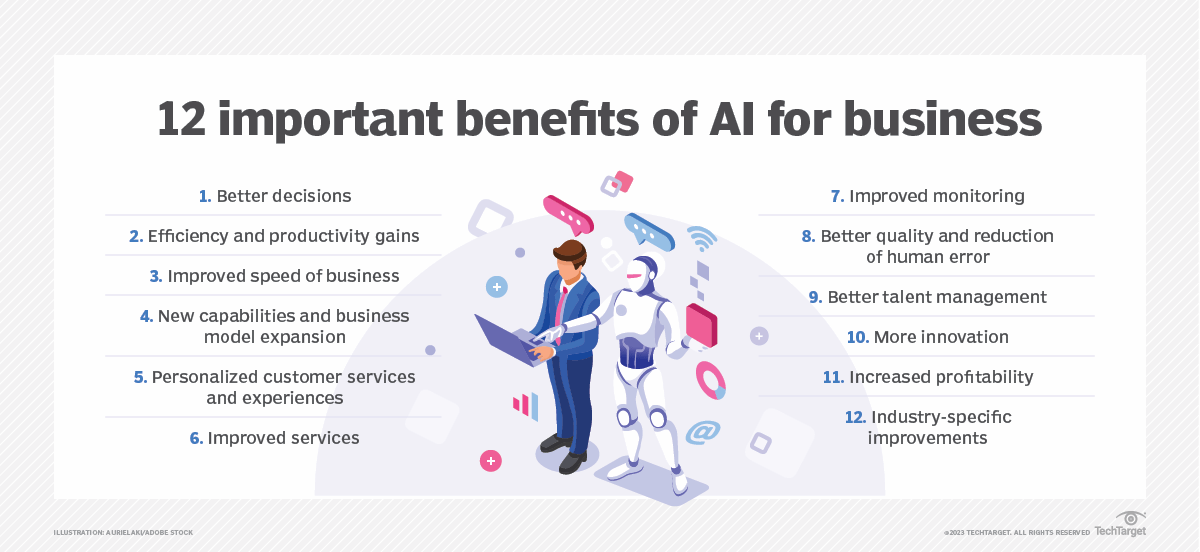
In an in-depth exploration by Mary K. Pratt, featured on TechTarget, the article titled “12 Key Benefits of AI for Business” delves into the myriad ways AI is transforming industries. Here are some of the standout benefits:
1. Better Decisions
AI empowers organizations to make more informed, data-driven decisions. By analyzing vast amounts of data, AI helps eliminate bias and personal preferences, leading to more accurate outcomes.
2. Efficiency and Productivity Gains
AI enables businesses to handle tasks at unprecedented volumes and speeds, freeing up human resources for higher-level tasks. This translates to significant productivity gains and cost reductions.
3. Improved Speed of Business
With AI, businesses can accelerate processes, from design to commercialization, resulting in shorter cycles and measurable returns on investment.
4. New Capabilities and Business Model Expansion
AI opens new avenues for business model expansion. For instance, autonomous vehicle companies can leverage data for new revenue streams, while insurance firms can explore fleet management opportunities.
5. Personalized Customer Services and Experiences
AI’s ability to analyze consumer data allows for highly personalized services, enhancing customer satisfaction across sectors from retail to healthcare.
6. Improved Services
AI facilitates more intuitive and accurate interactions with technology, enhancing user experiences in various industries, including real estate and customer service.
7. Improved Monitoring
Real-time data processing by AI allows for near-instantaneous monitoring, alerting organizations to issues and recommending actions, especially in manufacturing and cybersecurity.
8. Better Quality and Reduction of Human Error
AI reduces errors and improves adherence to standards, particularly when combined with robotic process automation, enhancing the value proposition for businesses.
9. Better Talent Management
AI streamlines hiring processes, eliminates bias, and enhances workforce productivity by identifying top-tier candidates and providing personalized employee experiences.
10. More Innovation
As familiarity with AI grows, employees use it to foster creativity and innovation, from crafting personalized cocktails in restaurants to supporting R&D in healthcare.
11. Increased Profitability
Through enhanced productivity and new growth opportunities, AI contributes to increased profitability, with its potential for revenue growth being exponential.
12. Industry-Specific Improvements
Retail: AI optimizes marketing, supply chain, and pricing strategies.
Pharmaceuticals: AI aids in drug discovery and data analysis.
Finance: AI enhances risk management and fraud detection.
While the benefits of AI are substantial, organizations must also navigate challenges such as AI bias, regulatory concerns, and talent shortages. As businesses continue to integrate AI, they must ensure the necessary infrastructure and skills are in place to fully realize its potential.
For more insights, visit the original article on TechTarget.
More Articles
Getting licensed or staying ahead in your career can be a journey—but it doesn’t have to be overwhelming. Grab your favorite coffee or tea, take a moment to relax, and browse through our articles. Whether you’re just starting out or renewing your expertise, we’ve got tips, insights, and advice to keep you moving forward. Here’s to your success—one sip and one step at a time!
Flood insurance premiums across Florida are climbing fast, with more than 80% of NFIP policyholders seeing annual increases under FEMA’s Risk Rating 2.0. Some counties now face hikes exceeding $3,500 per year, adding pressure in a state where homeowners insurance already averages nearly $11,000 annually. As risk-based pricing takes hold and climate impacts intensify, Florida homeowners — and the real estate pros who advise them — must prepare for continued premium growth and major county‑to‑county disparities.
As insurers step into 2026, the property and casualty market shows its first signs of real stability after several turbulent years. Q4 results reveal disciplined underwriting, cooling rate hikes, and steady premium growth across major carriers. Commercial lines show selective momentum, personal lines begin to level out, and AI-driven efficiency becomes the industry’s new engine for profitability. With catastrophe losses moderating and tech adoption accelerating, professionals across insurance, real estate, and finance can expect a pivotal year—and an ideal moment to sharpen their skills through continuing education.
A new CBRE survey shows that most U.S. commercial real estate investors expect to increase their property purchases in 2026, signaling renewed confidence and market stabilization. Dallas remains the nation’s top target for the fifth straight year, followed by high‑growth metros like Atlanta, San Francisco, Miami, Charlotte, Raleigh‑Durham, Nashville, Tampa, Seattle, and New York City. These cities continue to draw strong investor interest due to population growth, business expansion, and robust development activity.
Florida Insurance Commissioner Michael Yaworsky says the state's turbulent property insurance market is finally calming, with Florida posting the lowest rate increases in the nation last year. Yet rising home replacement costs mean many homeowners won’t see relief in their premiums just yet. With Citizens Insurance shrinking, new legislative priorities emerging, and long‑term reforms taking hold, Florida’s real estate and insurance professionals are entering 2026 with cautious optimism and a clearer picture of what’s ahead.
A new CBRE survey shows investor optimism surging as 95% plan to buy more or the same amount of commercial real estate in 2026, with over half increasing their capital allocation. Stabilizing values, improving fundamentals, and expected relief in debt costs are driving renewed confidence, putting markets like Dallas, Atlanta, and Tampa in the spotlight as multifamily and industrial assets lead demand.
Artificial intelligence has moved from industry buzzword to essential mortgage‑lending tool, reshaping how loan officers work, communicate and compete. From smarter lead targeting to rapid content creation and CRM‑powered automation, AI is now the dividing line between lenders who scale efficiently and those stuck in manual workflows. This article breaks down why AI adoption is no longer optional, how top lenders are using it and what mortgage professionals must do now to stay competitive.