As the digital landscape continues to evolve, businesses are increasingly turning to artificial intelligence (AI) technologies to enhance their operations and drive financial growth. According to a report by Frost & Sullivan, a staggering 89% of organizations believe that AI and machine learning will be instrumental in boosting revenue, improving operational efficiency, and enhancing customer experiences.
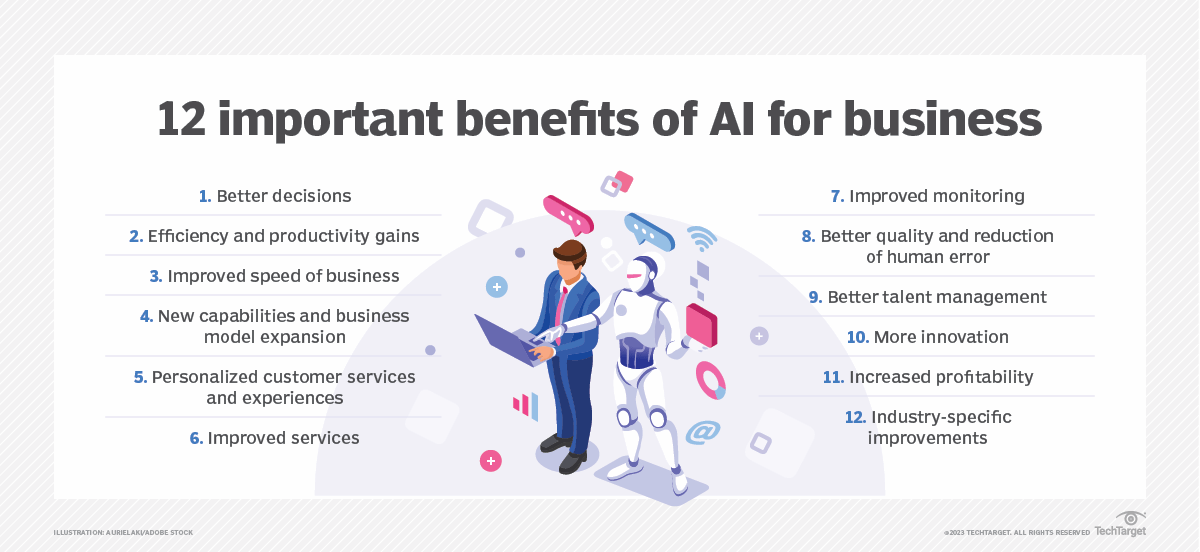
In an in-depth exploration by Mary K. Pratt, featured on TechTarget, the article titled “12 Key Benefits of AI for Business” delves into the myriad ways AI is transforming industries. Here are some of the standout benefits:
1. Better Decisions
AI empowers organizations to make more informed, data-driven decisions. By analyzing vast amounts of data, AI helps eliminate bias and personal preferences, leading to more accurate outcomes.
2. Efficiency and Productivity Gains
AI enables businesses to handle tasks at unprecedented volumes and speeds, freeing up human resources for higher-level tasks. This translates to significant productivity gains and cost reductions.
3. Improved Speed of Business
With AI, businesses can accelerate processes, from design to commercialization, resulting in shorter cycles and measurable returns on investment.
4. New Capabilities and Business Model Expansion
AI opens new avenues for business model expansion. For instance, autonomous vehicle companies can leverage data for new revenue streams, while insurance firms can explore fleet management opportunities.
5. Personalized Customer Services and Experiences
AI’s ability to analyze consumer data allows for highly personalized services, enhancing customer satisfaction across sectors from retail to healthcare.
6. Improved Services
AI facilitates more intuitive and accurate interactions with technology, enhancing user experiences in various industries, including real estate and customer service.
7. Improved Monitoring
Real-time data processing by AI allows for near-instantaneous monitoring, alerting organizations to issues and recommending actions, especially in manufacturing and cybersecurity.
8. Better Quality and Reduction of Human Error
AI reduces errors and improves adherence to standards, particularly when combined with robotic process automation, enhancing the value proposition for businesses.
9. Better Talent Management
AI streamlines hiring processes, eliminates bias, and enhances workforce productivity by identifying top-tier candidates and providing personalized employee experiences.
10. More Innovation
As familiarity with AI grows, employees use it to foster creativity and innovation, from crafting personalized cocktails in restaurants to supporting R&D in healthcare.
11. Increased Profitability
Through enhanced productivity and new growth opportunities, AI contributes to increased profitability, with its potential for revenue growth being exponential.
12. Industry-Specific Improvements
Retail: AI optimizes marketing, supply chain, and pricing strategies.
Pharmaceuticals: AI aids in drug discovery and data analysis.
Finance: AI enhances risk management and fraud detection.
While the benefits of AI are substantial, organizations must also navigate challenges such as AI bias, regulatory concerns, and talent shortages. As businesses continue to integrate AI, they must ensure the necessary infrastructure and skills are in place to fully realize its potential.
For more insights, visit the original article on TechTarget.
More Articles
Getting licensed or staying ahead in your career can be a journey—but it doesn’t have to be overwhelming. Grab your favorite coffee or tea, take a moment to relax, and browse through our articles. Whether you’re just starting out or renewing your expertise, we’ve got tips, insights, and advice to keep you moving forward. Here’s to your success—one sip and one step at a time!
The spotlight of the conference is on generative AI tools, which are reshaping legal departments' budgets and workflows. Tanja Podinic, senior vice president of AI programs at ContractPodAi, notes that the legal sector is at a transformative phase, with AI technologies prompting a shift in traditional practices.
Atlanta tops the list with its robust transaction volume and a remarkable 53.7% share of inbound moves. The city's vibrant culture and urban core, ripe for renovation, make it an attractive place to live. However, rising land, labor, and building costs are putting pressure on affordability.
Remote work, once a temporary necessity, has become a permanent fixture for many. This shift has prompted a significant migration from high-cost coastal metros like San Francisco and New York to more affordable regions.
Delaware has emerged as the top state for retirees in 2024, offering tax-friendly policies and strong well-being metrics, despite a higher cost of living.
In a world where the dream of owning a home often feels out of reach, down payment assistance (DPA) programs have emerged as a beacon of hope for aspiring homeowners. With over 2,000 programs available nationwide, these initiatives are designed to make homeownership more accessible by alleviating the financial burden of upfront costs.
The article emphasizes that successful real estate investments are grounded in understanding market dynamics and recognizing the potential for growth amidst economic fluctuations.