AI in Telemedicine Market on the Rise

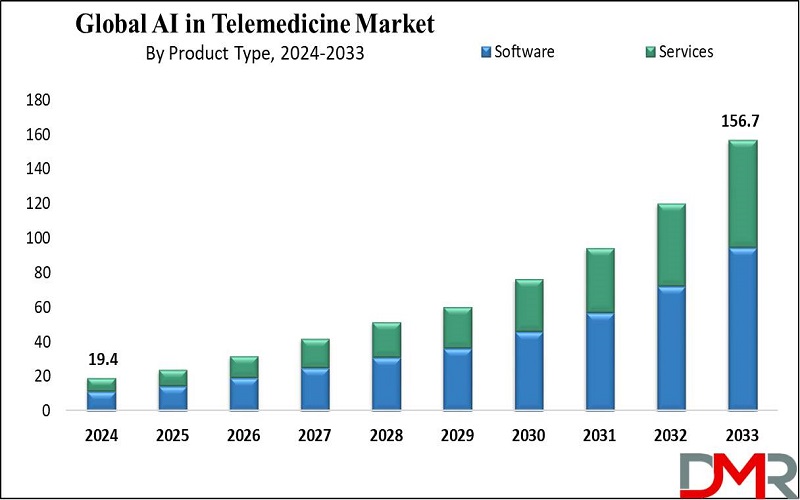
The AI in telemedicine market is set to experience a remarkable surge, growing from USD 19.4 billion in 2024 to an anticipated USD 156.7 billion by 2033. This represents a compound annual growth rate (CAGR) of 26.1%, driven by advancements in remote diagnostics, personalized treatments, and the integration of artificial intelligence across telemedicine platforms globally.
Global ai in telemedicine market growth analysis

The Role of AI in Enhancing Telemedicine

AI technologies are revolutionizing telemedicine by enhancing remote diagnostics and personalized treatment plans. Tools such as virtual assistants and chatbots are streamlining patient interactions, reducing wait times, and improving diagnostic accuracy. These advancements are pivotal in driving the market’s growth, with teleconsultation services and IT advancements playing a significant role.

Key Insights and Trends

  • Market Growth: The global AI in telemedicine market is projected to expand by USD 132.7 billion between 2025 and 2033.
  • Product Type: Software is expected to lead, accounting for 60.2% of revenue in 2024.
  • Application Analysis: Virtual nursing assistants are anticipated to secure 26.4% of market revenue by the end of 2024.
  • Regional Dominance: North America is forecasted to dominate with a 41.2% market share by 2024.

Technological advancements, including machine learning and natural language processing (NLP), are enhancing diagnostic accuracy and providing real-time data insights. The integration of cloud-based and edge AI technologies is further optimizing healthcare services.

Competitive Landscape

The market is highly competitive, with major players like Siemens Healthcare GmbH, IBM, and Cisco Systems Inc. leading the charge. These companies are driving innovation through technological advancements and addressing rising healthcare costs. Meanwhile, independent ventures are making significant strides by offering specialized services targeting specific medical conditions.

Opportunities and Future Prospects

The AI in telemedicine market presents numerous opportunities, including enhanced diagnostic accuracy, streamlined efficiency, and cost reduction. These factors are expected to transform healthcare delivery, making telemedicine services more scalable and accessible.
For more detailed insights, you can download the report excerpt or purchase the competition analysis dashboard.

More Articles

Getting licensed or staying ahead in your career can be a journey—but it doesn’t have to be overwhelming. Grab your favorite coffee or tea, take a moment to relax, and browse through our articles. Whether you’re just starting out or renewing your expertise, we’ve got tips, insights, and advice to keep you moving forward. Here’s to your success—one sip and one step at a time!

The Future of Commercial Real Estate: Trends and Predictions for 2025

The commercial real estate market in 2024 was characterized by adaptation to new economic realities and shifting consumer preferences.

Significant Overhaul in Illinois Real Estate Laws: What’s Changing?

Illinois is set to implement significant changes to its real estate laws following the National Association of REALTORS® rule adjustments, aiming to enhance transparency and accountability in the real estate sector.

Emerging Markets Lead Real Estate’s Green Revolution

Emerging markets are stepping up to the plate, enhancing the green credentials of their real estate assets. This movement is not just a whisper in the wind but a significant stride towards a more sustainable future.

Green Building Trends Reshape U.S. Commercial Real Estate Investing

Institutional investors are encountering a myriad of challenges that are shaping their investment strategies. One of the most significant factors influencing these strategies is the rise in interest rates, which has become a central concern for investors seeking to maximize returns.

The Future of Virtual Reality: Market Growth and Trends 2025-2029

The global virtual reality (VR) market is poised for a significant leap, with projections indicating a growth of USD 133.17 billion from 2025 to 2029. This remarkable expansion is driven by rapid advancements in VR technologies and the integration of artificial intelligence (AI) and machine learning (ML).