AI in Telemedicine Market on the Rise

The AI in telemedicine market is set to experience a remarkable surge, growing from USD 19.4 billion in 2024 to an anticipated USD 156.7 billion by 2033. This represents a compound annual growth rate (CAGR) of 26.1%, driven by advancements in remote diagnostics, personalized treatments, and the integration of artificial intelligence across telemedicine platforms globally.
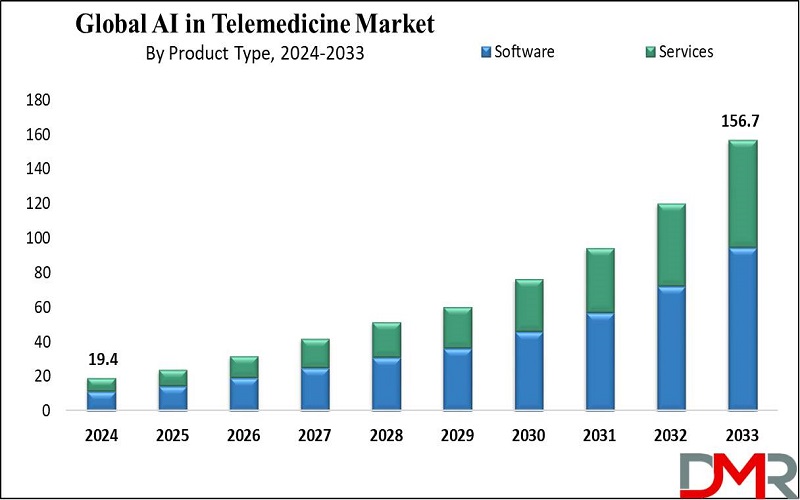
Global ai in telemedicine market growth analysis

The Role of AI in Enhancing Telemedicine

AI technologies are revolutionizing telemedicine by enhancing remote diagnostics and personalized treatment plans. Tools such as virtual assistants and chatbots are streamlining patient interactions, reducing wait times, and improving diagnostic accuracy. These advancements are pivotal in driving the market’s growth, with teleconsultation services and IT advancements playing a significant role.

Key Insights and Trends

  • Market Growth: The global AI in telemedicine market is projected to expand by USD 132.7 billion between 2025 and 2033.
  • Product Type: Software is expected to lead, accounting for 60.2% of revenue in 2024.
  • Application Analysis: Virtual nursing assistants are anticipated to secure 26.4% of market revenue by the end of 2024.
  • Regional Dominance: North America is forecasted to dominate with a 41.2% market share by 2024.

Technological advancements, including machine learning and natural language processing (NLP), are enhancing diagnostic accuracy and providing real-time data insights. The integration of cloud-based and edge AI technologies is further optimizing healthcare services.

Competitive Landscape

The market is highly competitive, with major players like Siemens Healthcare GmbH, IBM, and Cisco Systems Inc. leading the charge. These companies are driving innovation through technological advancements and addressing rising healthcare costs. Meanwhile, independent ventures are making significant strides by offering specialized services targeting specific medical conditions.

Opportunities and Future Prospects

The AI in telemedicine market presents numerous opportunities, including enhanced diagnostic accuracy, streamlined efficiency, and cost reduction. These factors are expected to transform healthcare delivery, making telemedicine services more scalable and accessible.
For more detailed insights, you can download the report excerpt or purchase the competition analysis dashboard.

More Articles

Getting licensed or staying ahead in your career can be a journey—but it doesn’t have to be overwhelming. Grab your favorite coffee or tea, take a moment to relax, and browse through our articles. Whether you’re just starting out or renewing your expertise, we’ve got tips, insights, and advice to keep you moving forward. Here’s to your success—one sip and one step at a time!

Emerging Trends Shaping the Future of Commercial Real Estate

Commercial real estate is undergoing rapid transformation driven by flexible workspaces, booming industrial demand, sustainability priorities, and advanced building technology. As tenant expectations evolve, investors and professionals who adapt to modular work environments, e-commerce driven logistics growth, green building standards, and tech integrated properties will be best positioned for long term success in an increasingly dynamic market.

Florida Ends Insurance Surcharge Early, Delivering 650 Million Dollars in Statewide Savings

Florida homeowners are getting long-awaited relief as the state ends its 1 percent insurance surcharge two years ahead of schedule. The charge, originally added after multiple insurer failures, will officially conclude on October 1, saving residents an estimated 650 million dollars. While individual savings average about 31 dollars per policy, the move signals a healthier and more stable insurance market—welcome news for homeowners, buyers, and real estate professionals across the state.

Real Estate Tech Gets Smarter: AI, Integrations, and Faster Listing Prep

This week’s biggest real estate tech updates are reshaping how agents market listings, how builders present inventory, and how sellers prep their homes. Canva and Rechat now offer a seamless MLS‑to‑marketing workflow, PulteGroup is expanding AI to create consistent digital listings, and Simplify Home is accelerating pre‑listing improvements with pay‑at‑closing options. These innovations highlight a clear trend: real estate pros who embrace smarter tools will move faster and win more business.

Starting Your Career? New Study Reveals the Best and Worst States for Young Professionals

A new national analysis shows that where you choose to launch your career can dramatically impact your early financial stability, job growth, and long‑term success. Wyoming, Vermont, and the Dakotas offer the strongest opportunities for entry‑level professionals thanks to abundant jobs and affordable housing. Meanwhile, states like California and Hawaii present steep challenges with extremely limited openings and sky‑high living costs. For those eyeing real estate, mortgage, insurance, or finance careers, Florida remains competitive but promising—and Cameron Academy is ready to help you get licensed and career‑ready no matter where you start.

Florida House Advances Major Housing Bill Amid Concerns Over Sprawl

Florida lawmakers have approved HB 399, a sweeping land‑use overhaul that aims to expand housing supply but has sparked concern over weakened local authority and potential sprawl. Supporters argue the bill will ease affordability pressures, while opponents warn it sidelines voter-approved growth protections and shifts too much power toward developers. The measure now moves to the Senate, positioning it as a pivotal issue for real estate professionals navigating Florida’s evolving regulatory landscape.

Florida Keys Buyers Gain the Upper Hand as Market Shifts Toward 2026

A new study shows that buyers in the Florida Keys are gaining more influence over pricing and negotiations, signaling a cooling and maturing market heading into 2026. With increased leverage on the buyer side, real estate professionals must adapt their strategies—sharpening pricing analysis, negotiation skills, and market insights—to stay competitive in a shifting Monroe County landscape.