AI Is Reshaping Mortgage Underwriting in 2026 — And Professionals Are Taking Notice
If you’ve been watching the mortgage industry evolve over the past few years, buckle up — 2026 is shaping up to be the year artificial intelligence finally steps into the underwriting spotlight. A new National Mortgage News survey reveals that 57% of mortgage professionals believe AI-powered underwriting will deliver the most transformative change across the industry this year.
And it’s not just hype. With breakthroughs in large language models and workflow automation, AI is now capable of tackling the “messy real world” of lending decisions — the odd file structures, inconsistent documentation, and human bottlenecks that have slowed innovation for decades.
Why Underwriting Is the Perfect AI Use Case
Theo Ellis, CEO of fintech platform Friday Harbor, highlights why underwriting is primed for transformation: it’s rule-heavy, data-packed, and historically vulnerable to bias. According to Ellis, the reason it has taken decades for AI to break through is simple — “the real world’s really messy.” But today’s AI systems finally process that complexity with consistency and speed.
Loan officers are already benefiting from early AI-powered file reading and workflow orchestration. John Brumund, senior vice president at Quontic Bank’s mortgage division, notes that loans passing through AI before reaching underwriting consistently produce more efficient outcomes.
The Ripple Effect: Credit, Verification, and Preapprovals
The survey shows widespread expectations for AI’s influence far beyond underwriting:
51% anticipate improved credit scoring and deeper analysis
49% expect real-time employment and income verification to accelerate significantly
Loan officers gain the power to build stronger, more accurate preapprovals earlier
This early clarity isn’t just good for borrowers — it’s a win for listing agents seeking reliable, confidence-boosting preapproval letters. As Ellis noted, “Underwriters can now focus on true risk management decisions,” thanks to AI offloading the administrative weight.
Policy Winds and Regulatory Influence
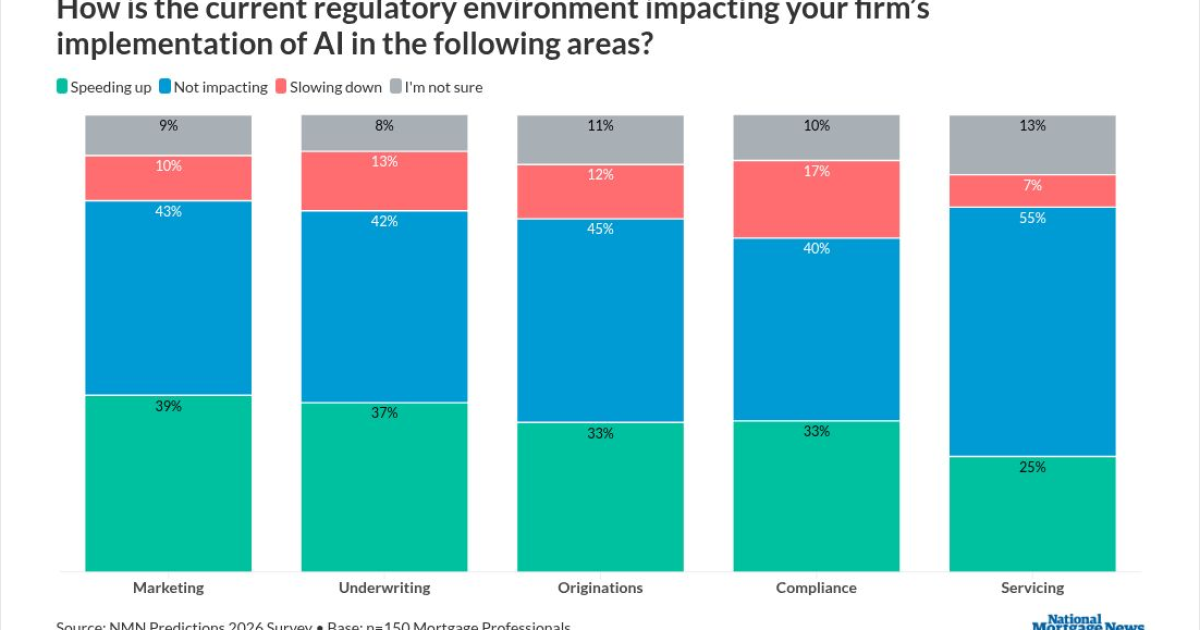
Policy direction is also fueling the rise of AI. With the second Trump administration signaling a looser federal mortgage regulatory environment, 41% of respondents expect overall policy softening. Another 37% say the current climate has encouraged increased AI use specifically in underwriting.
But states aren’t relaxing as quickly. Lenders remain cautious — data privacy and consumer protection still dominate conversations. Brumund emphasizes that mishandling data within AI systems is simply “not acceptable today.”
Resistance, Operational Overhaul, and the Path Forward
Despite momentum, large-scale adoption faces friction. Flyhomes CEO Tushar Garg cautions that redesigning underwriting processes carries real operational risk — and in the mortgage world, “things do not happen quickly or cleanly.”
Still, something powerful is happening: grassroots pressure from within the industry itself. Loan officers and processing teams are watching peers succeed and pushing leadership for the same AI tools. Faster cycle times, clearer paths to clear-to-close, and huge efficiency wins are too significant to ignore.
And when lenders see competitors scaling these benefits beyond small pilots, the rush toward AI becomes inevitable.
What This Means for Mortgage and Real Estate Professionals
For professionals in mortgage, real estate, and adjacent fields, AI’s rise in underwriting is more than a tech milestone — it’s a career-defining shift. Understanding how AI tools work, how they affect borrower experience, and how they influence regulatory expectations will be essential for the next generation of rising industry leaders.
That’s why institutions like Cameron Academy continue to develop forward-thinking education tailored to real estate, mortgage, insurance, finance, and other professional pathways. Staying ahead of AI-driven transformation is becoming a must-have advantage for long-term success.
To explore the original reporting and dive deeper, visit National Mortgage News at their full article here, written by Technology Reporter Spencer Lee.
More Articles
Getting licensed or staying ahead in your career can be a journey—but it doesn’t have to be overwhelming. Grab your favorite coffee or tea, take a moment to relax, and browse through our articles. Whether you’re just starting out or renewing your expertise, we’ve got tips, insights, and advice to keep you moving forward. Here’s to your success—one sip and one step at a time!
A Leon County judge has ordered Florida’s administrative courts to restart arbitration on more than 400 stalled Citizens Insurance cases, reigniting a legal showdown over whether the state’s insurer of last resort can force policyholders out of traditional courtrooms. The ruling directly conflicts with a separate Hillsborough County injunction that called Citizens’ arbitration system “likely unconstitutional,” setting up a rare judicial clash that could reshape how Floridians fight denied or underpaid property claims.
Inhabit has launched a powerful new suite of AI‑driven tools designed to modernize leasing, strengthen fraud prevention, and simplify compliance for property managers nationwide. From advanced leasing assistants and NYC‑specific regulatory AI to instant income verification and upcoming identity‑screening tech, these innovations aim to solve some of the industry’s toughest challenges. Real estate professionals—especially in multifamily—can expect faster operations, stronger safeguards, and a more efficient workflow as these technologies roll out.
A growing body of demographic research suggests that today’s housing shortage may give way to a future surplus as millions of Baby Boomer–owned homes return to the market over the next two decades. With affordability at historic lows and inventory still tight, this long‑term shift could eventually cool prices and transform the landscape for real estate professionals. The analysis draws parallels to aging populations abroad and highlights why understanding demographic cycles is becoming essential knowledge for agents, brokers, and mortgage professionals preparing for the next era of the housing market.
Griffin Funding has appointed John Jones as Senior Vice President of Growth and EOS Integrator, a move aimed at accelerating the lender’s push toward $3 billion in annual non‑QM loan volume by 2030. Jones, previously the company’s fractional integrator and COO, will lead expansion strategies, operational optimization, and leadership development as the lender strengthens its position in the increasingly competitive non‑QM market.
A new report shows Tampa outperforming the national real estate slowdown with a 6.5 percent annualized multifamily return, nearly 20 percent higher than the U.S. average. While many metros face oversupply or regulatory drag, Tampa’s balanced development pipeline, strong population growth, and investor confidence continue to fuel resilient performance heading into 2026.
A new Colliers outlook reveals that global capital is picking up momentum again, with investors shifting toward more active, hands‑on strategies. Data centers are surging, offices are rebounding, and value‑add plays like adaptive reuse are defining the next wave of opportunity. Regional markets—from the U.S. to APAC—are seeing renewed demand as fundraising spreads across continents and investors seek speed, control, and scale. This snapshot helps today’s real estate and finance professionals stay aligned with where global money is moving next.