AI Transformation in Healthcare: A Market on the Brink of Explosive Growth
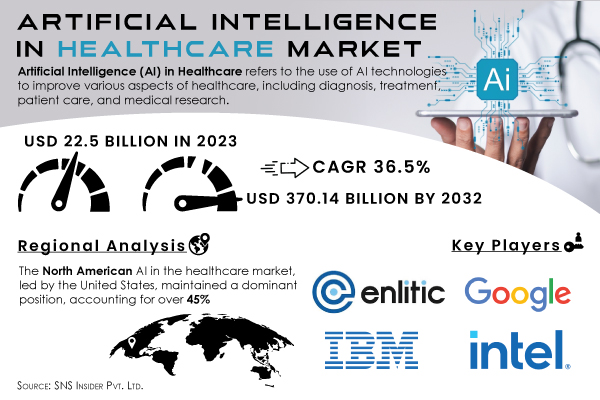
In a world where technology continues to reshape industries, the healthcare sector is witnessing a monumental transformation, largely driven by Artificial Intelligence (AI). According to GlobeNewswire, the AI in Healthcare market, valued at USD 22.5 billion in 2023, is projected to skyrocket to USD 370.14 billion by 2032. This growth is fueled by a remarkable compound annual growth rate (CAGR) of 36.5%.
The adoption of AI-based solutions across various healthcare applications, including diagnostics, treatment planning, and robotic surgeries, is on the rise. This surge is attributed to the increasing volume of healthcare data and advancements in machine learning and natural language processing, enhancing decision-making, patient outcomes, and operational efficiencies.
Market Dynamics
Technological innovations and heightened investments have paved the way for advanced AI tools catering to diverse healthcare needs. On the demand side, the necessity for data-driven decision-making in healthcare, coupled with the quest to improve patient outcomes, accelerates AI technology adoption. AI’s role in overcoming challenges like the shortage of skilled healthcare professionals is proving crucial.
Key Industry Players
Major industry players, including Enlitic Inc., GE Healthcare, Google Inc., IBM Corporation, iCarbonX, Intel Corporation, and Microsoft Corporation, are at the forefront of advancing AI applications in clinical tasks such as diagnostic imaging and drug discovery.
Regional Insights
In 2023, North America dominated the AI in Healthcare market, driven by early adoption of advanced technologies and significant investments. Meanwhile, Asia-Pacific is predicted to be the fastest-growing region from 2024 to 2032, with countries like China and India leading this growth.
Recent Developments
August 2024: Philips introduced the AI-powered HealthSuite Platform for enhanced patient management.
July 2024: IBM Watson Health launched an AI-driven drug discovery platform to expedite new therapies.
June 2024: Microsoft unveiled Azure AI Health Insights for predictive analytics in healthcare.
May 2024: Medtronic released the AI-based endoscopy system, GI Genius, for early colorectal cancer detection.
April 2024: Siemens Healthineers launched an AI-enhanced imaging software to boost diagnostic imaging accuracy.
Outlook
As AI adoption in diagnostics, treatment, and robotic surgeries continues to rise, the healthcare AI market is poised for significant upswing, led by software solutions and robotic surgery applications. For further comprehensive details, visit the complete market outlook report here.
More Articles
Getting licensed or staying ahead in your career can be a journey—but it doesn’t have to be overwhelming. Grab your favorite coffee or tea, take a moment to relax, and browse through our articles. Whether you’re just starting out or renewing your expertise, we’ve got tips, insights, and advice to keep you moving forward. Here’s to your success—one sip and one step at a time!
The commercial real estate sector closed out 2025 with renewed stability, as the Real Estate Roundtable’s latest sentiment index shows rising confidence and improving market fundamentals. Executives report better access to capital, stronger performance in residential, retail, and hospitality, and early signs of recovery in the office market. With financing loosening and asset values climbing, the outlook for 2026 is increasingly optimistic, creating fresh opportunities for both seasoned professionals and newcomers preparing to enter the field.
The CFPB is proposing changes to how lenders evaluate “disparate impact” under the Equal Credit Opportunity Act, potentially tightening the scrutiny on credit decisions that unintentionally disadvantage protected groups. These updates could reshape underwriting models, lending criteria, and compliance requirements — ultimately influencing mortgage approvals, buyer qualifications, and day‑to‑day real estate activity.
Florida’s insurance crisis has become the defining issue heading into 2026, with Republicans touting recent market improvements while Democrats argue families are still being crushed by soaring premiums. From billion‑dollar auto insurance refunds to condo markets destabilized by post‑Surfside rate spikes, the state’s political divide is shaping the future of real estate, insurance, and affordability for millions.
October 2025 brought a wave of major regulatory updates across insurance, finance, and compliance. From stricter oversight on retail insurers and new FCA rules on ESG and travel insurance, to EIOPA’s EU‑wide consultations and refreshed corporate governance standards, regulators signaled higher expectations and faster change ahead. For professionals—and those pursuing licenses—these shifts directly impact risk management, product design, and consumer outcomes, making regulatory awareness a critical competitive advantage.
After nearly two years of sluggish activity, commercial real estate lending is finally accelerating—fast. New data from CBRE shows loan closings jumped 112% year‑over‑year in Q3 2025, reaching their highest level since 2018. With interest rates stabilizing and credit spreads tightening, investors are returning, banks are re‑entering the market, and multifamily financing is dominating once again. The long‑stalled deal flow is thawing, signaling renewed momentum heading into 2026.
Farmers Insurance is lifting its cap on new homeowner policies in California after two years of limiting growth, signaling a shift in the state’s strained insurance market. The expansion comes with a proposed 6.99 percent rate increase that still needs regulatory approval. Supporters call it a turning point driven by new wildfire‑risk rules, while consumer advocates warn the reforms contain loopholes and could lead to higher costs for homeowners.