AI Transformation in Healthcare: A Market on the Brink of Explosive Growth
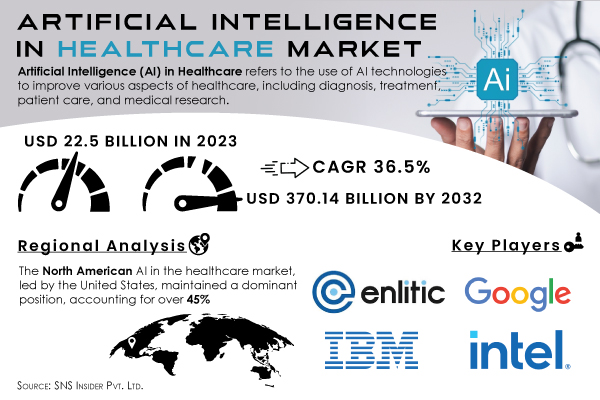
In a world where technology continues to reshape industries, the healthcare sector is witnessing a monumental transformation, largely driven by Artificial Intelligence (AI). According to GlobeNewswire, the AI in Healthcare market, valued at USD 22.5 billion in 2023, is projected to skyrocket to USD 370.14 billion by 2032. This growth is fueled by a remarkable compound annual growth rate (CAGR) of 36.5%.
The adoption of AI-based solutions across various healthcare applications, including diagnostics, treatment planning, and robotic surgeries, is on the rise. This surge is attributed to the increasing volume of healthcare data and advancements in machine learning and natural language processing, enhancing decision-making, patient outcomes, and operational efficiencies.
Market Dynamics
Technological innovations and heightened investments have paved the way for advanced AI tools catering to diverse healthcare needs. On the demand side, the necessity for data-driven decision-making in healthcare, coupled with the quest to improve patient outcomes, accelerates AI technology adoption. AI’s role in overcoming challenges like the shortage of skilled healthcare professionals is proving crucial.
Key Industry Players
Major industry players, including Enlitic Inc., GE Healthcare, Google Inc., IBM Corporation, iCarbonX, Intel Corporation, and Microsoft Corporation, are at the forefront of advancing AI applications in clinical tasks such as diagnostic imaging and drug discovery.
Regional Insights
In 2023, North America dominated the AI in Healthcare market, driven by early adoption of advanced technologies and significant investments. Meanwhile, Asia-Pacific is predicted to be the fastest-growing region from 2024 to 2032, with countries like China and India leading this growth.
Recent Developments
August 2024: Philips introduced the AI-powered HealthSuite Platform for enhanced patient management.
July 2024: IBM Watson Health launched an AI-driven drug discovery platform to expedite new therapies.
June 2024: Microsoft unveiled Azure AI Health Insights for predictive analytics in healthcare.
May 2024: Medtronic released the AI-based endoscopy system, GI Genius, for early colorectal cancer detection.
April 2024: Siemens Healthineers launched an AI-enhanced imaging software to boost diagnostic imaging accuracy.
Outlook
As AI adoption in diagnostics, treatment, and robotic surgeries continues to rise, the healthcare AI market is poised for significant upswing, led by software solutions and robotic surgery applications. For further comprehensive details, visit the complete market outlook report here.
More Articles
Getting licensed or staying ahead in your career can be a journey—but it doesn’t have to be overwhelming. Grab your favorite coffee or tea, take a moment to relax, and browse through our articles. Whether you’re just starting out or renewing your expertise, we’ve got tips, insights, and advice to keep you moving forward. Here’s to your success—one sip and one step at a time!
After nearly 20 years under uniquely harsh lending rules, Florida may finally see its condo market freed from a 25% down payment requirement imposed only on the state. Industry leaders say Fannie Mae could announce changes as early as December—potentially restoring the standard 10% down payment used everywhere else in the country. Experts believe the shift would boost maintenance funding, improve affordability, and stabilize Florida’s condo market after years of strain.
Phoenix’s commercial real estate market is shaking off years of uncertainty as broker optimism hits its highest level since interest rates began climbing. The latest ASU Commercial Broker Sentiment Index soared to 62.7, signaling strong confidence across multifamily, retail, office, and capital markets. With population growth accelerating, interest rates easing, and AI boosting industry efficiency, Phoenix is positioning itself for a powerful run into 2026—offering meaningful opportunities for both new and seasoned real estate professionals.
Michigan’s House Rules Committee heard testimony on a proposal that would let licensed professionals complete all required continuing education online. Supporters say the change would modernize outdated rules, reduce costs, and improve access for rural and busy workers. The state licensing department backs the measure, and lawmakers noted it could reshape CE options across industries from real estate to insurance and healthcare.
Florida homeowners are now paying an average of $5,838 per year for insurance — nearly $3,000 above the national average — making it one of the most expensive states in the country. As premiums continue to triple for some residents, many are being forced into tough decisions, from delaying home improvements to dropping coverage altogether. With more than 40% of claims closed with no payment and lawmakers pushing for aggressive reforms, the crisis is reshaping Florida’s housing market and placing growing pressure on real estate, mortgage, and insurance professionals statewide.
Griffin Funding has elevated John Jones to Senior Vice President of Growth and EOS Integrator, marking a major step in the company’s long-term expansion strategy. Already a key operational leader since April 2025, Jones will now drive performance optimization, market expansion, and leadership development as the lender pursues an ambitious goal of reaching $3 billion in annual non-QM loan volume by 2030. His promotion underscores Griffin Funding’s commitment to scaling strategically while strengthening its position in the fast-growing non-QM space.
Despite recent Federal Reserve rate cuts, commercial real estate remains frozen. Long‑term Treasury yields continue to climb, keeping borrowing costs high and preventing the relief investors expected. With nearly $1 trillion in commercial loans coming due, refinancing at today’s elevated rates is squeezing owners, slowing transactions, and creating a widening gap between buyers and sellers. For patient, well‑capitalized investors, this period of recalibration may offer some of the strongest opportunities in years.