Auction.com has unveiled its 2025 Distressed Market Outlook, projecting a potential 8% decrease in foreclosure auction volume for the upcoming year. This baseline scenario is complemented by two alternative forecasts which could see an increase in auction volumes based on differing economic conditions.
Jason Allnutt, CEO at Auction.com, highlighted the importance of their platform, stating, “The Auction.com marketplace provides rich, real-time data on supply, demand, and pricing for distressed properties sold at auction nationwide.” This data is crucial for forecasting trends in the retail housing market.
The report indicates that foreclosure auction volumes are set to hit a three-year low in 2024. This decline is attributed to increased market headwinds, such as rising retail inventory and persistently high mortgage rates, which have impacted local community developers.
Auction buyers have shown a decreased willingness to pay prices relative to the after-repair value of properties towards the end of 2024. However, signs of recovery were evident in November and December, as price demands began to climb.
Foreclosure Auction Supply
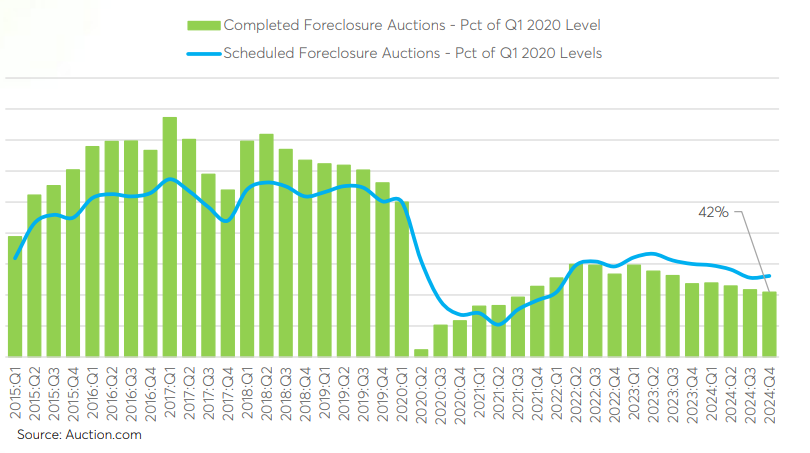
Completed foreclosure auction volume in Q4 of 2024 decreased by 3% from Q3 and was down 11% from the previous year, reaching its lowest since Q3 of 2021. Auction.com data, which represents nearly half of all completed foreclosure auctions nationwide, shows a 42% decrease from Q1 2020 levels.
REO Auction Supply
Bank-owned (REO) auction volume in Q4 of 2024 saw a 3% increase from Q3 and remained stable compared to the previous year. This volume is at 39% of Q1 2020 levels, marking a slight increase from earlier quarters.
Distressed Market Waterfall
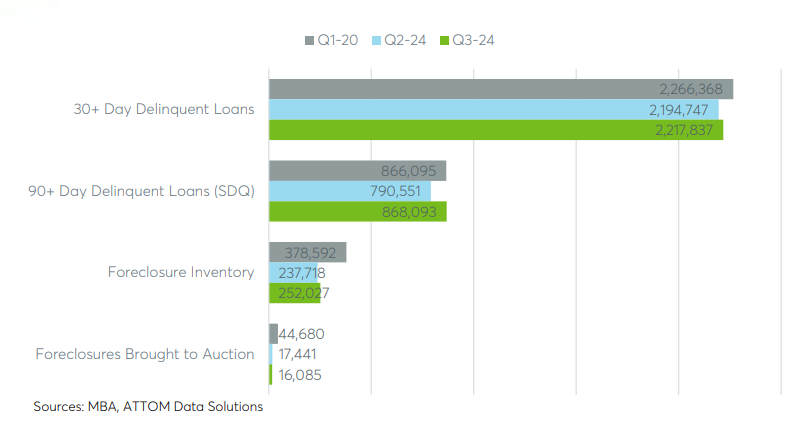
The volume of distressed loans upstream from completed foreclosure auctions shifted in Q3 of 2024, with seriously delinquent mortgages rising by 10% from the previous quarter. Despite this, foreclosure inventory remains significantly below pre-pandemic levels.
Ali Haralson, President of Auction.com, noted, “While the number of distressed homeowners has returned to pre-pandemic levels, many are avoiding foreclosure thanks to ample home equity that allows them to sell through a pre-foreclosure sale.”
2025 Foreclosure Outlook
Daren Blomquist, VP of Market Economics at Auction.com, stated, “Emerging risks in the economy and housing market are pushing delinquencies higher, but those higher delinquencies will not likely translate into higher foreclosure auction volume until at least early 2026.”
The report uses a regression-based model with home price appreciation and unemployment rates as primary inputs. It predicts a baseline 8% decrease in foreclosure auction volume for 2025. However, changes in these economic indicators could lead to varying outcomes.
This article is based on information from themortgagepoint.com, published one month ago.
More Articles
Getting licensed or staying ahead in your career can be a journey—but it doesn’t have to be overwhelming. Grab your favorite coffee or tea, take a moment to relax, and browse through our articles. Whether you’re just starting out or renewing your expertise, we’ve got tips, insights, and advice to keep you moving forward. Here’s to your success—one sip and one step at a time!
A new national survey shows that while most real estate agents now use AI for everyday tasks like writing listing descriptions and social posts, many remain uneasy trusting the technology with higher‑stakes responsibilities. Agents report major time savings and better communication thanks to AI, but lingering concerns about accuracy, compliance and data interpretation reveal a growing skills gap. The industry’s next big need: stronger AI tools, clearer standards and hands‑on training — a gap education providers like Cameron Academy are poised to fill.
Florida homeowners and real estate professionals are being crushed by skyrocketing insurance premiums, shrinking coverage, and a claims system stacked against consumers. While residents face the highest insurance costs in the nation, meaningful reform bills are being ignored in Tallahassee, leaving families, businesses, and the entire real estate market exposed.
Artificial intelligence is exposing the real estate industry's biggest weakness: fragmented, inconsistent data scattered across disconnected systems. Unlike finance and e‑commerce, real estate never built a unified digital foundation—and now AI can’t function without one. As companies scramble to standardize information, organizations like OSCRE are pushing shared data models that could transform everything from leasing to property management. The result may be the industry’s most collaborative era yet, where clean, interoperable data becomes the key to unlocking AI’s full power.
Off‑market networks, rising small‑investor buying, regulatory shifts, and intensifying portal competition are reshaping how homes are found and sold. With inventory tight and traditional listings declining, agents who understand investor behavior, private deal flow, and evolving rules are gaining a major edge in today’s fast‑changing housing landscape.
Despite state leaders celebrating stabilization, Florida homeowners continue to face some of the highest insurance premiums in the country. Local experts say rates have stopped skyrocketing but have settled at levels that feel permanently elevated—especially for older or coastal homes. With insurers still avoiding high‑risk areas and demanding costly home upgrades, many Floridians are questioning whether this expensive reality is here to stay.
California is pushing a landmark proposal that would force insurers to offer coverage to homeowners who meet state‑approved wildfire‑mitigation standards. The new SB 1076, known as the Insurance Coverage for Fire‑Safe Homes Act, aims to stabilize the state’s distressed insurance market by guaranteeing coverage for fire‑hardened homes starting in 2028—backed by strict penalties for insurers who refuse. As supporters rally and critics warn of market strain, the bill could reshape real estate, insurance, and lending practices across wildfire‑prone regions.