Auction.com has unveiled its 2025 Distressed Market Outlook, projecting a potential 8% decrease in foreclosure auction volume for the upcoming year. This baseline scenario is complemented by two alternative forecasts which could see an increase in auction volumes based on differing economic conditions.
Jason Allnutt, CEO at Auction.com, highlighted the importance of their platform, stating, “The Auction.com marketplace provides rich, real-time data on supply, demand, and pricing for distressed properties sold at auction nationwide.” This data is crucial for forecasting trends in the retail housing market.
The report indicates that foreclosure auction volumes are set to hit a three-year low in 2024. This decline is attributed to increased market headwinds, such as rising retail inventory and persistently high mortgage rates, which have impacted local community developers.
Auction buyers have shown a decreased willingness to pay prices relative to the after-repair value of properties towards the end of 2024. However, signs of recovery were evident in November and December, as price demands began to climb.
Foreclosure Auction Supply
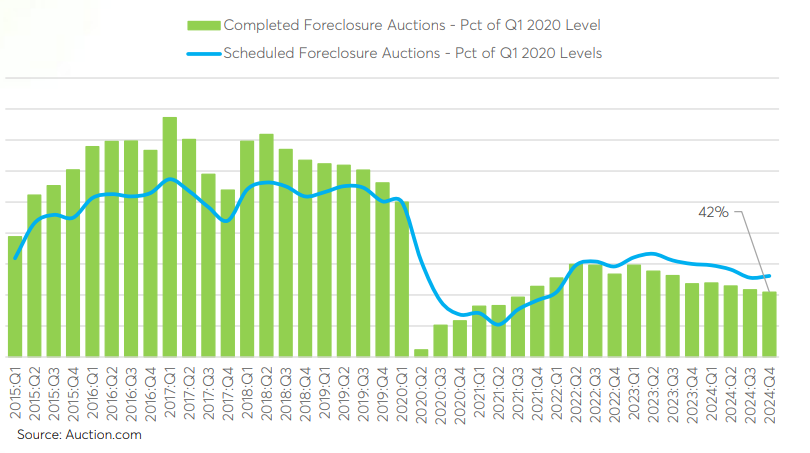
Completed foreclosure auction volume in Q4 of 2024 decreased by 3% from Q3 and was down 11% from the previous year, reaching its lowest since Q3 of 2021. Auction.com data, which represents nearly half of all completed foreclosure auctions nationwide, shows a 42% decrease from Q1 2020 levels.
REO Auction Supply
Bank-owned (REO) auction volume in Q4 of 2024 saw a 3% increase from Q3 and remained stable compared to the previous year. This volume is at 39% of Q1 2020 levels, marking a slight increase from earlier quarters.
Distressed Market Waterfall
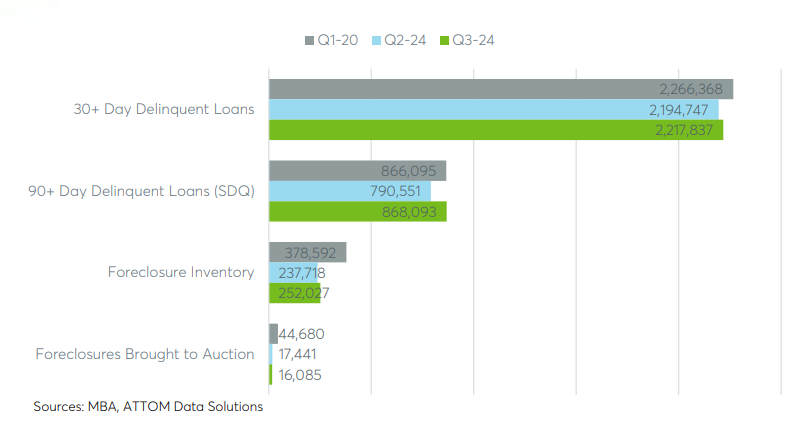
The volume of distressed loans upstream from completed foreclosure auctions shifted in Q3 of 2024, with seriously delinquent mortgages rising by 10% from the previous quarter. Despite this, foreclosure inventory remains significantly below pre-pandemic levels.
Ali Haralson, President of Auction.com, noted, “While the number of distressed homeowners has returned to pre-pandemic levels, many are avoiding foreclosure thanks to ample home equity that allows them to sell through a pre-foreclosure sale.”
2025 Foreclosure Outlook
Daren Blomquist, VP of Market Economics at Auction.com, stated, “Emerging risks in the economy and housing market are pushing delinquencies higher, but those higher delinquencies will not likely translate into higher foreclosure auction volume until at least early 2026.”
The report uses a regression-based model with home price appreciation and unemployment rates as primary inputs. It predicts a baseline 8% decrease in foreclosure auction volume for 2025. However, changes in these economic indicators could lead to varying outcomes.
This article is based on information from themortgagepoint.com, published one month ago.
More Articles
Getting licensed or staying ahead in your career can be a journey—but it doesn’t have to be overwhelming. Grab your favorite coffee or tea, take a moment to relax, and browse through our articles. Whether you’re just starting out or renewing your expertise, we’ve got tips, insights, and advice to keep you moving forward. Here’s to your success—one sip and one step at a time!
Artificial intelligence has shifted from a novelty to a defining force in real estate, transforming everything from listing creation to virtual staging while raising new legal and ethical risks. As AI adoption accelerates, experts warn that the agents who embrace automation and new tools now will gain a major competitive edge, while those who delay could fall behind in a rapidly evolving industry.
As AI and automation reshape the workforce, one form of career protection remains as powerful as ever: earning a state license. From real estate to trades to finance, licensed professionals stay in high demand because their work requires proven competence, accountability and human judgment—qualities technology can enhance but never replace. With trade enrollment surging, investor interest growing and licensing on the rise across the country, credentials have become a reliable path to stability, mobility and long-term earning potential.
A new wave of AI platforms is redefining how real estate agents identify buyer intent, spark conversations, and nurture relationships. From conversational home search engines to predictive opportunity alerts and relationship‑intelligence systems, these tools are helping agents connect sooner and smarter—reshaping daily workflows as the 2026 market approaches.
Texas money is riding hard into San Francisco, snapping up distressed downtown buildings at prices not seen in decades. From Union Square to California Street, major players like Lone Star Funds are betting big on the city’s rebound, signaling that the market may have finally hit bottom and that a new wave of opportunity is taking shape for savvy real estate professionals nationwide.
The 2025 holiday season is expected to break the $1 trillion sales mark, but economists say the milestone masks deeper consumer caution, income‑driven spending gaps, and weakening unit sales. Urban Land Magazine’s latest analysis shows how these mixed signals are shaping a selective, uneven landscape for U.S. commercial real estate heading into 2026—where strong locations thrive, weaker assets struggle, and affluent shoppers continue to dictate market performance.
As 2025 ends, the housing market is inching toward balance with slower price growth, rising inventory, and steadier mortgage rates. Experts predict modest 1% to 2% home‑price growth in 2026—not a crash, but a calmer, more predictable market shaped by regional differences. With the Fed easing rates and inventory climbing in key cities, 2026 may become the most buyer‑friendly year in recent memory, especially for those prepared to act when the right home appears.