Auction.com has unveiled its 2025 Distressed Market Outlook, projecting a potential 8% decrease in foreclosure auction volume for the upcoming year. This baseline scenario is complemented by two alternative forecasts which could see an increase in auction volumes based on differing economic conditions.
Jason Allnutt, CEO at Auction.com, highlighted the importance of their platform, stating, “The Auction.com marketplace provides rich, real-time data on supply, demand, and pricing for distressed properties sold at auction nationwide.” This data is crucial for forecasting trends in the retail housing market.
The report indicates that foreclosure auction volumes are set to hit a three-year low in 2024. This decline is attributed to increased market headwinds, such as rising retail inventory and persistently high mortgage rates, which have impacted local community developers.
Auction buyers have shown a decreased willingness to pay prices relative to the after-repair value of properties towards the end of 2024. However, signs of recovery were evident in November and December, as price demands began to climb.
Foreclosure Auction Supply
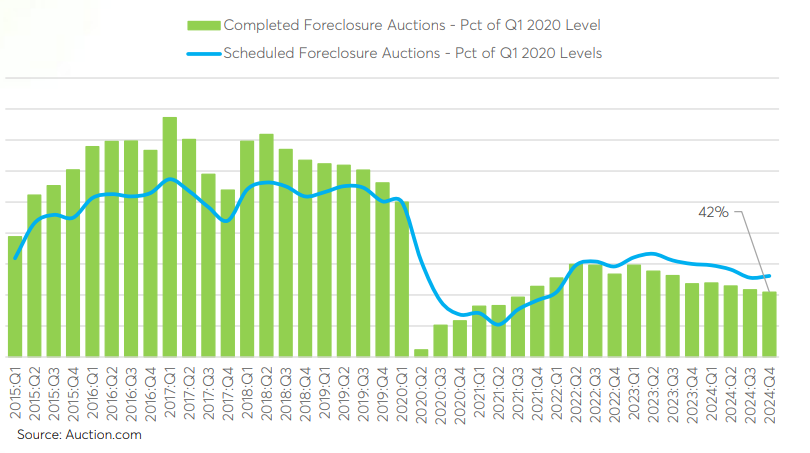
Completed foreclosure auction volume in Q4 of 2024 decreased by 3% from Q3 and was down 11% from the previous year, reaching its lowest since Q3 of 2021. Auction.com data, which represents nearly half of all completed foreclosure auctions nationwide, shows a 42% decrease from Q1 2020 levels.
REO Auction Supply
Bank-owned (REO) auction volume in Q4 of 2024 saw a 3% increase from Q3 and remained stable compared to the previous year. This volume is at 39% of Q1 2020 levels, marking a slight increase from earlier quarters.
Distressed Market Waterfall
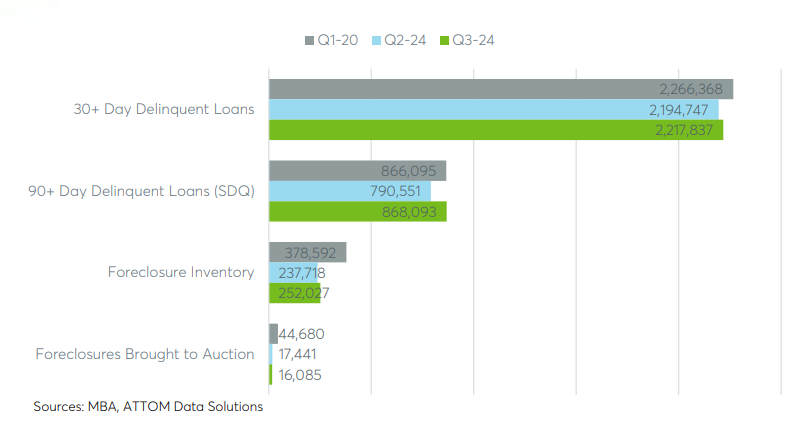
The volume of distressed loans upstream from completed foreclosure auctions shifted in Q3 of 2024, with seriously delinquent mortgages rising by 10% from the previous quarter. Despite this, foreclosure inventory remains significantly below pre-pandemic levels.
Ali Haralson, President of Auction.com, noted, “While the number of distressed homeowners has returned to pre-pandemic levels, many are avoiding foreclosure thanks to ample home equity that allows them to sell through a pre-foreclosure sale.”
2025 Foreclosure Outlook
Daren Blomquist, VP of Market Economics at Auction.com, stated, “Emerging risks in the economy and housing market are pushing delinquencies higher, but those higher delinquencies will not likely translate into higher foreclosure auction volume until at least early 2026.”
The report uses a regression-based model with home price appreciation and unemployment rates as primary inputs. It predicts a baseline 8% decrease in foreclosure auction volume for 2025. However, changes in these economic indicators could lead to varying outcomes.
This article is based on information from themortgagepoint.com, published one month ago.
More Articles
Getting licensed or staying ahead in your career can be a journey—but it doesn’t have to be overwhelming. Grab your favorite coffee or tea, take a moment to relax, and browse through our articles. Whether you’re just starting out or renewing your expertise, we’ve got tips, insights, and advice to keep you moving forward. Here’s to your success—one sip and one step at a time!
Fort Myers Beach is becoming the front line of a new Florida—one shaped by hurricane devastation, soaring insurance premiums, and rapid gentrification. Three years after Hurricane Ian, residents are still battling massive rebuilding costs and insurance bills that now exceed $5,700 a year on average, with flood insurance reaching $10,000 for some families. Long-time locals, small businesses, and service workers are being priced out as wealthy investors move in, transforming once-affordable coastal communities. Real estate professionals warn that foreclosures may rise if economic pressures continue, signaling a pivotal moment for Florida’s housing market and the professionals who serve it.
Economic uncertainty, AI disruption, slowing population growth, and rising portfolio risk are reshaping commercial real estate heading into 2026. A new report unveiled at NAR NXT highlights the forces that will reward informed professionals — and challenge those who aren’t prepared. From fiscal policy and shifting capital flows to tech transformation and housing shortages, the landscape is evolving fast. Cameron Academy breaks down the key issues so real estate, mortgage, finance, and insurance professionals can stay ahead of the curve.
A sudden federal shutdown of FEMA’s BRIC resiliency program has left cities and commercial property owners scrambling, exposing billions in real estate to rising climate threats. With nearly a billion dollars in mitigation funding clawed back and extreme weather intensifying, insurance premiums are expected to surge and coverage may shrink — placing new pressure on markets like Florida and New York.
A new Florida Senate bill aims to stop cities and counties from blocking residential developments over vague “compatibility” concerns. Supporters say the measure would speed up homebuilding and ease housing shortages, while opponents argue it strips communities of essential oversight and could accelerate growth without proper planning. The proposal could reshape development timelines and land-use decisions statewide, making it a major issue for real estate professionals to watch.
Cape Coral–Fort Myers has officially moved into buyer-friendly territory, with homes now sitting a median 119 days on the market—far longer than both the Florida and U.S. averages. Rising inventory, a 36.9 percent price‑reduction rate, and slower absorption compared to accumulated supply are giving buyers more leverage and time to negotiate, signaling a meaningful reset in this once‑fast‑moving Florida market.
Kansas City’s commercial real estate sector is finally turning a corner after several years of sluggish activity. Retail is leading the rebound, while multifamily and industrial properties are gaining traction as pricing stabilizes and buyer confidence returns. A standout 2025 transaction—the sale of the 380‑unit Cyan Southcreek community—signals that capital is flowing back into the market. With bid‑ask spreads tightening and investor optimism rising, Kansas City is entering a period of renewed opportunity for real estate professionals and investors alike.



 Florida’s Middle Class Is Being Squeezed Out: Insurance Costs, Rebuilding Struggles, and a Changing Coastline Gallery