The California housing market continues to be a subject of intense scrutiny and interest, as it remains one of the most dynamic and challenging real estate landscapes in the United States. With a mix of rising prices, regional disparities, and economic influences, understanding the current state and future outlook is crucial for both buyers and sellers.
A Closer Look: January 2025 Market Overview
In January 2025, the California Association of Realtors® (C.A.R.) reported a complex picture of the state’s housing market. Home sales dropped by 10% from December, with a seasonally adjusted annualized rate of 254,110 homes sold, marking a 1.9% decrease from January 2024. Meanwhile, the median home price rose to $838,850, a 6.3% increase year-over-year but a 2.6% decline from the previous month. Elevated mortgage rates and the impact of wildfires have significantly influenced these trends.
Mortgage Rates and Their Market Impact
The average 30-year fixed mortgage rate stood at 6.96% in January 2025, up from 6.64% a year earlier. This increase in borrowing costs has led to reduced buyer demand and longer decision-making times. Potential buyers are closely monitoring interest rate trends, hoping for a decline that could make home purchases more affordable.
Regional Differences: A Diverse Market
California’s housing market is characterized by significant regional diversity. For example, the Central Coast experienced both sales and price increases, while the Far North saw a decline in sales. These variations are driven by factors such as local economies, population growth, and housing supply.
Inventory and Home Buying Challenges
January 2025 saw the Unsold Inventory Index at 4.1 months, indicating more options for buyers compared to December 2024. Homes took an average of 35 days to sell, suggesting a slightly cooling market, though it remains competitive.
Looking Forward: What Lies Ahead?
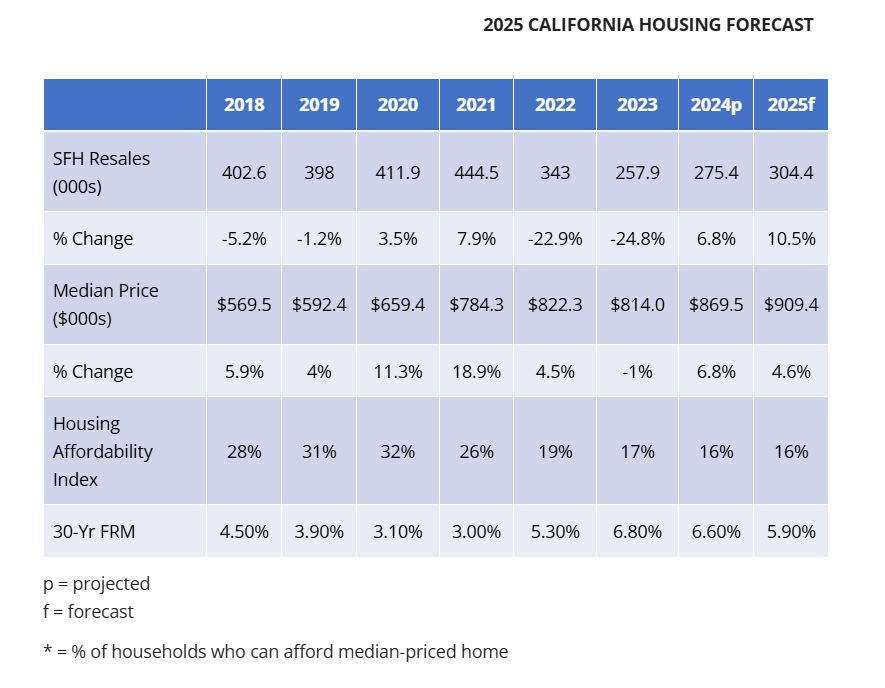
As we move further into 2025, there is cautious optimism. The spring buying season typically brings increased activity, which could lead to more competition and higher prices. The anticipated decline in mortgage rates from 6.6% in 2024 to 5.9% in 2025 may encourage hesitant buyers to enter the market. The C.A.R. forecast expects a 10.5% increase in single-family home sales, highlighting potential growth.
Final Thoughts
While challenges such as affordability and natural disaster impacts persist, California’s housing market remains significant due to its economic influence and diverse opportunities. Staying informed and working with local real estate professionals can help buyers and sellers make strategic decisions in this ever-evolving market.
For more detailed analysis and information, individuals are encouraged to explore resources like those provided by Norada Real Estate Investments.
For further insights, readers are also invited to check related articles on broader market predictions and historical trends, accessible through the original source.
More Articles
Getting licensed or staying ahead in your career can be a journey—but it doesn’t have to be overwhelming. Grab your favorite coffee or tea, take a moment to relax, and browse through our articles. Whether you’re just starting out or renewing your expertise, we’ve got tips, insights, and advice to keep you moving forward. Here’s to your success—one sip and one step at a time!
Nevada has enacted a first‑in‑the‑nation law permitting insurers to sell homeowners policies that exclude wildfire coverage, a move supporters say could help stabilize premiums but critics warn may leave homeowners financially devastated. The policy shift positions Nevada as a testing ground for potential nationwide changes, raising major implications for real estate, mortgage, and insurance professionals as lenders, high‑risk communities, and regulators navigate the evolving landscape.
Tampa Bay’s office sector just delivered its most powerful year in nearly a decade, according to JLL’s Q4 2025 report. With more than 600,000 square feet of positive net absorption, falling vacancies, shrinking inventory, and major tenants like Fisher Investments and GEICO locking in massive leases, the region is emerging as one of the nation’s strongest post‑recovery office markets. The surge in demand for high‑quality space is driving rents up, tightening supply, and setting the stage for continued momentum into 2026.
The Consumer Financial Protection Bureau has proposed new updates to the Nationwide Mortgage Licensing System and Registry, expanding data collection, tightening verification standards, and refreshing record‑retention rules. These changes aim to strengthen background checks, enhance regulatory oversight, and align the system with federal requirements—impacting both current and aspiring mortgage loan originators nationwide.
Nevada has become the first state to let insurers sell homeowners policies that exclude wildfire coverage — a dramatic shift that could reshape insurance pricing across the West. Supporters say the move may lower premiums and spark innovation, while critics warn it could leave homeowners exposed to devastating losses. As regulators and insurers nationwide watch closely, the experiment could have major implications for real estate, mortgages, and insurance markets.
After years of soaring premiums and insurer failures, Florida lawmakers are rolling out a new slate of reforms aimed at finally delivering relief to homeowners. From cracking down on profit‑sharing affiliates to unveiling hidden rate factors and rewarding claim‑free residents, these proposals could reshape the state’s insurance landscape — and bring real savings to property owners and real estate professionals alike.
With traditional CRE lending slowing nationwide, C‑PACE financing is surging to all‑time highs — including a record‑setting $465 million loan for a major D.C. redevelopment. Backed by long repayment terms, fixed rates, and tax‑assessment security, C‑PACE is rapidly becoming a preferred tool for funding energy efficiency, resiliency upgrades, and even large‑scale project recapitalizations. Major players like Nuveen Green Capital and Peachtree Group are driving billions in new volume as 40 states adopt the program, signaling a major shift in how commercial real estate projects are financed.