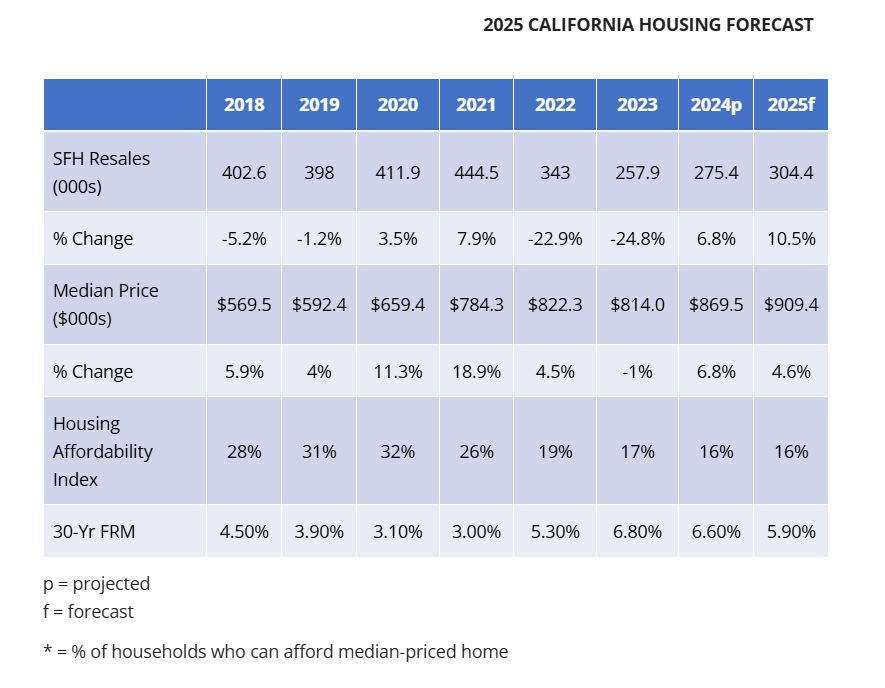
The California housing market continues to be a subject of intense scrutiny and interest, as it remains one of the most dynamic and challenging real estate landscapes in the United States. With a mix of rising prices, regional disparities, and economic influences, understanding the current state and future outlook is crucial for both buyers and sellers.
A Closer Look: January 2025 Market Overview
In January 2025, the California Association of Realtors® (C.A.R.) reported a complex picture of the state’s housing market. Home sales dropped by 10% from December, with a seasonally adjusted annualized rate of 254,110 homes sold, marking a 1.9% decrease from January 2024. Meanwhile, the median home price rose to $838,850, a 6.3% increase year-over-year but a 2.6% decline from the previous month. Elevated mortgage rates and the impact of wildfires have significantly influenced these trends.
Mortgage Rates and Their Market Impact
The average 30-year fixed mortgage rate stood at 6.96% in January 2025, up from 6.64% a year earlier. This increase in borrowing costs has led to reduced buyer demand and longer decision-making times. Potential buyers are closely monitoring interest rate trends, hoping for a decline that could make home purchases more affordable.
Regional Differences: A Diverse Market
California’s housing market is characterized by significant regional diversity. For example, the Central Coast experienced both sales and price increases, while the Far North saw a decline in sales. These variations are driven by factors such as local economies, population growth, and housing supply.
Inventory and Home Buying Challenges
January 2025 saw the Unsold Inventory Index at 4.1 months, indicating more options for buyers compared to December 2024. Homes took an average of 35 days to sell, suggesting a slightly cooling market, though it remains competitive.
Looking Forward: What Lies Ahead?
As we move further into 2025, there is cautious optimism. The spring buying season typically brings increased activity, which could lead to more competition and higher prices. The anticipated decline in mortgage rates from 6.6% in 2024 to 5.9% in 2025 may encourage hesitant buyers to enter the market. The C.A.R. forecast expects a 10.5% increase in single-family home sales, highlighting potential growth.
Final Thoughts
While challenges such as affordability and natural disaster impacts persist, California’s housing market remains significant due to its economic influence and diverse opportunities. Staying informed and working with local real estate professionals can help buyers and sellers make strategic decisions in this ever-evolving market.
For more detailed analysis and information, individuals are encouraged to explore resources like those provided by Norada Real Estate Investments.
For further insights, readers are also invited to check related articles on broader market predictions and historical trends, accessible through the original source.
More Articles
Getting licensed or staying ahead in your career can be a journey—but it doesn’t have to be overwhelming. Grab your favorite coffee or tea, take a moment to relax, and browse through our articles. Whether you’re just starting out or renewing your expertise, we’ve got tips, insights, and advice to keep you moving forward. Here’s to your success—one sip and one step at a time!
The latest MBA survey shows overall mortgage applications dipping 1.4% during the holiday week, even as purchase activity rose on a seasonally adjusted basis. Refinances cooled despite lower rates, which averaged 6.32% for a 30‑year fixed. Rising ARMs and shifting buyer behavior highlight a market still trying to stabilize amid softening economic indicators.
October delivered the first year‑over‑year slowdown in commercial real estate deals in nearly two years, signaling a growing disconnect between buyers and sellers as elevated rates and policy uncertainty reshape pricing expectations. While multifamily cooled and office assets traded at steep discounts, hotels and adaptive‑reuse projects stood out as rare bright spots. For professionals across real estate, mortgage, and finance, the shifting landscape underscores the need for sharper analysis and continued education heading into 2026.
The US workers’ compensation market is bracing for a pivotal year in 2026 as medical inflation, rising claim complexity, and tightening state regulations push costs higher for insurers and employers. With cumulative trauma injuries increasing and states expanding presumption laws—especially for first responders and healthcare workers—underwriting strategies are being forced to evolve. At the same time, technology like predictive analytics and workplace wearables is reshaping loss prevention, while more organizations turn to captives and hybrid programs to manage volatility.
Over the past 25 years, Florida Realtors has transformed from a simple support desk into one of the most influential tech ecosystems in real estate. Through member‑driven tools like Tech Helpline, Form Simplicity and the new Sabal Sign platform, the association has built a stable, fully integrated system used by agents across the U.S. and Canada. Free from outside investors and focused entirely on member needs, Florida Realtors has quietly become a tech powerhouse—proving that long-term vision, not venture capital, is what truly drives innovation in the industry.
Massachusetts is poised for a major shift in home‑sale transparency as Gov. Maura Healey pushes for mandatory flood disclosures — a change that could impact buyers, sellers, and real estate professionals statewide. With worsening climate conditions and growing flood damage in communities like Winthrop and Salem, the proposal aims to ensure buyers understand a property’s true risk before they commit. The move has wide support from insurers and municipalities, while the real estate industry remains split over its potential impact on the state’s long‑standing “buyer beware” culture.
Florida’s long‑troubled property insurance market is finally showing early signs of recovery. Thanks to recent legislative reforms that reduced litigation and attracted new insurers, some homeowners are even seeing their premiums drop. These improvements are boosting consumer confidence and creating new opportunities for real estate, mortgage, and insurance professionals across the state.