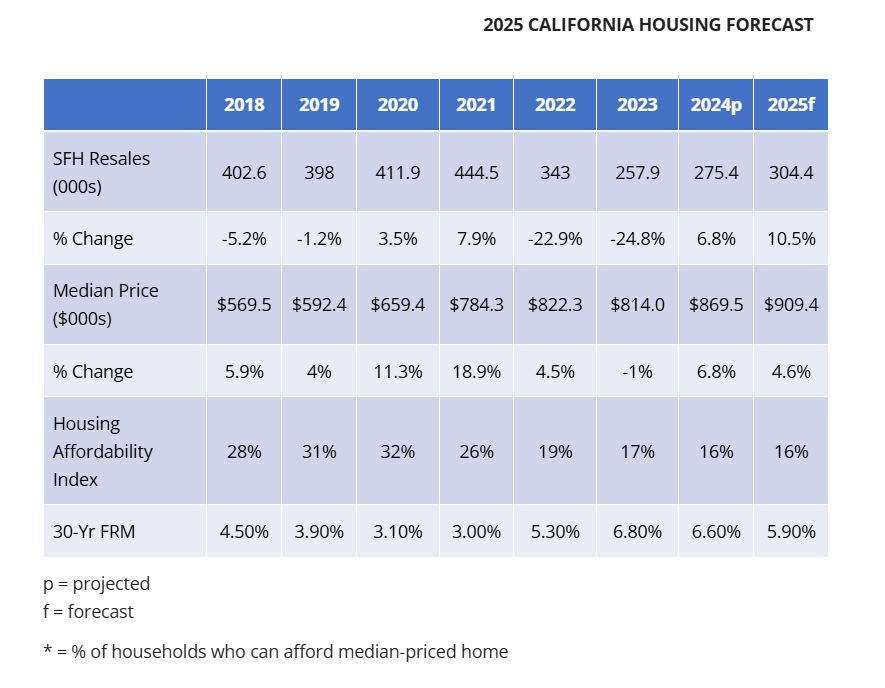
The California housing market continues to be a subject of intense scrutiny and interest, as it remains one of the most dynamic and challenging real estate landscapes in the United States. With a mix of rising prices, regional disparities, and economic influences, understanding the current state and future outlook is crucial for both buyers and sellers.
A Closer Look: January 2025 Market Overview
In January 2025, the California Association of Realtors® (C.A.R.) reported a complex picture of the state’s housing market. Home sales dropped by 10% from December, with a seasonally adjusted annualized rate of 254,110 homes sold, marking a 1.9% decrease from January 2024. Meanwhile, the median home price rose to $838,850, a 6.3% increase year-over-year but a 2.6% decline from the previous month. Elevated mortgage rates and the impact of wildfires have significantly influenced these trends.
Mortgage Rates and Their Market Impact
The average 30-year fixed mortgage rate stood at 6.96% in January 2025, up from 6.64% a year earlier. This increase in borrowing costs has led to reduced buyer demand and longer decision-making times. Potential buyers are closely monitoring interest rate trends, hoping for a decline that could make home purchases more affordable.
Regional Differences: A Diverse Market
California’s housing market is characterized by significant regional diversity. For example, the Central Coast experienced both sales and price increases, while the Far North saw a decline in sales. These variations are driven by factors such as local economies, population growth, and housing supply.
Inventory and Home Buying Challenges
January 2025 saw the Unsold Inventory Index at 4.1 months, indicating more options for buyers compared to December 2024. Homes took an average of 35 days to sell, suggesting a slightly cooling market, though it remains competitive.
Looking Forward: What Lies Ahead?
As we move further into 2025, there is cautious optimism. The spring buying season typically brings increased activity, which could lead to more competition and higher prices. The anticipated decline in mortgage rates from 6.6% in 2024 to 5.9% in 2025 may encourage hesitant buyers to enter the market. The C.A.R. forecast expects a 10.5% increase in single-family home sales, highlighting potential growth.
Final Thoughts
While challenges such as affordability and natural disaster impacts persist, California’s housing market remains significant due to its economic influence and diverse opportunities. Staying informed and working with local real estate professionals can help buyers and sellers make strategic decisions in this ever-evolving market.
For more detailed analysis and information, individuals are encouraged to explore resources like those provided by Norada Real Estate Investments.
For further insights, readers are also invited to check related articles on broader market predictions and historical trends, accessible through the original source.
More Articles
Getting licensed or staying ahead in your career can be a journey—but it doesn’t have to be overwhelming. Grab your favorite coffee or tea, take a moment to relax, and browse through our articles. Whether you’re just starting out or renewing your expertise, we’ve got tips, insights, and advice to keep you moving forward. Here’s to your success—one sip and one step at a time!
Bluerate.ai—formerly MyMortgageRates—is stepping into 2025 with a mission to modernize a mortgage process that has barely changed in decades. Built by Zeitro, the platform equips both borrowers and loan officers with powerful AI tools, from online pre‑qualification and automated financial data extraction to instant guideline answers and scenario analysis. With more than 3,000 verified NMLS‑licensed loan officers and real‑time rate comparisons from major lenders, Bluerate.ai is quickly becoming a must‑know platform for mortgage and real estate professionals seeking speed, clarity, and a fully digital lending experience.
After the longest government shutdown in U.S. history, key federal housing programs such as FHA, VA, USDA, and NFIP are officially back in operation—offering long‑awaited relief to agents, lenders, and insurance professionals. But with a six‑week backlog slowing everything from loan guarantees to flood-insurance renewals, real estate pros should brace for delays and focus on resetting client expectations. A new federal spending deal restores funding through early 2026 and gives the market room to breathe, while NAR’s aggressive advocacy helped push the government toward reopening. Now, professionals who communicate clearly and stay on top of regulatory updates will be best positioned to guide clients through the temporary turbulence.
Commercial real estate is rapidly shifting toward a digital-first model, with platforms like Crexi leading the charge. By unifying property data, AI-driven insights, transparent bidding, and streamlined transaction tools, digital marketplaces are becoming essential to how modern CRE deals are sourced, analyzed, and closed. With more than 2 million monthly users and over $1 trillion in facilitated transactions, Crexi showcases how technology is reshaping the industry and giving real estate professionals a powerful competitive edge.
Europe’s biggest landlords—including Aroundtown, Vonovia, and top global investors—have teamed up to launch ATechX, a powerful new accelerator giving proptech startups something they rarely get: access to real buildings, real customers, and a clear path to scale across multiple countries. Designed to move founders beyond “pilot purgatory,” ATechX offers a true sandbox for innovation in Europe’s aging, regulation‑heavy property market, helping promising technology reach commercial traction faster than ever.
Mortgage rates are finally easing, inventory is climbing, and buyers are gaining leverage for the first time in years — yet sky‑high prices and economic jitters are keeping many on pause. With economists warning that inflation could push rates higher again, this fall may offer a rare window for well‑prepared buyers. Here’s what’s driving the shift, where opportunities are emerging, and how real estate professionals can stay ahead.
Griffin Funding has appointed John Jones as Senior Vice President of Growth and EOS Integrator, aiming to scale the company toward a $3 billion annual non-QM volume goal by 2030. After serving in fractional leadership roles since April 2025, Jones now steps in full‑time to lead organizational structure, efficiency, market expansion, and cross‑department alignment. Backed by strong liquidity and rising deal volume, Griffin Funding appears positioned for major industry impact in the years ahead.