After a year shaped by economic slowdowns, persistent unemployment and hesitations in new construction, 2026 is emerging as a long‑awaited turning point for the commercial real estate landscape. Research groups and industry analysts appear to be in rare agreement: stabilization and early recovery are slowly strengthening across the sector.
This article is inspired by in‑depth reporting originally featured in CNBC’s Property Play newsletter by Diana Olick. For additional insights, visit their coverage:
Read the original article on CNBC.
A Market Searching for Its New Balance
Colliers calls 2026 a “new equilibrium.” Cushman & Wakefield points to “firmer fundamentals.” KBW notes an “ongoing recovery,” while CoStar highlights “price stability at last.” These are not hollow predictions—they reveal a sector finally regaining its footing.
Deloitte’s global survey of 850 real estate executives uncovered widespread but cautious optimism. While expectations for revenue growth have cooled slightly, most leaders believe 2026 will end with stronger market performance.
Although higher tariffs and stricter immigration policies weighed heavily on developers in 2025, easing interest rates are now opening the doors for capital to re‑enter the market.
Capital Markets Begin to Wake Up
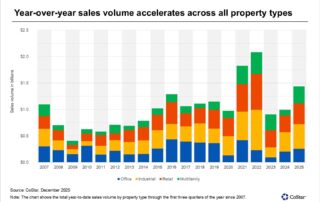
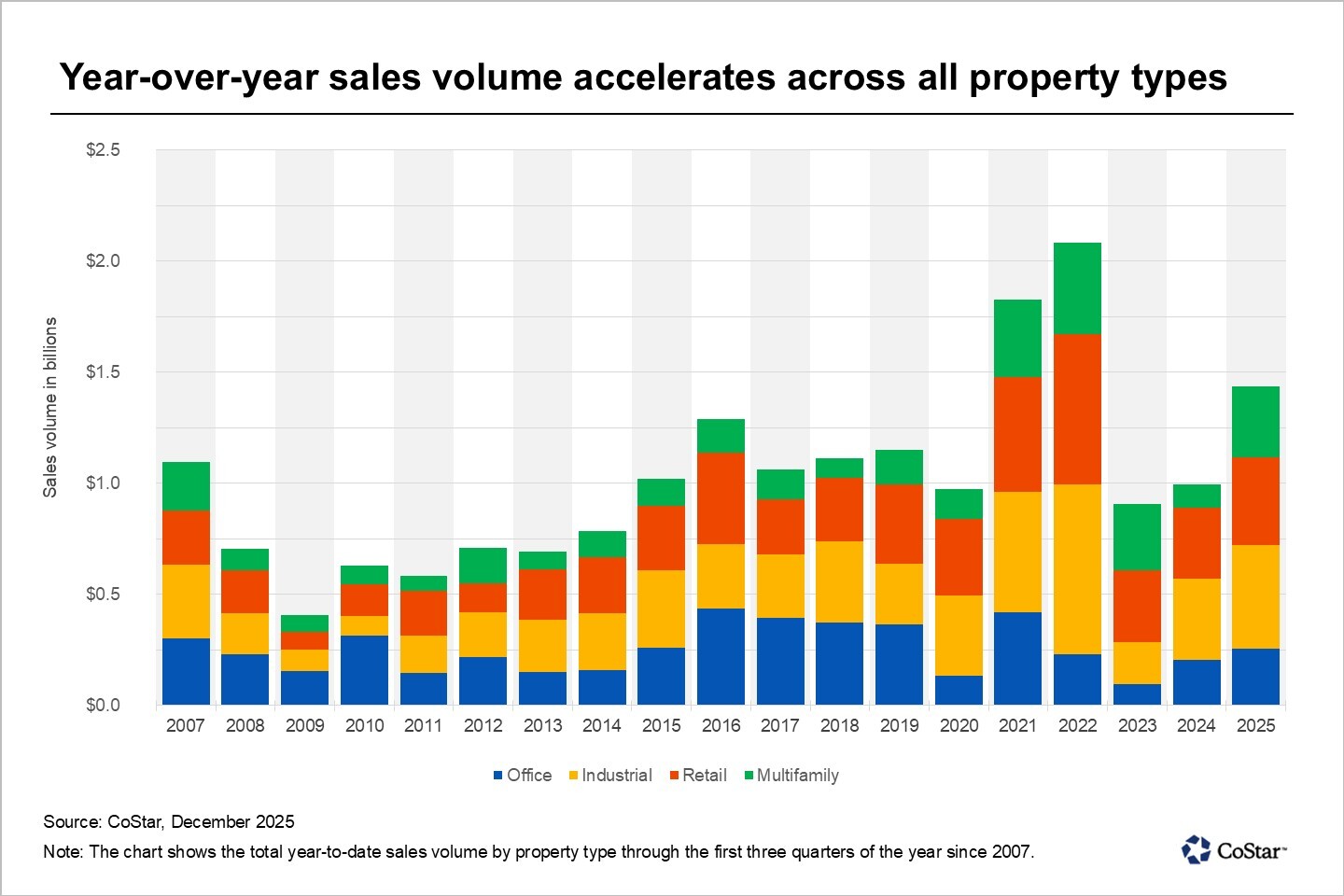
Colliers is calling 2026 the year of the “Capital Markets Reawakening,” forecasting a 15% to 20% bump in sales volume. Deal‑making is accelerating as pricing appears to have reached its long‑awaited floor.
CoStar notes that cap rates may move lower as vacancies peak in both industrial and multifamily properties. Lending is rising. Institutional money is returning. Cushman & Wakefield reports lending up 35% year over year and institutional sales activity climbing 17%.
The bond market is echoing this revival: spreads between government and corporate yields are narrowing—a classic indicator of upcoming investment momentum.
Office, Industrial, Retail, and Beyond
Office: Vacancy rates could finally drop below 18%. With construction at a 30‑year low, high‑quality Class A buildings in key metros are quickly becoming scarce, and hybrid‑friendly workplaces dominate tenant demand.
Industrial: Construction has slowed by 63% since 2022, but demand is exploding. Reshoring, advanced manufacturing and the booming data‑center ecosystem may drive a staggering 220 million square feet of absorption in 2026.
Retail: CoStar reports nearly 26 million square feet of retail usage in unexpected places—from multifamily complexes to hospitality properties. Smaller retail footprints are trending, especially for restaurants and service‑oriented operators. Still, potential tariff pressure could curb consumer spending later in the year.
Multifamily: Record new supply is temporarily easing rents. After years of dominating investment activity, multifamily may see slight declines as investors pivot toward once‑struggling sectors re‑emerging with fresh opportunity.
Data Centers: The shining star of 2025 shows no signs of slowing. Deloitte highlights nine global markets with fully pre‑leased pipelines—yet political hurdles, zoning battles and electrical‑grid limitations could delay select 2026 projects.
REITs Preparing for a Big Year
PWC foresees a powerful wave of mergers and acquisitions as valuations align and public‑to‑private deals accelerate. Consolidation, AI‑enhanced operations and scaled platforms will redefine the REIT landscape.
Nareit reports that REITs—after lagging behind in 2025—may be positioned for strong outperformance as valuation gaps shrink and balance sheets remain exceptionally healthy.
What This Means for Professionals and Investors
For developers, brokers, analysts and investors, 2026 represents strategic opportunity—not unchecked optimism, but a grounded moment to act with intelligence and timing.
If you’re seeking to build or expand your real estate career—especially in high‑growth states like Florida—understanding these shifts is invaluable. Cameron Academy provides licensing education, continuing training and professional development tools designed to help both new and seasoned professionals stay market‑ready.
From commercial investment to long‑term career planning, 2026 may be one of the most promising years in recent memory for those ready to move with purpose.