Commercial Real Estate Deal Growth Stalls: What Slowing Momentum Means for 2026
Commercial real estate investors hit the brakes this October, marking the first year‑over‑year decline in deal volume since early 2024. After nearly two years of strong momentum, the market’s sudden hesitation has thrown a spotlight on widening pricing gaps, elevated financing costs, and the ongoing standoff between CRE buyers and sellers.
According to Mortgage Professional America, the slowdown doesn’t signal a collapse—rather, it underscores how far pricing expectations have drifted apart in today’s high‑rate environment. Kevin Fagan, head of CRE capital market research at Moody’s, described October’s numbers as a sign of an extended stalemate rather than an impending downturn.
Deal Volume Still Active, but Momentum Slows
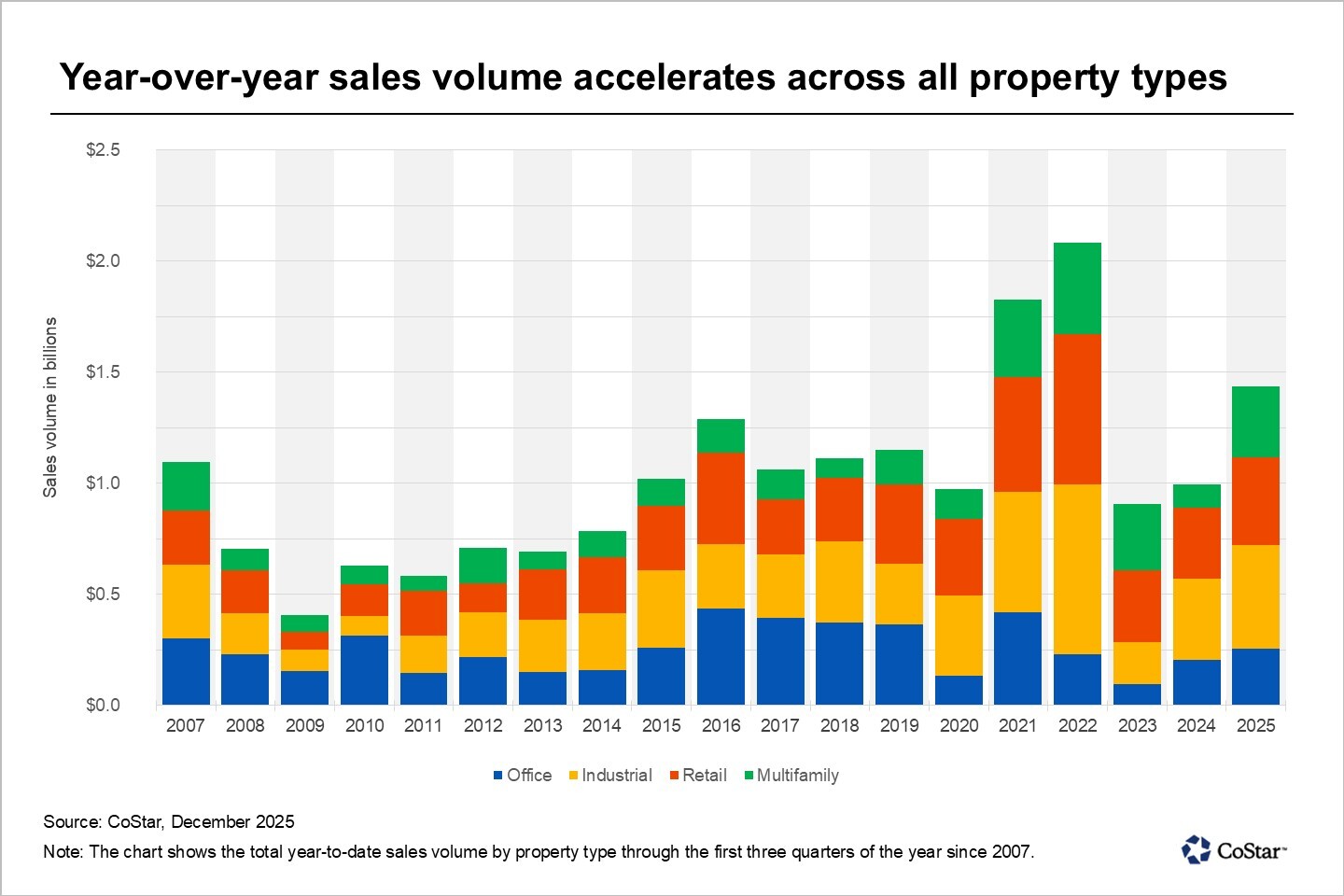
Despite the cooling pace, October still delivered $24.4 billion in U.S. CRE sales—roughly 70% of the volume seen in October 2019. Total 2025 deal activity remains above 2024 levels. But as Moody’s data shared with CNBC reveals, the rapid growth seen in late 2024 and early 2025 has lost steam.
Multifamily took the sharpest hit, with a steep 27% drop in October deal volume. Yet, many multifamily assets still trade at premiums—showing that while demand is strong, pricing has become more tangled and competitive.
Hospitality Surges as Conversions Reshape the Market
The hospitality sector emerged as the only segment with a year‑over‑year increase, rising approximately 6%. A standout transaction was the sale of the New York Edition hotel from Abu Dhabi Investment Authority to Kam Sang Company for $231.2 million.
Kevin Fagan highlights a broader trend: struggling office buildings transforming into valuable hotel or residential conversions. Iconic projects such as the Woolworth Building illustrate how adaptive reuse continues to redefine the CRE landscape.
Meanwhile, value‑seeking buyers made headlines when New York Life acquired a Manhattan office tower for nearly half its 2015 valuation. Institutional investors are circling distressed but well‑located assets—hinting that prime office space still offers long‑term promise.
Commercial Mortgages: A Volatile but Active Landscape
The third quarter of 2025 brought a powerful resurgence in mortgage originations. According to the Mortgage Bankers Association, commercial and multifamily lending jumped 36% year‑over‑year.
Even more surprising: office lending surged 181%. Despite the sector’s challenges, lenders are selectively backing properties with conversion potential or those supported by medical and life‑science tenants—two fields rapidly absorbing obsolete office inventory.
What This Means for 2026
This slowdown suggests 2026 will be shaped not only by fundamentals like rent growth and occupancy, but by how quickly market participants recalibrate expectations in a higher‑cost environment.
For commercial originators, investors, brokers, and analysts, this means strengthening market literacy—particularly around evolving debt markets, valuation resets, and underwriting shifts. And professionals entering or upskilling in real estate, mortgage, or finance will need sharper insights and stronger training than ever.
This is where institutions like Cameron Academy play a crucial role. With licensing education, continuing education, and professional development across real estate, mortgage, insurance, and financial services, Cameron Academy helps future‑focused professionals stay competitive, confident, and opportunity‑ready.
As the market transitions into its next cycle, knowledge isn’t just power—it’s deal flow, resilience, and long‑term career growth.
More Articles
Getting licensed or staying ahead in your career can be a journey—but it doesn’t have to be overwhelming. Grab your favorite coffee or tea, take a moment to relax, and browse through our articles. Whether you’re just starting out or renewing your expertise, we’ve got tips, insights, and advice to keep you moving forward. Here’s to your success—one sip and one step at a time!
In 2026, financial advisors are no longer just experimenting with AI — they’re relying on it. Once confined to back-office duties, AI now supports meeting prep, portfolio analysis, and even early-stage financial planning. Advisors say the tech is strengthening client relationships by freeing them from administrative overload, though entry-level roles like paraplanners may feel the squeeze as automation accelerates.
Cybercriminals are weaponizing AI to launch highly convincing email scams and system breaches across the mortgage industry, overwhelming lenders and servicers whose cybersecurity measures can’t keep up. With major companies already hit and regulation lagging behind, experts warn the sector—now considered critical infrastructure—must rapidly upgrade protections, collaborate on threat intelligence, and improve AI governance before the risks escalate further.
Escrow payments are quietly surging across the country as property taxes and insurance premiums spike—pushing many homeowners toward delinquencies and even foreclosure. New data from Cotality shows the sharpest increases hitting the South and Midwest, with Florida among the hardest‑hit states. Even with fixed mortgage rates, rising escrow requirements are driving monthly payments higher and threatening affordability heading into 2026.
Milwaukee entered 2025 with renewed momentum, posting its strongest commercial real estate sales volume in three years. After a period of uncertainty and high capital costs, investors are returning with a sharper focus on quality assets, realistic pricing, and reliable cash flow. Activity is increasing across industrial, office, multifamily, and retail sectors, signaling a broad-based recovery fueled by stabilizing interest rates and improved market confidence.
As 2026 approaches, the title insurance industry is navigating a complex mix of market recovery, rising fraud threats, and sweeping regulatory changes. Industry leaders say the path forward centers on smarter technology, leaner operations, and stronger support for title agents. With AI-driven workflows, enhanced fraud prevention, and new compliance demands—including FinCEN’s expanded Geographic Targeting Orders—companies like Stewart and First American are reshaping how title work gets done. For real estate and mortgage professionals, the year ahead promises more automation, heightened standards, and major opportunities for those who stay ahead of the curve.
The real estate industry is undergoing a major transformation in 2025 as advancements in AI, proptech, blockchain, and data intelligence redefine how properties are marketed, valued, financed, and experienced. From instant digital valuations and immersive virtual tours to tokenized investments and predictive analytics, technology is reshaping every stage of the real estate lifecycle. Professionals who embrace these innovations—while maintaining the human expertise clients still rely on—will lead the next era of the industry.