Commercial Real Estate Market Set for Significant Growth
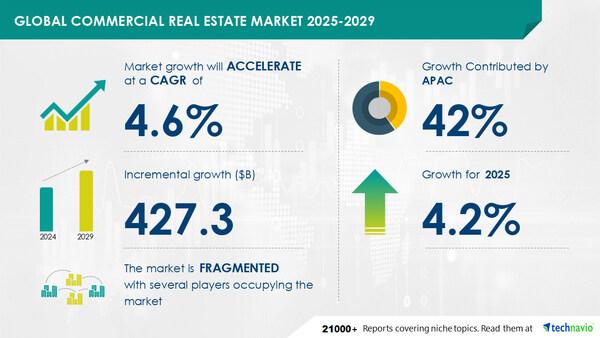
In a recent report from PR Newswire, the global commercial real estate market is projected to expand by a staggering USD 427.3 billion between 2025 and 2029. This remarkable growth is largely driven by the robust expansion of the global commercial sector and the transformative power of technological innovations, particularly those harnessed by artificial intelligence (AI).
Technological Innovations and Market Dynamics
The market is expected to grow at a compound annual growth rate (CAGR) of 4.6% over the forecast period. While the rise of remote work and e-commerce presents challenges, these shifts are simultaneously reshaping traditional office and retail spaces. Major players such as CBRE Group Inc. and WeWork Inc. are at the forefront of navigating these changes.
The report highlights the increasing trend towards smart city infrastructure, which is boosting demand for commercial spaces, particularly in the IT and engineering sectors. Moreover, co-working and flexible office spaces are gaining traction as businesses adapt to new work patterns.
AI and Virtual Reality: Transforming the Landscape
Technological advancements, including AI and virtual reality, are revolutionizing the commercial real estate sector. These innovations are enhancing property management through data analytics and providing virtual property tours, thereby offering a more immersive experience for potential tenants and buyers.
The Technavio report further underscores the role of AI in driving market trends and competitive dynamics, offering businesses the tools to stay ahead in an evolving landscape.
Opportunities and Challenges
While the commercial real estate market is poised for growth, it must navigate several challenges. The shift towards online shopping has reduced demand for traditional retail spaces, impacting foot traffic in physical stores. Similarly, the trend towards remote work is affecting the need for conventional office spaces.
To address these challenges, businesses are focusing on flexible office layouts and integrating advanced technologies like virtual reality. These strategies are crucial for adapting to the changing consumer behaviors and technological advancements that are reshaping the commercial real estate market.
Conclusion
The commercial real estate market is on the cusp of a significant transformation, driven by global commercial sector growth and AI-powered innovations. As businesses adapt to new realities, the market offers exciting opportunities for innovation and growth, with key players leveraging technology to redefine the future of commercial spaces.
Discover more about the evolving commercial real estate market and the role of AI by accessing the full report from Technavio.
More Articles
Getting licensed or staying ahead in your career can be a journey—but it doesn’t have to be overwhelming. Grab your favorite coffee or tea, take a moment to relax, and browse through our articles. Whether you’re just starting out or renewing your expertise, we’ve got tips, insights, and advice to keep you moving forward. Here’s to your success—one sip and one step at a time!
The advent of Artificial Intelligence (AI) has ushered in a new era in the realm of property valuation and appraisal. AI, a formidable tool capable of swiftly analyzing vast amounts of data, provides real-time insights into property values. However, the importance of human expertise in interpreting data and making informed judgments cannot be undermined. A blend of AI and human judgment ensures accurate and reliable property valuations. AI has also made significant strides in the development of valuation products for Home Equity Lines of Credit (HELOCs) and second-lien mortgages. These products leverage AI technology to assess risk more effectively, providing lenders with a comprehensive understanding of the property's value. As AI continues to evolve, we can expect further advancements in the property valuation and appraisal process. The future of property valuations lies in the synergy between AI and human expertise, ensuring accurate, reliable, and contextually informed property valuations.
The U.S. housing market has experienced a significant surge in home prices, marking the largest annual increase since February 2023. In August alone, home prices recorded a remarkable 3.7% gain. While this upward trend has been observed across the country, there are specific housing markets where prices are projected to decline. In this article, we explore the factors driving the rise in home prices and delve into the markets that are likely to experience price drops. Join us as we navigate through the intricacies of the housing market, uncovering the driving forces behind the price increase and shedding light on the markets where caution may be warranted.
The real estate industry is abuzz with the news of RE/MAX's proposed agreement that effectively ends the National Association of Realtors (NAR) membership requirement and commission rule. This groundbreaking settlement has far-reaching implications for RE/MAX agents and franchisees, as well as the broader real estate industry. The proposed settlement by RE/MAX marks a significant departure from the status quo. By eliminating the NAR membership requirement and commission rule, RE/MAX is paving the way for a more open and competitive real estate market. This move has the potential to disrupt long-standing practices and reshape the industry as we know it.
Chase Bank has made a groundbreaking decision to accept cryptocurrencies, including SHIB and XRP, as a form of payment for mortgage loans. This move marks a significant milestone in the mainstream adoption of digital currencies. It offers numerous benefits for both customers and Chase Bank, providing a convenient and efficient way to make mortgage payments and attracting tech-savvy customers. However, it also comes with risks due to the volatility of digital currencies. This development has the potential to reshape the financial industry and the way we think about mortgage payments. Explore more about finance and technology with Cameron Academy's online career education courses.
Fannie Mae, a government-sponsored enterprise, has launched a new initiative to expand homeownership opportunities. This initiative introduces a 5% down payment option, revolutionizing the traditional requirements for purchasing multifamily homes. The program offers aspiring homeowners and investors the chance to secure a multifamily property with just a 5% down payment. This reduced requirement breaks down the barriers that have hindered many individuals from entering the multifamily housing market. The program is available for both owner-occupied and non-owner-occupied multifamily properties, offering flexibility for investors and homeowners alike. Discover how Fannie Mae's 5% down payment option can help you achieve your dream of owning a multifamily property. Contact our team today to learn more about Fannie Mae's 5% down payment option and find the perfect multifamily property for your needs.
In a surprising turn of events, Redfin, a prominent real estate brokerage, has made the decision to sever ties with the National Association of Realtors (NAR). This move has sparked a wave of reactions within the industry, with experts weighing in on the potential implications for the real estate market. Redfin's criticism of NAR's rules and regulations stems from their belief in the need for innovation and competition in the real estate market. The industry's response to the Redfin-NAR split has been mixed. Some industry experts view this split as a positive development that will foster healthy competition and drive innovation in the real estate market. However, not everyone shares this optimistic outlook. Critics argue that the split could potentially undermine the stability and unity of the real estate market. The Redfin-NAR split has far-reaching implications for the future of the real estate industry. It highlights the ongoing tensions and debates surrounding the role of traditional brokerages versus emerging online platforms. The split also raises important questions about industry regulations and the balance between competition and cooperation.