Commercial Real Estate Market Set for Significant Growth
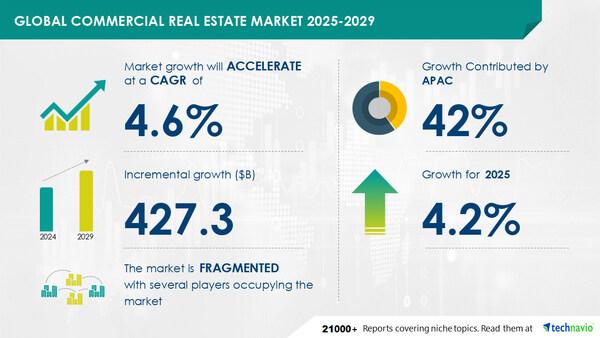
In a recent report from PR Newswire, the global commercial real estate market is projected to expand by a staggering USD 427.3 billion between 2025 and 2029. This remarkable growth is largely driven by the robust expansion of the global commercial sector and the transformative power of technological innovations, particularly those harnessed by artificial intelligence (AI).
Technological Innovations and Market Dynamics
The market is expected to grow at a compound annual growth rate (CAGR) of 4.6% over the forecast period. While the rise of remote work and e-commerce presents challenges, these shifts are simultaneously reshaping traditional office and retail spaces. Major players such as CBRE Group Inc. and WeWork Inc. are at the forefront of navigating these changes.
The report highlights the increasing trend towards smart city infrastructure, which is boosting demand for commercial spaces, particularly in the IT and engineering sectors. Moreover, co-working and flexible office spaces are gaining traction as businesses adapt to new work patterns.
AI and Virtual Reality: Transforming the Landscape
Technological advancements, including AI and virtual reality, are revolutionizing the commercial real estate sector. These innovations are enhancing property management through data analytics and providing virtual property tours, thereby offering a more immersive experience for potential tenants and buyers.
The Technavio report further underscores the role of AI in driving market trends and competitive dynamics, offering businesses the tools to stay ahead in an evolving landscape.
Opportunities and Challenges
While the commercial real estate market is poised for growth, it must navigate several challenges. The shift towards online shopping has reduced demand for traditional retail spaces, impacting foot traffic in physical stores. Similarly, the trend towards remote work is affecting the need for conventional office spaces.
To address these challenges, businesses are focusing on flexible office layouts and integrating advanced technologies like virtual reality. These strategies are crucial for adapting to the changing consumer behaviors and technological advancements that are reshaping the commercial real estate market.
Conclusion
The commercial real estate market is on the cusp of a significant transformation, driven by global commercial sector growth and AI-powered innovations. As businesses adapt to new realities, the market offers exciting opportunities for innovation and growth, with key players leveraging technology to redefine the future of commercial spaces.
Discover more about the evolving commercial real estate market and the role of AI by accessing the full report from Technavio.
More Articles
Getting licensed or staying ahead in your career can be a journey—but it doesn’t have to be overwhelming. Grab your favorite coffee or tea, take a moment to relax, and browse through our articles. Whether you’re just starting out or renewing your expertise, we’ve got tips, insights, and advice to keep you moving forward. Here’s to your success—one sip and one step at a time!
The title and real estate industries are entering their most dramatic compliance overhaul in decades. FinCEN’s new anti‑money‑laundering rule now applies to every state, enforces a first‑dollar reporting requirement, and places full responsibility on settlement agents. With the rule already in effect and mandatory reporting beginning March 1, 2026, professionals face urgent operational changes involving software, training, and entity‑buyer disclosures. Combined with state‑level rate shifts and heightened scrutiny of attorney opinion letters, 2025 marks a turning point that demands stronger compliance literacy across the entire real estate and finance ecosystem.
Retirement planning went through major changes in 2025, from new SECURE Act updates to shifting investment behaviors. As we move into 2026, seven key trends are reshaping how Americans save and build long‑term wealth. These shifts matter not only for everyday investors but also for professionals across real estate, finance, mortgage, insurance, and other licensed fields. Understanding these developments can help you strengthen your own financial strategy while staying competitive in your career.
Florida’s housing market is cooling faster than any other state, and soaring insurance premiums are the primary force driving buyers away. With cancellation rates in major metros topping 20%, steep price drops across Southwest Florida, rising HOA and condo fees, and thousands of homes added to new flood zones, many buyers are discovering that insurance—not the mortgage—is what kills the deal. As Citizens shrinks and new legislation raises coverage requirements, professionals in real estate, mortgage, and insurance must adapt quickly to a market where affordability hinges on risk, regulation, and rising premiums.
Commercial real estate is entering 2026 with renewed optimism as pricing floors, revitalized capital markets, and improved market visibility signal a shift away from the volatility of 2025. Analysts from Deloitte, Colliers, Cushman & Wakefield, and CoStar highlight firmer fundamentals, rising deal flow, and increased lender participation. Key sectors such as office, industrial, retail, multifamily, and data centers are showing distinct recovery patterns, positioning industry professionals and students for new opportunities in the year ahead.
Florida’s property insurance market is finally stabilizing after years of storms, lawsuits, and rising rates — yet many homeowners are still seeing higher bills. The reason isn’t the rates themselves but soaring replacement values driven by inflation in labor and building materials. Even as insurers lower rates, the cost to rebuild a home continues to rise, making up roughly 75% of recent premium increases. With new insurers entering the market and reforms taking effect, homeowners now have more options to shop, recalculate coverage, and control their costs.
The 2026 job market is shifting fast, and the biggest winners will be professionals who can prove they’re continuously learning. With more than 90% of employers now preferring candidates with microcredentials, short targeted certificates are becoming the new career currency. From AI and data skills to modern communication and adaptability, microcredentials are helping workers stand out in a competitive landscape — especially as industries like real estate, mortgage, insurance, and finance demand ongoing upskilling.