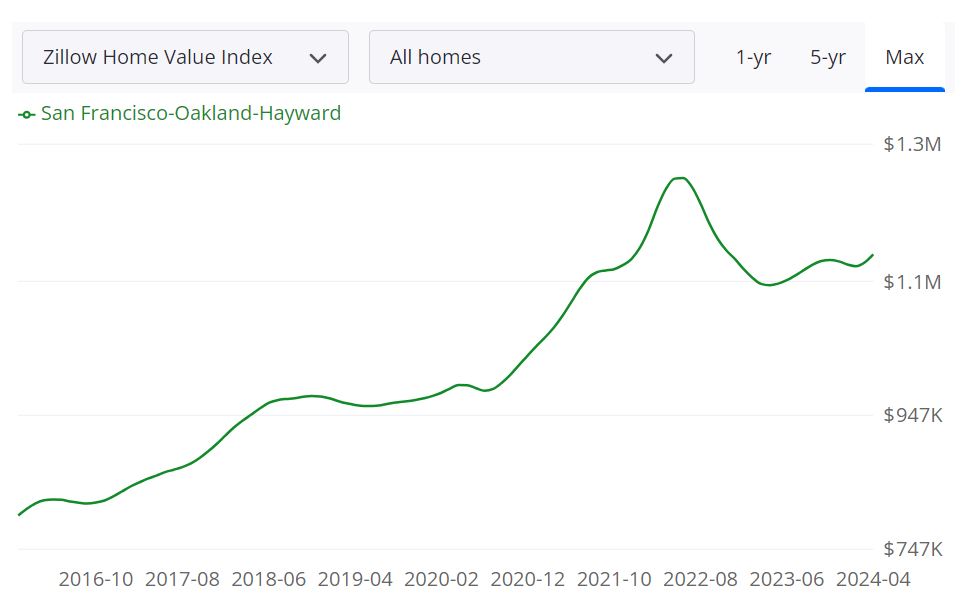
The Bay Area housing market, renowned for its competitive nature and soaring prices, continues to evolve, leaving both buyers and sellers eager for insights to navigate its complexities. This dynamic market, centered around San Francisco, Oakland, and San Jose, remains a focal point due to its unique blend of economic strength, cultural vibrancy, and desirable living conditions.
Market Predictions and Trends
The Bay Area housing market in 2024 is projected to unfold in one of three scenarios, each influenced by various economic factors:
Moderate Price Correction: Rising interest rates and economic uncertainties could lead to a slight decline in prices, providing some relief to buyers without triggering a market crash.
Stagnant Growth: Strong demand, coupled with housing shortages, might stabilize prices, offering no significant advantage to either buyers or sellers.
Continued Growth: Despite economic challenges, the limited housing supply and high desirability may sustain price increases, though at a slower pace.
Key indicators like inventory levels, days on the market, and sales volume will be crucial in forecasting the market’s trajectory.
Reasons for High Prices
Several factors contribute to the Bay Area’s steep housing costs:
Strong Economy: As a global tech hub, the region attracts high-income professionals, fueling demand.
Limited Supply: Geographical constraints and strict zoning laws hinder new construction efforts.
High Land Costs and Foreign Investment: Expensive land and international buyers drive prices upward.
Desirability and Limited Growth Space: The area’s quality of life and restricted space for expansion add to the price pressures.
Hottest Markets and Investment Opportunities
Currently, the suburb of Woodlands in Walnut Creek is experiencing a market surge thanks to its suburban appeal and proximity to job centers. Other areas like Oakland in the East Bay and Fremont in the South Bay are also attracting significant interest from buyers.
For investors, the Bay Area’s enduring demand, diverse locations, and robust rental market present lucrative opportunities. However, challenges such as high property prices and complex regulations require careful market analysis. The region offers a range of real estate investment options, from residential and multi-unit properties to commercial real estate and short-term rentals.
The Bay Area’s robust economy, heavily driven by the tech sector, continues to promise growth. Despite supply shortages and zoning restrictions, the region remains a potentially rewarding arena for real estate investments, as detailed in the original article from Norada Real Estate Investments.
More Articles
Getting licensed or staying ahead in your career can be a journey—but it doesn’t have to be overwhelming. Grab your favorite coffee or tea, take a moment to relax, and browse through our articles. Whether you’re just starting out or renewing your expertise, we’ve got tips, insights, and advice to keep you moving forward. Here’s to your success—one sip and one step at a time!
After years of sharp increases and shrinking coverage options, Florida’s home insurance market is showing its strongest signs of recovery yet. Multiple insurers are proposing significant premium cuts for 2026 — some in the double digits — as storm‑loss data improves and private carriers re‑enter the state. Citizens Insurance is also seeking its first broad rate reduction in a decade, potentially lowering costs for millions of homeowners. This shift could boost affordability and confidence across Florida’s real estate and mortgage markets heading into the new year.
An AI company that began in a bedroom is now shaking the foundations of the lending industry. Salient, led by CEO Ari Malik, has skyrocketed to a $500 million valuation by fixing one of finance’s messiest problems: debt servicing. With zero customer churn, 100% pilot-to-contract conversions, and AI agents reportedly 30 times more compliant than humans, Salient is redefining how lenders manage loans. Its rapid rise highlights a new era where trust, regulation‑ready AI, and deep industry understanding are becoming essential for professionals across real estate, mortgage, finance, and insurance.
Redmond, Washington is tackling its housing crisis with Prisma, a six‑story, transit‑oriented development built on discounted surplus land from Sound Transit. The project will deliver 328 deeply affordable units—most reserved for households earning 50 percent of AMI or less, including families and people with disabilities. Enabled by a rare cross‑sector funding partnership, Prisma showcases how cities can combine transit investment, public resources, and private support to create long‑term, equitable housing solutions.
Citizens Property Insurance Corp. is recommending rate decreases for millions of Florida homeowners in 2026, marking the first potential premium drop in over a decade. If approved by state regulators, personal-line policies would fall an average of 2.6%, with some homeowners seeing reductions up to 11.5%. The shift reflects growing market stability driven by recent insurance reforms and increased private‑sector participation, though not all counties will benefit equally.
Despite alarming headlines, experts say AI isn’t the true driver behind Wall Street job cuts. Major banks like JPMorgan and Goldman Sachs are trimming staff, but economists point to post‑pandemic overhiring and economic uncertainty—not robots—as the real cause. While banks are investing heavily in AI tools, actual AI‑driven layoffs remain minimal. Instead, AI is slowing new hiring, reshaping roles, and pushing professionals across finance, real estate, and other industries to upskill rather than fear replacement.
Artificial intelligence is reshaping the real estate industry in 2025, powering a new surge of growth and maturity in the proptech sector. AI tools once considered experimental—such as predictive analytics, automated valuations, and digital transaction platforms—are now becoming essential to real estate, mortgage, insurance, and finance workflows. With rising investor confidence and widespread professional adoption, AI‑driven proptech is transforming how the industry operates and what skills modern professionals need to stay competitive.