
Forecasting the Future: Housing Market Insights for 2025 to 2028


As we look to the horizon of the U.S. housing market, Fannie Mae’s Home Price Expectations Survey offers a crucial glimpse into the coming years. Compiled from the insights of over 100 housing experts, this survey predicts notable changes in home prices from 2025 to 2028. The analysis, originally detailed by Norada Real Estate Investments, suggests a shift in market dynamics that could impact homeowners and investors alike.

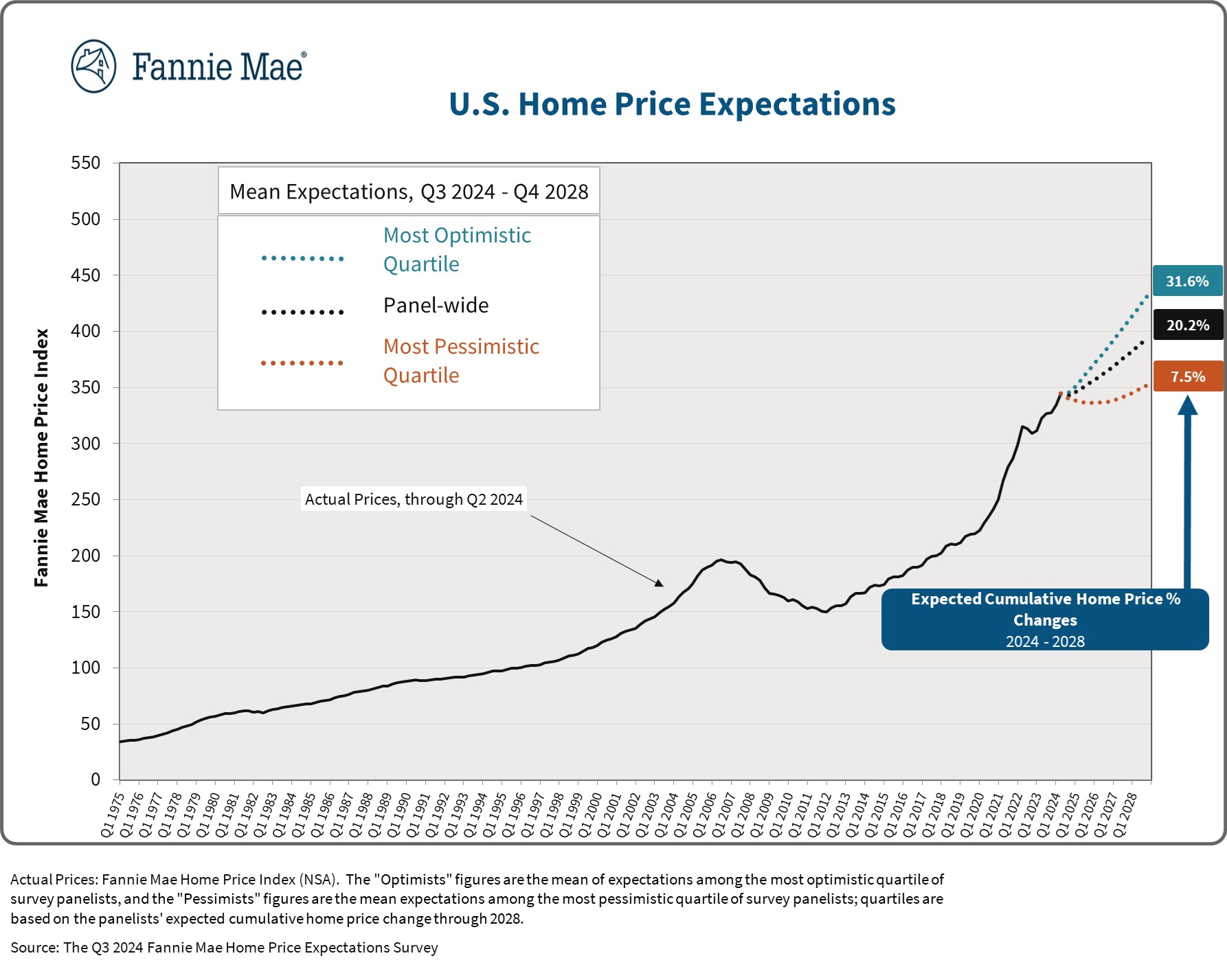
U. S. Home price expectations for 2024-2028

Slowing Growth in Home Prices


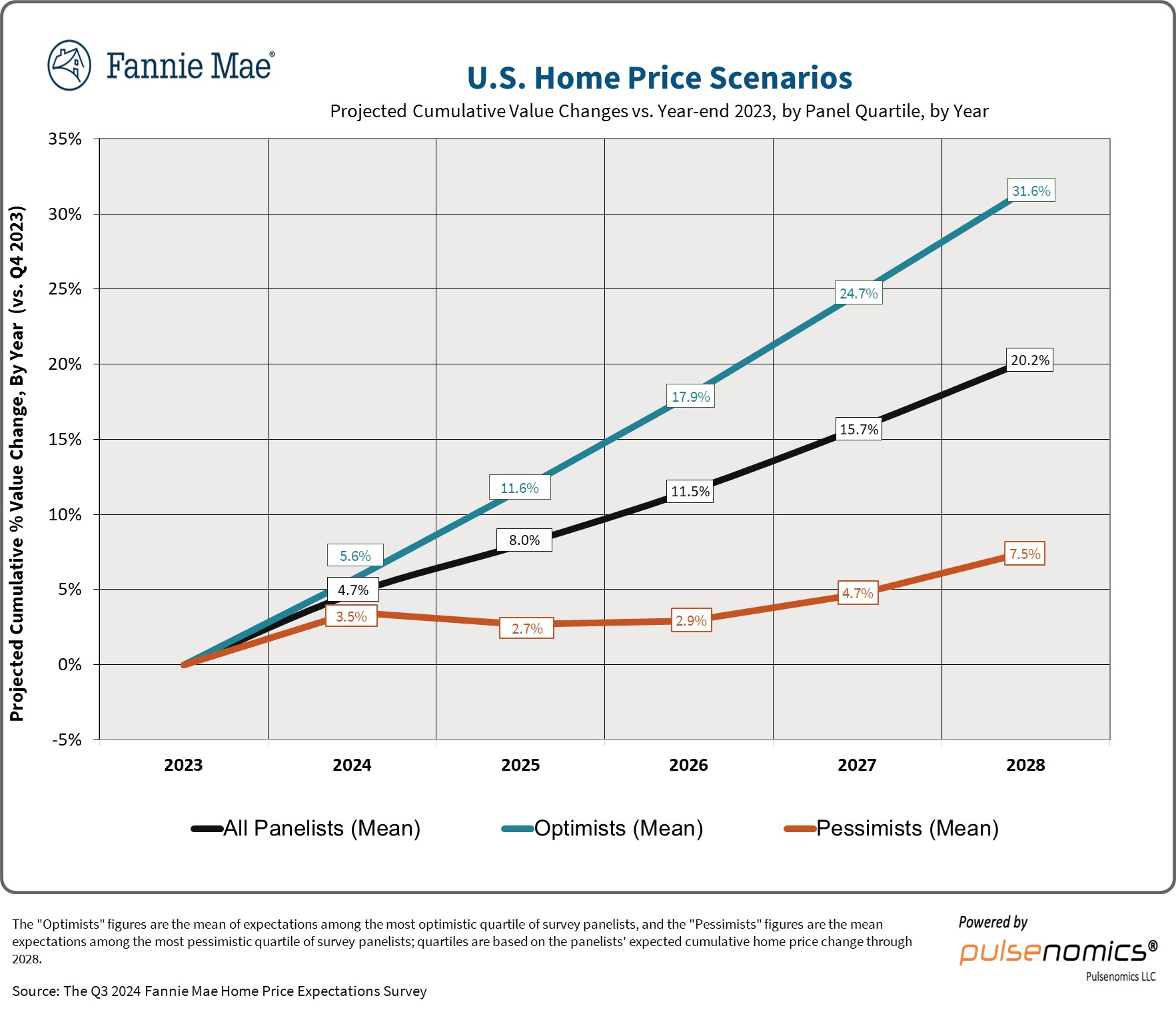
The survey anticipates a slower pace of home price growth in the coming years compared to the robust 6% increase seen in 2023. For 2024, experts forecast a 4.7% growth, with a further decline to 3.1% in 2025. This trend reflects a potential cooling of the market, influenced by policy changes and ongoing supply constraints.

Diverging Predictions and Market Uncertainty


The panel’s projections reveal a wide range of outcomes, from optimistic to pessimistic scenarios. By the end of 2028, the most optimistic forecasts suggest a 31.6% cumulative gain in home prices, while the most pessimistic predict only a 7.5% increase. This divergence highlights the uncertainty and complexity of the market’s future.

Yearly breakdown of projected home price changes (2023-2028)

Historical Context and Future Implications


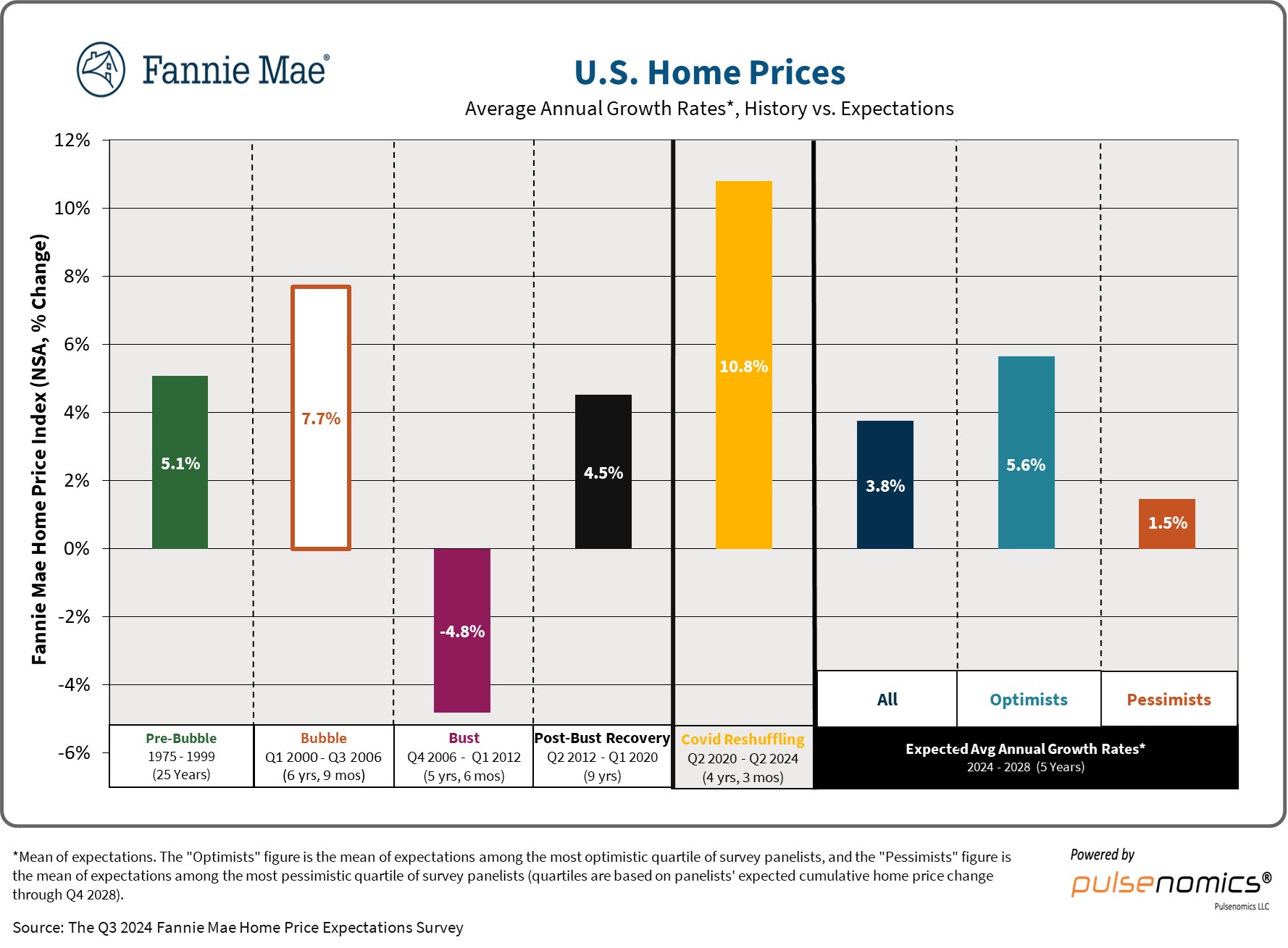
Examining historical data from key periods such as the “Pre-Bubble”, “Bubble”, “Bust”, and “Covid Reshuffling” phases, the survey provides a comprehensive view of market fluctuations. These insights are invaluable for buyers, sellers, and investors, each facing unique challenges and opportunities in light of the projected trends.

  • For Buyers: Expect a more moderate pace of price appreciation and continued affordability challenges due to the housing shortage.
  • For Sellers: Anticipate slower home price appreciation and a potentially more balanced market.
  • For Investors: Returns might moderate, but rental demand is likely to remain strong.


The Role of Policy and Supply Constraints


The persistent shortage of housing remains a major issue, with an estimated deficit of approximately 2.8 million homes. Potential policy reforms, such as zoning and permitting changes, could positively impact housing supply, but there is skepticism about their widespread adoption and effectiveness.

U. S. Home prices: from pre-bubble boom to covid reshuffling

The Path Ahead


While home prices are expected to continue their upward trend, albeit at a reduced pace, the future of the housing market remains intricately linked to external factors such as policy reform and economic conditions. For a deeper understanding, readers are encouraged to explore the original article and related reports provided by Norada Real Estate Investments.

More Articles

Getting licensed or staying ahead in your career can be a journey—but it doesn’t have to be overwhelming. Grab your favorite coffee or tea, take a moment to relax, and browse through our articles. Whether you’re just starting out or renewing your expertise, we’ve got tips, insights, and advice to keep you moving forward. Here’s to your success—one sip and one step at a time!

Free Money in 2026? The Truth About the DOGE Dividend Stimulus Check

The DOGE Dividend: What You Need to Know About the Proposed 2026 Stimulus Check Hey there! If you’ve been wondering #ReadMore

Navigating Seller’s Market: Twin Cities Housing Trends and Predictions for 2024

The Minneapolis housing market is currently navigating a complex terrain, marked by a curious blend of optimism and caution. In 2024, home sales in the Twin Cities area experienced a modest uptick of 1.8%.

Future Homes: Sustainability and Smart Technology Shaping Real Estate

In the ever-evolving landscape of real estate, two groundbreaking trends are shaping the homes of tomorrow: sustainability and smart home technology. As consumers become increasingly aware of their environmental impact and as technology continues to advance at lightning speed, these trends are significantly influencing buying decisions in the residential real estate market.

By |February 25, 2025|Categories: Article, Real Estate, Technology|Tags: , |0 Comments

Harvard Study Projects Dramatic Slowdown in U.S. Household Growth

In a comprehensive analysis by Harvard's Joint Center for Housing Studies, there is a projected increase of 8.6 million households in the United States from 2025 to 2035. This equates to approximately 860,000 new households per year, marking a significant deceleration compared to the post-Great Recession era, which saw a sluggish yet larger gain of 10.1 million households.

By |February 24, 2025|Categories: Article, Demographics, Housing|Tags: , |0 Comments

AI Revolutionizing Real Estate: Predicting Trends and Values

The real estate industry, often seen as conservative, is gradually embracing technological advancements with AI leading the charge. Generative AI is already revolutionizing real estate marketing by enhancing customer experiences and optimizing content creation.

By |February 24, 2025|Categories: Article, Real Estate, Technology/AI|Tags: , |0 Comments

In-Person Work Policies: A Beacon of Hope for Commercial Real Estate

With office occupancy plummeting by 90% from February to March 2020, the impact of remote work was palpable. However, the researchers found that hybrid mandates and adding more in-office days could mitigate some of these challenges.