Global Capital Is on the Move: What Colliers’ 2026 Outlook Means for the Future of Real Estate
A new wave of global capital is reshaping the real estate landscape, and investors across the world are gearing up for a high‑momentum 2026. Colliers’ freshly released
2026 Global Investor Outlook reveals something the industry has been eager to hear: confidence is returning, liquidity is improving, and investors are becoming far more hands‑on in shaping their portfolios.
Investors Shift Into Active, Hands-On Strategies
Nearly half of global investors (49%) now prefer direct investments and separate accounts—signaling a decisive break from passive structures. Platform joint ventures and M&A activity are rising, giving investors more influence, more flexibility, and more strategic control.
Damian Harrington, Director and Head of Research for Global Capital Markets & EMEA at Colliers, highlights this shift clearly: investors want control, agility, and scale. With only 9% of fundraising targeting core and core‑plus strategies—despite 37% of investors seeking them—a major disconnect is driving investors toward strategies where they can steer progress themselves.
Global Diversification Is Accelerating
International capital is moving across borders at remarkable speed. Multi‑regional strategies now represent nearly 30% of global fundraising, reflecting a stronger appetite for diversified, global exposure. Europe saw fundraising jump 50% year‑over‑year, while Asia Pacific surged an incredible 130%, with Japan, Australia, and India leading the demand.
Data Centers Dominate as Offices Rebound
Digital infrastructure continues to soar, with data centers representing a massive 31% of global real estate funds raised in 2025. This makes them the second‑most favored asset class worldwide. At the same time, office properties—once overshadowed by pandemic‑era uncertainty—are experiencing a meaningful rebound thanks to widespread return‑to‑office policies.
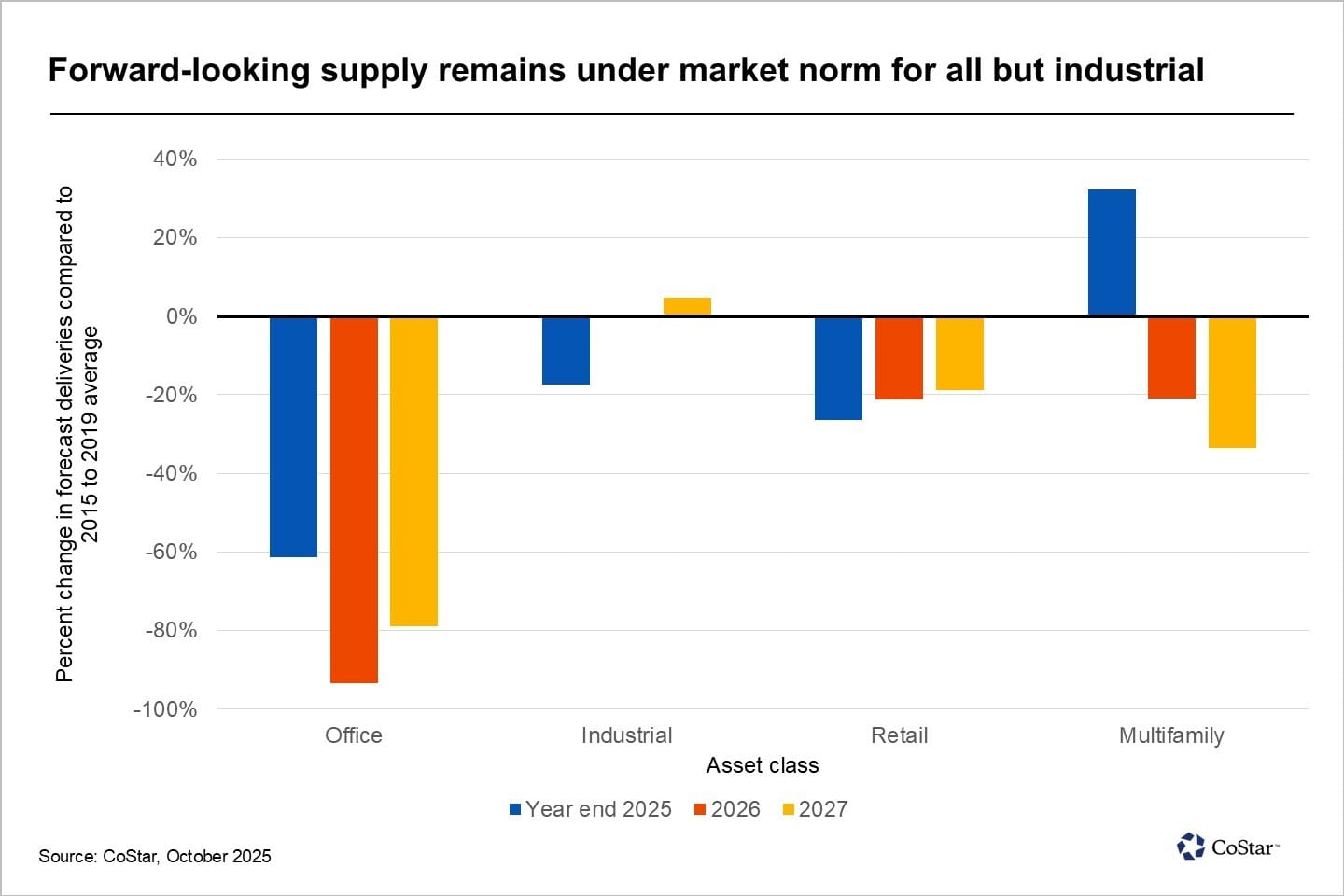
Meanwhile, alternative sectors such as student housing, self‑storage, and healthcare are seeing significant growth driven by demographic pressures. Industrial, multifamily, and retail remain strong, supported by solid fundamentals and limited supply.
Value-Add Strategies Drive Redevelopment
Investors are leaning heavily into value‑add and adaptive reuse strategies, particularly in supply‑constrained markets. With construction and operating costs climbing, repositioning existing properties has become a preferred path. Office buildings across APAC and Europe are being modernized with sustainability upgrades, advanced tech integration, and fresh tenant‑oriented designs.
Regional Highlights
United States: High activity driven by pent‑up capital and attractive pricing—especially in multifamily, industrial, and data centers.
EMEA: Strong liquidity and a resurgence in office and industrial activity draw global capital back to Europe.
APAC: Allocations continue rising across logistics, office, data centers, and student housing.
Canada: Multifamily and retail remain national safe‑haven assets amid severe supply constraints.
Why This Matters for Real Estate Professionals
For agents, brokers, and aspiring professionals, understanding global capital movement is an essential edge. These trends influence everything from local inventory to commercial redevelopment opportunities. Whether you’re preparing to enter the industry or sharpening your competitive skills, staying informed is an undeniable advantage.
That’s why institutions like
Cameron Academy continue to stand out as a trusted resource for real estate, mortgage, insurance, finance, and other professional licensing education across all 50 states. In a fast‑shifting market, being properly trained and confidently licensed positions you ahead of the curve.
Getting licensed or staying ahead in your career can be a journey—but it doesn’t have to be overwhelming. Grab your favorite coffee or tea, take a moment to relax, and browse through our articles. Whether you’re just starting out or renewing your expertise, we’ve got tips, insights, and advice to keep you moving forward. Here’s to your success—one sip and one step at a time!
Skyrocketing insurance premiums and soaring rebuilding costs are transforming communities across Southwest Florida, especially in the wake of Hurricane Ian. As longtime residents struggle to keep up with rising financial pressure, wealthier newcomers and stricter building standards are reshaping the identity of places like Fort Myers Beach. With insurance rates now driving home sales, triggering potential foreclosures, and squeezing both owners and renters, Florida’s middle-class families face a growing question: can they afford to stay in the state they love?
Florida’s insurance industry is stabilizing fast, with nearly 1.6 million policies shifting from Citizens to private insurers and litigation dropping sharply. Regulators report stronger market confidence, decreasing premiums, and renewed competition—signaling one of the healthiest periods the state has seen in years.
A Leon County judge has ordered the restart of arbitration for Citizens Property Insurance claims, directly conflicting with a previous ruling that halted the process as potentially unconstitutional. With more than 400 cases now back in motion, real estate, insurance, and mortgage professionals can expect renewed activity in claim disputes and fresh uncertainty as Florida courts clash over the legality of Citizens’ arbitration system.
The DFW market is transitioning into a new construction phase marked by a slowdown in office development, a more selective approach to industrial projects, and an evolving housing landscape shaped by affordability and population growth. Developers are recalibrating their priorities, and for real estate professionals, understanding these shifts offers a critical edge in navigating—and capitalizing on—the next phase of the metroplex’s growth.
A new federal lawsuit claims Zillow pushed homebuyers toward Zillow Home Loans by rewarding affiliated agents with valuable leads — all without proper disclosure. The suit alleges undisclosed incentives, referral quotas, and potential RESPA violations, raising major concerns about steering, fiduciary duties, and Zillow’s expanding mortgage ambitions.
The mortgage industry is evolving fast, and the lenders who come out on top will be those who innovate without uprooting what already works. By building on strong technology foundations, streamlining workflows and adopting smart automation, lenders can reduce costs, improve customer experience and stay resilient in any market cycle. This article breaks down why innovation matters now, how a stable tech ecosystem protects lenders in volatile conditions and why small, strategic steps can drive long-term transformation.