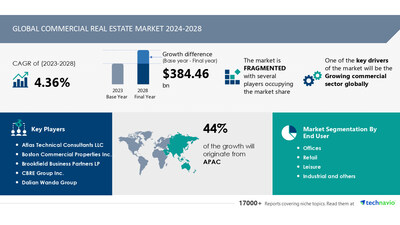
The global commercial real estate market is on a path to substantial growth, with an anticipated increase of USD 384.46 billion from 2024 to 2028. This projection, as reported by Technavio, indicates a compound annual growth rate (CAGR) of 4.36% during the forecast period. The burgeoning global commercial sector is a primary driver of this upward trend.
Despite this optimistic outlook, the industry must navigate challenges posed by the increasing prevalence of remote work and online shopping, which threaten traditional retail and office space demand. Companies are adapting by incorporating co-working spaces, flexible work environments, and advanced virtual collaboration technologies.
Prominent industry players such as Atlas Technical Consultants LLC, Boston Commercial Properties Inc., and CBRE Group Inc. are instrumental in this market evolution. The shift towards integrated marketing communication strategies, leveraging platforms like social media, highlights the importance of engaging customers across multiple channels.
Emerging trends within the industry include a surge in demand for distribution and fulfillment centers, spurred by the growth of e-commerce. Manufacturing facilities are also experiencing a resurgence due to reshoring trends. Office spaces are evolving to accommodate flexible work models, with an emphasis on modern health and safety measures. Concurrently, the logistics sector is witnessing heightened demand linked to the rise in e-commerce sales.
Regionally, the Asia-Pacific (APAC) region leads with a 44% contribution to market performance, bolstered by technological advancements, including AI capabilities, which redefine competitive dynamics within the sector. Key countries such as the US, China, Japan, Germany, and the UK are pivotal in shaping market landscapes.
Technavio’s analysis underscores the challenges facing the market, including economic factors like interest rates and conditions impacting property demands. Additionally, the evolution of technologies, such as virtual tours and online leasing, underscores the need for modernized property marketing and management strategies.
In conclusion, while the commercial real estate market exhibits strong growth potential, strategic agility, technology adoption, and innovative marketing will be crucial in overcoming the market’s evolving challenges and seizing emerging opportunities.
For a comprehensive exploration of these trends, readers can view the Commercial Real Estate Market Analysis by Technavio and access additional insights and resources available through Technavio’s extensive research and advisory services.
More Articles
Getting licensed or staying ahead in your career can be a journey—but it doesn’t have to be overwhelming. Grab your favorite coffee or tea, take a moment to relax, and browse through our articles. Whether you’re just starting out or renewing your expertise, we’ve got tips, insights, and advice to keep you moving forward. Here’s to your success—one sip and one step at a time!
Artificial intelligence is speeding ahead, but real estate is discovering a hard truth: AI can’t work well on messy, inconsistent, and siloed data. Unlike finance or e‑commerce, the industry has never agreed on shared definitions or standardized frameworks, making it difficult for AI tools to interpret information at scale. Now, leaders across real estate are realizing that the real breakthrough won’t come from smarter algorithms—it will come from finally unifying the industry’s fragmented data so AI can deliver its full value.
Manhattan’s iconic Waldorf Astoria is hitting the market again—and its billion‑dollar price tag may reveal whether commercial real estate is finally recovering. After years of inflation, shutdowns, and stalled investment, new forecasts from major firms show growing optimism, making this sale a critical test for the 2026 market.
Homeowners across Florida are facing sharp increases in their escrow payments as insurance premiums continue to rise. With insurers leaving the state, rates climbing, and replacement policies costing far more, many residents are experiencing sudden spikes in their monthly mortgage bills. These escalating insurance-driven escrow costs are reshaping affordability, influencing buyer qualifications, and redefining financial stability for Floridians and the broader real estate market.
The modern MLS marketplace is one of real estate’s greatest success stories: transparent, efficient, and designed to help buyers and sellers win. But its very effectiveness has sparked a new risk — professionals looking to “stand out” by limiting exposure and restricting information. Research shows that full MLS visibility can boost a seller’s price by $50,000 to $75,000, yet off‑market tactics threaten to chip away at the system that delivers those gains. The MLS doesn’t need replacing; it needs thoughtful upgrades and well‑trained professionals who know how to protect and leverage its power.
Florida homeowners are being hit with a new kind of sticker shock as rising insurance premiums push escrow payments sharply higher, adding hundreds of dollars to monthly mortgage bills. The surge is reshaping budgets, impacting buyer qualification, and redefining affordability across the state. With insurers pulling back and premiums climbing faster than wages, both current owners and hopeful buyers must now navigate a market where insurance risk—not just home price—plays a major role in the true cost of living in the Sunshine State.
Florida’s mobile and manufactured homes are surging in popularity, but insuring them requires specialized HO-7 coverage designed for structures built off-site and more vulnerable to wind and weather. With rising premiums, unique risks, and new 2026 market shifts, homeowners and industry professionals need to understand what these policies cover, what they don’t, which insurers are leading the pack, and how to save without sacrificing protection.