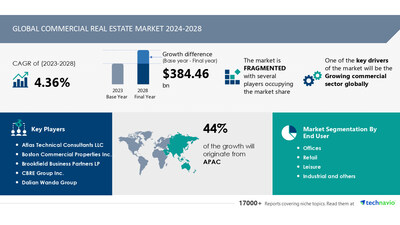
The global commercial real estate market is on a path to substantial growth, with an anticipated increase of USD 384.46 billion from 2024 to 2028. This projection, as reported by Technavio, indicates a compound annual growth rate (CAGR) of 4.36% during the forecast period. The burgeoning global commercial sector is a primary driver of this upward trend.
Despite this optimistic outlook, the industry must navigate challenges posed by the increasing prevalence of remote work and online shopping, which threaten traditional retail and office space demand. Companies are adapting by incorporating co-working spaces, flexible work environments, and advanced virtual collaboration technologies.
Prominent industry players such as Atlas Technical Consultants LLC, Boston Commercial Properties Inc., and CBRE Group Inc. are instrumental in this market evolution. The shift towards integrated marketing communication strategies, leveraging platforms like social media, highlights the importance of engaging customers across multiple channels.
Emerging trends within the industry include a surge in demand for distribution and fulfillment centers, spurred by the growth of e-commerce. Manufacturing facilities are also experiencing a resurgence due to reshoring trends. Office spaces are evolving to accommodate flexible work models, with an emphasis on modern health and safety measures. Concurrently, the logistics sector is witnessing heightened demand linked to the rise in e-commerce sales.
Regionally, the Asia-Pacific (APAC) region leads with a 44% contribution to market performance, bolstered by technological advancements, including AI capabilities, which redefine competitive dynamics within the sector. Key countries such as the US, China, Japan, Germany, and the UK are pivotal in shaping market landscapes.
Technavio’s analysis underscores the challenges facing the market, including economic factors like interest rates and conditions impacting property demands. Additionally, the evolution of technologies, such as virtual tours and online leasing, underscores the need for modernized property marketing and management strategies.
In conclusion, while the commercial real estate market exhibits strong growth potential, strategic agility, technology adoption, and innovative marketing will be crucial in overcoming the market’s evolving challenges and seizing emerging opportunities.
For a comprehensive exploration of these trends, readers can view the Commercial Real Estate Market Analysis by Technavio and access additional insights and resources available through Technavio’s extensive research and advisory services.
Select options
This product has multiple variants. The options may be chosen on the product page
Details
More Articles
Getting licensed or staying ahead in your career can be a journey—but it doesn’t have to be overwhelming. Grab your favorite coffee or tea, take a moment to relax, and browse through our articles. Whether you’re just starting out or renewing your expertise, we’ve got tips, insights, and advice to keep you moving forward. Here’s to your success—one sip and one step at a time!
The debut episode of NAR’s Change Agents podcast highlights why real estate expertise is more valuable than ever in an AI-driven world. eXp Realty CEO Leo Pareja explains that while technology accelerates communication and connections, consumers still rely on seasoned professionals to guide them through life’s biggest financial decisions. From the Everest analogy to real-world AI success stories, the conversation reveals how trust, transparency, and expert guidance remain the core of the real estate experience.
U.S. 30‑year mortgage rates have dipped to 5.98%, breaking below 6% for the first time since 2022. This third consecutive weekly decline signals a potentially energized spring buying season as lower Treasury yields and easing market anxiety push rates down. Buyers, sellers, and real estate professionals may see renewed activity as affordability slightly improves and refinancing picks up momentum.
A sweeping federal reporting requirement is about to impact how companies, trusts, investors, and even cash buyers purchase residential real estate. FinCEN’s new rule closes long‑standing loopholes that allowed anonymous all‑cash property deals, requiring many entity-based buyers to disclose their true beneficial owners. Real estate agents, brokers, and advisors should brace for workflow changes and increased compliance responsibilities, while investors are urged to review their acquisition structures now to avoid delays once the rule takes effect.
After briefly dipping below 6 percent for the first time in years, mortgage rates have surged again following U.S.-Israeli military strikes on Iran. Rising oil prices and a jump in Treasury yields have pushed the average 30-year fixed rate back to 6.12 percent, creating fresh uncertainty just as the spring housing market was gaining traction. Experts warn that continued geopolitical instability could keep rates elevated, while upcoming U.S. employment data may determine whether relief is on the horizon for buyers and sellers.
New 2026 data reveals that the average life insurance policy costs just 26 dollars a month—less than most lunch outings—making it more affordable than many professionals expect. Rates vary based on age, health, gender, smoking habits, and term length, with younger and healthier applicants paying significantly less. As real estate, mortgage, insurance, and finance professionals plan long-term financial stability, understanding these pricing factors is crucial.