Global Surge in Wearable Healthcare Devices Market
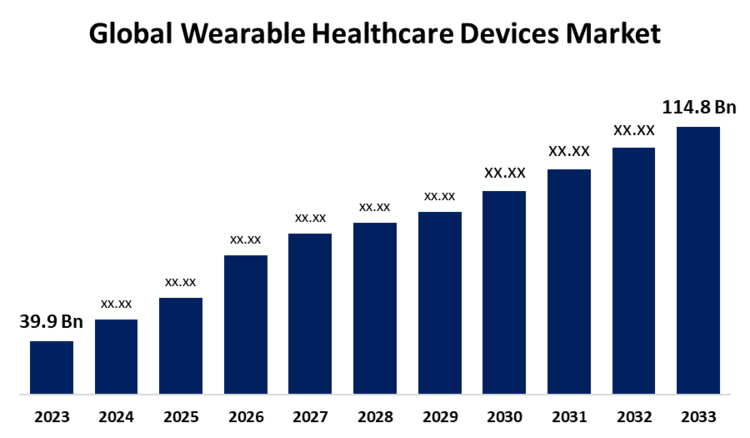
The global wearable healthcare devices market is on a remarkable growth trajectory, projected to escalate from USD 39.9 billion in 2023 to an impressive USD 114.8 billion by 2033. This surge, at a compound annual growth rate (CAGR) of 11.15%, underscores the increasing demand for proactive health management and advancements in sensor technology.
Wearable healthcare devices, including smartwatches and trackers, have become essential tools for individuals eager to monitor and manage their health proactively. These devices are more than just fitness trackers; they offer a multitude of functions such as heart rate monitoring, smartphone notifications, and integration with third-party applications. However, the continuous health monitoring they provide raises significant concerns about the security and privacy of sensitive health data.
Market Segmentation and Trends
The market is categorized by product types, applications, and distribution channels. Smartwatches are anticipated to lead the product segment, while the general health and fitness application segment is expected to dominate due to the growing focus on real-time health monitoring. E-commerce emerges as the leading distribution channel, facilitating the availability of these devices through digital platforms.
Geographical Insights
North America holds the largest market share, driven by favorable reimbursement laws, high per capita spending on advanced technologies, and significant investments by market players. Meanwhile, the Asia-Pacific region is expected to experience the fastest growth, propelled by initiatives to reduce patient hospital stays in countries like China, Japan, and India.
Competitive Landscape
The competitive landscape features major vendors such as Dr. Reddy’s Laboratories Ltd, Samsung Electronics, Huawei Technologies, Fitbit, and Apple. These companies continue to innovate and collaborate, fueling the market’s expansion. A notable development is the introduction of Nerivio, a non-invasive wearable for managing migraines, by Dr. Reddy’s Laboratories in Germany, marking its expansion in the European digital therapy market.
For those interested in delving deeper, the complete report and related documents are accessible through the following link. This information is crucial for stakeholders aiming to strategize and capitalize on burgeoning opportunities within the wearable healthcare devices marketplace.
More Articles
Getting licensed or staying ahead in your career can be a journey—but it doesn’t have to be overwhelming. Grab your favorite coffee or tea, take a moment to relax, and browse through our articles. Whether you’re just starting out or renewing your expertise, we’ve got tips, insights, and advice to keep you moving forward. Here’s to your success—one sip and one step at a time!
Investors worldwide are redeploying capital, embracing more active deal structures, and expanding into new regions as the 2026 market takes shape. Data centers, revived office demand, and global diversification are driving a major shift—creating fresh opportunities for real estate, mortgage, and finance professionals who understand where capital is heading next.
Florida homeowners now pay an average of $5,838 per year for insurance—about $3,000 more than the national average—pushing many families to the financial brink. Residents report premiums tripling, claims being severely underpaid, and insurers dropping policies at one of the highest rates in the country. As frustration mounts, lawmakers and industry experts are calling for sweeping reforms to curb rising costs, increase accountability, and stabilize a market that’s reshaping real estate decisions across the state.
Florida’s insurance market has hit a major turning point. Citizens Property Insurance—once the state’s largest insurer with 1.4 million policies—has shed more than 900,000 policies as private insurers return in force. Driven by Florida’s depopulation program and the arrival of 17 new companies, nearly 200,000 policies shifted to private carriers in October alone, with about 40 percent offering lower premiums. The shift signals rising competition, stabilizing rates, and new opportunities for homeowners and industry professionals navigating Florida’s evolving insurance landscape.
The National Association of REALTORS® has approved 18 major updates to modernize its MLS policies—the largest overhaul in two decades. Announced at NAR NXT in Houston and set to take effect in January 2026, the changes aim to streamline MLS operations, improve enforcement clarity, and better align policies with how today’s real estate professionals actually work.
Inhabit has rolled out a powerful lineup of AI-driven leasing, marketing, fraud prevention, and compliance tools designed to streamline operations and protect property teams from growing risks. From hybrid AI leasing assistants to instant income verification and upcoming portfolio-wide lease audits, these innovations aim to cut costs, eliminate inefficiencies, and strengthen regulatory confidence across the multifamily industry.
Florida’s latest round of insurance reforms was meant to calm a volatile market, yet many experts warn the same deep structural problems remain. Homeowners are being pushed from Citizens into higher‑priced, lightly capitalized private insurers, ratings agencies face scrutiny for inflated grades, and political influence clouds oversight. For real estate and insurance professionals, these trends signal ongoing risk, rising costs, and a market in need of a complete rebuild.