Health Insurance Shake-Up: Why America’s Coverage Markets Are Entering a New Era

America’s health insurance landscape is changing—and fast. From power‑player insurers tightening their grip on group markets to an explosion of competition in the ACA individual marketplace, the past decade has redrawn the map of who covers whom, and at what cost. A new and comprehensive analysis from Peterson‑KFF delivers a rare, data‑driven look at exactly how competitive—or consolidated—our commercial insurance markets have become.

Whether you’re in insurance, finance, healthcare, business administration, or simply navigating your own coverage, these shifts are reshaping how Americans access care. And for career‑hungry professionals, understanding these dynamics is becoming nothing short of essential.

Source Spotlight: Data and insights courtesy of the brilliant analysts at the Peterson‑KFF Health System Tracker—one of the nation’s top authorities on healthcare performance and market trends.

One Big Trend: Group Markets Are Consolidating, While the Individual Market Opens Up

Fully insured group plans (both small and large employers) have become more concentrated than ever. Meanwhile, the individual market—fueled by the ACA—has seen a surge in competition and consumer choice.

In 2013, the dominant insurer in each state held roughly 56%–59% of the market across all segments. But by 2023, the picture split dramatically:

  • Group markets became more consolidated
  • The individual market saw dominance drop to 53%—meaning more players, more plans, more options
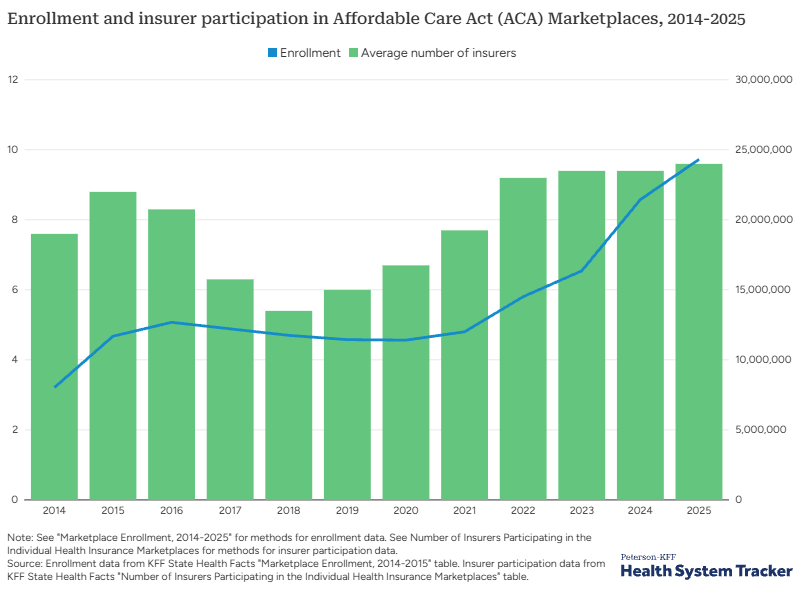
Aca marketplace participation chart

Why Employers Are Fleeing Fully Insured Plans

The fully insured market is shrinking. Large group enrollment fell from 46M in 2013 to 38M in 2023. Small group enrollment dropped from 17M to 10M.

So what’s happening?

Employers—especially large ones—are moving to self‑funded and level‑funded plans. These approaches offer companies more flexibility, cost control, and customization. By 2025, a stunning 67% of employees are covered under self‑funded structures.

Small businesses are joining the movement as well, driven by rising premiums and better hybrid funding options.

The Individual Market Is Thriving—For Now

ACA enrollment jumped from 11 million in 2013 to 18 million in 2023. Expanded subsidies played a huge part in making coverage affordable and attractive.

But a major policy cliff looms: enhanced tax credits expire at the end of 2025 unless Congress extends them. If not, premiums could double for many families, pushing an estimated 4 million Americans out of coverage.

One Insurer to Rule Them All? In Many States, Yes.

Market concentration remains extremely high. Some insurers dominate their state at stunning levels:

  • BCBS of Alabama: 94% of the large group market
  • Highmark (Delaware): 93% of individual market
  • Wellmark (Iowa): 90% of individual market

Even large states aren’t immune—North Carolina’s small group market is 82% controlled by a single insurer.

Record Competition in the ACA Marketplaces

Since 2018, insurers have flocked back to the ACA Marketplace. Urban regions now offer a rich tapestry of plans, while rural areas still lag but are improving. Both enrollment and participation are reaching record highs—making the ACA Marketplace healthier than it has been in years.

The Numbers Behind the Concentration: HHI

The government uses the Herfindahl‑Hirschman Index (HHI) to measure competition. In 2023:

  • 48 states + DC had highly concentrated large group markets
  • All 50 states + DC had highly concentrated small group markets
  • 47 states + DC had highly concentrated individual markets

Even with an improving ACA landscape, most segments still lean heavily toward consolidation.

Why This Matters for Professionals

Across insurance, finance, healthcare, HR, and business strategy, understanding these shifts helps professionals:

  • Advise clients on plan structures and cost trends
  • Prepare for policy impacts in 2025 and beyond
  • Spot career opportunities in a fast‑evolving industry
  • Navigate market swings with confidence

Want to get licensed or expand your professional credentials? Whether you’re pursuing insurance, finance, or real estate, Cameron Academy offers flexible, career‑boosting courses nationwide—helping you stay competitive as markets shift.

Final Takeaway

The U.S. health insurance system is in a pivotal period. Group plans are consolidating, self‑funding is exploding, the ACA individual market is more competitive than ever, and major policy changes could reshape everything again in 2025. The Peterson‑KFF analysis provides an essential blueprint for navigating these changes.

If you want to stay informed—and stay ahead—this is the moment to pay attention.

More Articles

Getting licensed or staying ahead in your career can be a journey—but it doesn’t have to be overwhelming. Grab your favorite coffee or tea, take a moment to relax, and browse through our articles. Whether you’re just starting out or renewing your expertise, we’ve got tips, insights, and advice to keep you moving forward. Here’s to your success—one sip and one step at a time!

United Real Estate’s Innovative Approach: Empowering Franchisees

United Real Estate is revolutionizing the real estate industry with its innovative approach to empowering agents and bridging the value gap. The company's Bullseye Lead Boost Program aims to transform the lead generation process, giving agents more control over their leads and ensuring they get the most value out of their investment. United Real Estate also provides comprehensive support and resources to franchisees, helping them maximize their returns in the competitive real estate market. Learn more about this innovative approach at Cameron Academy.

By |October 3, 2023|Categories: Real Estate Lead Generation|Tags: |0 Comments

New Initiatives by Fannie Mae to Enhance Latino Homeownership Access

Fannie Mae, the government-sponsored enterprise (GSE), recently announced the launch of innovative programs and resources aimed at tackling the homeownership gap experienced by the Latino community. These initiatives are designed to provide responsible access to housing and long-term sustainable homeownership opportunities. In an effort to promote homeownership among Latinos, Fannie Mae is implementing the HomeReady® Hispanic Centric Approach, a program tailored to meet the unique needs of this community. This initiative offers flexible underwriting guidelines and low down payment options, making homeownership more attainable for qualified Latino borrowers. Furthermore, Fannie Mae is expanding its downpayment assistance program, providing financial support to eligible homebuyers. This expansion aims to help more Latino families overcome the challenge of saving for a down payment, turning their dreams of homeownership into a reality.

By |October 3, 2023|Categories: Latino Homeownership Access|Tags: |0 Comments

Demands for Resignation and Accountability at NAR: A Comprehensive Report

This comprehensive report delves into the ongoing demands for change within the National Association of Realtors (NAR) following allegations of sexual harassment and a toxic work environment. The demands include the resignation of top leaders, the implementation of a third-party human resources reporting system, and an independent review of the organization's policies and procedures. We will also explore the response from NAR and the advocacy efforts of the NAR Accountability Project. This report aims to provide a thorough analysis of the situation and shed light on the need for accountability and a more inclusive work culture.

Approaching Annual High: Mortgage Rates Hit 7.49%

The mortgage market experienced a significant uptick in rates last week, with figures inching closer to the annual high of 7.49%. This unexpected surge has raised concerns among potential homebuyers and industry experts alike. The recent rise in mortgage rates can be attributed to two key factors: a hawkish Federal Reserve meeting and robust jobless claims data. Despite the overall upward trajectory, mortgage rates found some relief towards the end of the week as bond yields began to decline. This reversal offered a glimmer of hope for potential homebuyers, suggesting that rates may stabilize in the near future. However, market volatility and external factors remain influential, warranting cautious optimism.

By |October 2, 2023|Categories: Mortgage Rates|Tags: |0 Comments

Changes to Homeowners Insurance Rules in California

California is implementing new rules for homeowners insurance carriers to address challenges faced by insurance companies and provide homeowners with more options. The proposed changes aim to retain insurance companies within the state, ensuring a stable insurance market and offering homeowners a wider range of coverage choices. These changes come in response to the departure of major insurance companies and the increased enrollment in the California FAIR Plan. The proposed changes would allow insurers to consider climate change and reinsurance costs when setting their rates. However, they would still require permission from the state to make rate adjustments.

13% Decline in Pending-Home Sales Amid High Mortgage Rates: A Redfin Report

The housing market is currently grappling with a significant decline in pending-home sales due to the surge in mortgage rates and home prices. A recent report from Redfin reveals a 13% drop in pending-home sales compared to the previous year, underscoring the hurdles faced by potential homebuyers. The affordability crisis in the housing market continues to escalate as mortgage rates and home prices hit record highs. The combination of these factors has led to an unprecedented increase in monthly housing payments, making it increasingly challenging for prospective homebuyers to enter the market.

By |September 26, 2023|Categories: Real Estate Market Analysis|Tags: |0 Comments