Health Insurance Shake-Up: Why America’s Coverage Markets Are Entering a New Era
America’s health insurance landscape is changing—and fast. From power‑player insurers tightening their grip on group markets to an explosion of competition in the ACA individual marketplace, the past decade has redrawn the map of who covers whom, and at what cost. A new and comprehensive analysis from Peterson‑KFF delivers a rare, data‑driven look at exactly how competitive—or consolidated—our commercial insurance markets have become.
Whether you’re in insurance, finance, healthcare, business administration, or simply navigating your own coverage, these shifts are reshaping how Americans access care. And for career‑hungry professionals, understanding these dynamics is becoming nothing short of essential.
Source Spotlight: Data and insights courtesy of the brilliant analysts at the Peterson‑KFF Health System Tracker—one of the nation’s top authorities on healthcare performance and market trends.
One Big Trend: Group Markets Are Consolidating, While the Individual Market Opens Up
Fully insured group plans (both small and large employers) have become more concentrated than ever. Meanwhile, the individual market—fueled by the ACA—has seen a surge in competition and consumer choice.
In 2013, the dominant insurer in each state held roughly 56%–59% of the market across all segments. But by 2023, the picture split dramatically:
- Group markets became more consolidated
- The individual market saw dominance drop to 53%—meaning more players, more plans, more options
Why Employers Are Fleeing Fully Insured Plans
The fully insured market is shrinking. Large group enrollment fell from 46M in 2013 to 38M in 2023. Small group enrollment dropped from 17M to 10M.
So what’s happening?
Employers—especially large ones—are moving to self‑funded and level‑funded plans. These approaches offer companies more flexibility, cost control, and customization. By 2025, a stunning 67% of employees are covered under self‑funded structures.
Small businesses are joining the movement as well, driven by rising premiums and better hybrid funding options.
The Individual Market Is Thriving—For Now
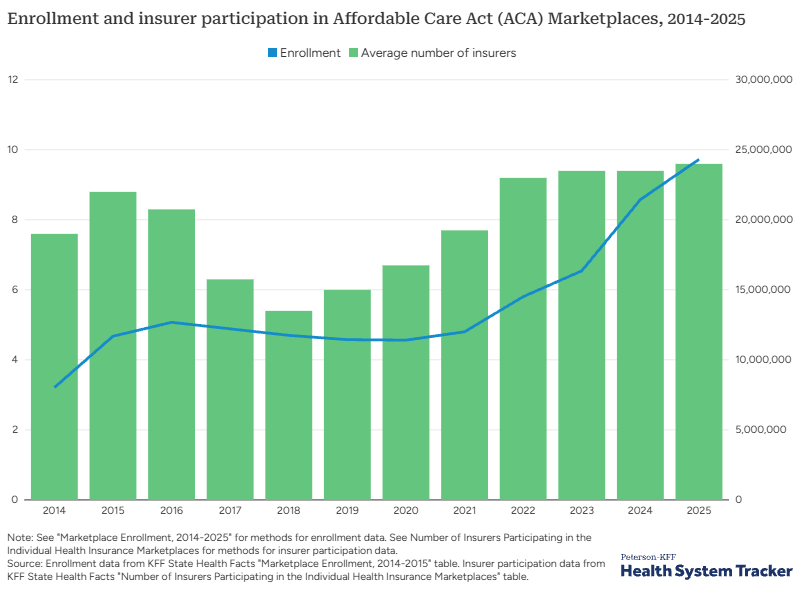
ACA enrollment jumped from 11 million in 2013 to 18 million in 2023. Expanded subsidies played a huge part in making coverage affordable and attractive.
But a major policy cliff looms: enhanced tax credits expire at the end of 2025 unless Congress extends them. If not, premiums could double for many families, pushing an estimated 4 million Americans out of coverage.
One Insurer to Rule Them All? In Many States, Yes.
Market concentration remains extremely high. Some insurers dominate their state at stunning levels:
- BCBS of Alabama: 94% of the large group market
- Highmark (Delaware): 93% of individual market
- Wellmark (Iowa): 90% of individual market
Even large states aren’t immune—North Carolina’s small group market is 82% controlled by a single insurer.
Record Competition in the ACA Marketplaces
Since 2018, insurers have flocked back to the ACA Marketplace. Urban regions now offer a rich tapestry of plans, while rural areas still lag but are improving. Both enrollment and participation are reaching record highs—making the ACA Marketplace healthier than it has been in years.
The Numbers Behind the Concentration: HHI
The government uses the Herfindahl‑Hirschman Index (HHI) to measure competition. In 2023:
- 48 states + DC had highly concentrated large group markets
- All 50 states + DC had highly concentrated small group markets
- 47 states + DC had highly concentrated individual markets
Even with an improving ACA landscape, most segments still lean heavily toward consolidation.
Why This Matters for Professionals
Across insurance, finance, healthcare, HR, and business strategy, understanding these shifts helps professionals:
- Advise clients on plan structures and cost trends
- Prepare for policy impacts in 2025 and beyond
- Spot career opportunities in a fast‑evolving industry
- Navigate market swings with confidence
Want to get licensed or expand your professional credentials? Whether you’re pursuing insurance, finance, or real estate, Cameron Academy offers flexible, career‑boosting courses nationwide—helping you stay competitive as markets shift.
Final Takeaway
The U.S. health insurance system is in a pivotal period. Group plans are consolidating, self‑funding is exploding, the ACA individual market is more competitive than ever, and major policy changes could reshape everything again in 2025. The Peterson‑KFF analysis provides an essential blueprint for navigating these changes.
If you want to stay informed—and stay ahead—this is the moment to pay attention.