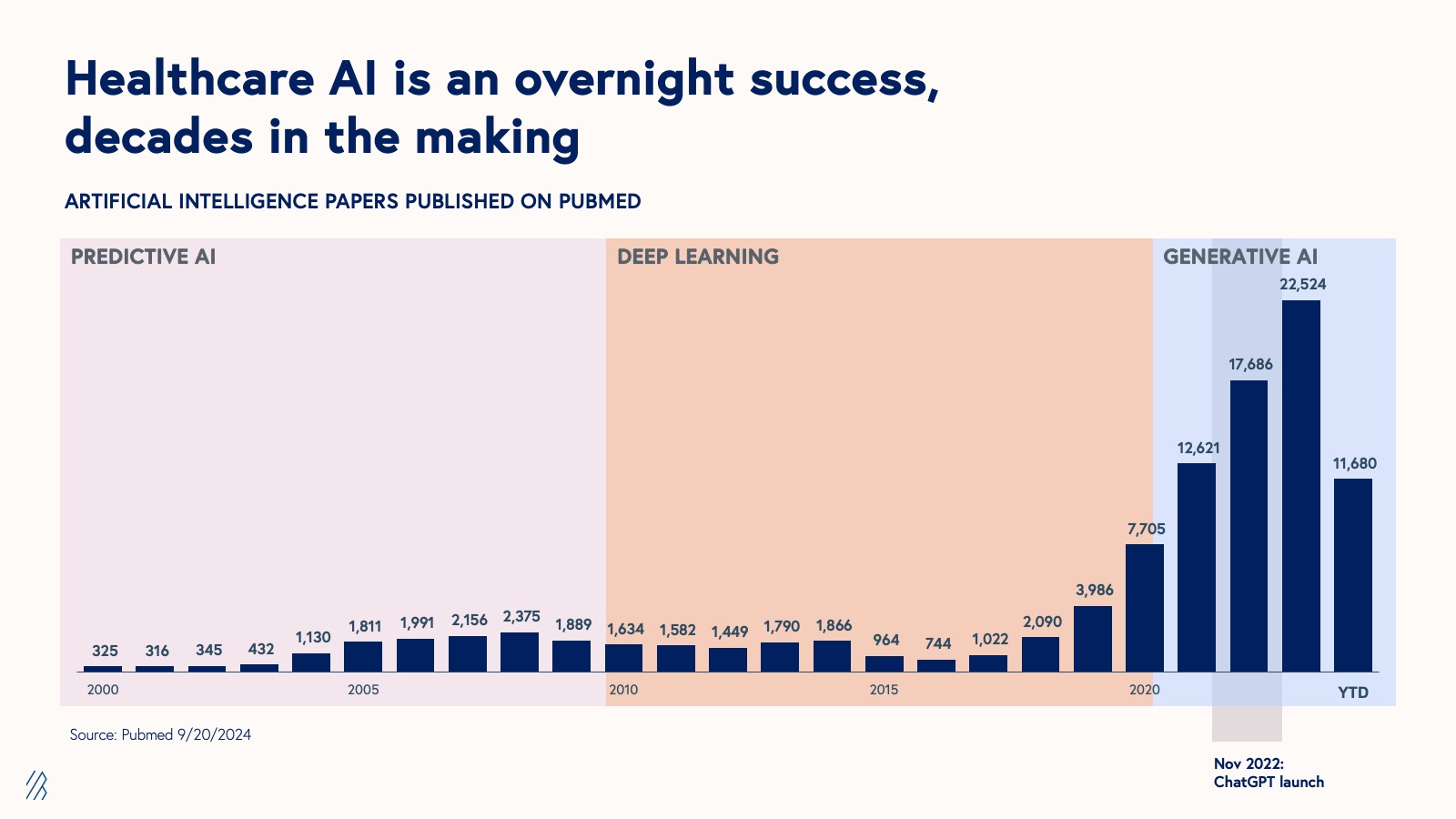
The healthcare industry stands on the precipice of a transformative era, driven by the integration of artificial intelligence (AI) into its core operations. This evolution is not a sudden phenomenon but the culmination of over eighty years of technological advancements and strategic innovations.
A recent article from Bessemer Venture Partners delves into this pivotal moment, highlighting how AI is reshaping markets and modern medicine. The demand for healthcare AI solutions is unprecedented, with a significant surge in interest from startups and established tech giants alike. This is not just hype; it’s a reflection of the tangible benefits AI brings to the table.
In a survey, 70% of healthcare providers and payers reported implementing generative AI, with expectations for continued investment growth. This trend underscores the sector’s readiness to embrace AI-driven efficiencies.
The groundwork for this AI revolution was laid through decades of investment in electronic health records (EHRs), which have digitized vast amounts of clinical and administrative data. This digital foundation is now fertile ground for AI applications, with nearly 40% of healthcare startups in 2024 focusing on AI technologies.
Healthcare AI’s potential extends from the micro-level, such as protein functions, to macro-level population health dynamics. As new data types emerge and AI research accelerates, the sector is poised for rapid evolution, aiming to solve real-world healthcare challenges.
However, this promising landscape is not without its challenges. Navigating complex regulations and market dynamics requires innovative solutions and strategic partnerships. Understanding these factors is crucial for startups aiming to thrive in this competitive environment.
The insights from the Bain Research and other sources suggest that both startups and incumbents stand to gain significantly as the market matures. This evolution promises not only economic growth but also enhanced patient care and systemic improvements in healthcare delivery.
Challenges and Opportunities
Despite the promising developments, AI startups in healthcare face numerous obstacles. The US healthcare system, bound by intricate regulations and misaligned incentives, presents a challenging landscape. Founders must be prepared for resistance to change, as innovation and pushback evolve in tandem.
Regulation, while a barrier to entry, also serves as an enduring moat for incumbents. The dense regulatory landscape creates obstacles for newcomers, but it also protects established players. Engaging in advocacy and lobbying work can help startups navigate this environment.
Moreover, the healthcare market is fragmented, with numerous smaller markets rather than a monolithic industry. Identifying and targeting the right sub-verticals is crucial for unlocking sufficient total addressable market (TAM).
The ongoing digital transformation and the advent of multimodal AI offer significant opportunities for healthcare. These technologies can diagnose diseases earlier, identify barriers to patient recovery, and enhance healthcare system efficiency.
Investment and Future Prospects
Bessemer Venture Partners has dedicated $1 billion to investments in AI companies, actively seeking promising new partners in this rapidly evolving field. The potential for AI to redefine healthcare is immense, with opportunities for startups to make a real difference for patients and healthcare professionals.
As the concept of a “learning healthcare system” becomes a reality, driven by AI, the industry is poised for a new era of continuous improvement and innovation. The journey from digital transformation to AI-driven healthcare is just beginning, and the best is yet to come.
More Articles
Getting licensed or staying ahead in your career can be a journey—but it doesn’t have to be overwhelming. Grab your favorite coffee or tea, take a moment to relax, and browse through our articles. Whether you’re just starting out or renewing your expertise, we’ve got tips, insights, and advice to keep you moving forward. Here’s to your success—one sip and one step at a time!
Artificial intelligence is speeding ahead, but real estate is discovering a hard truth: AI can’t work well on messy, inconsistent, and siloed data. Unlike finance or e‑commerce, the industry has never agreed on shared definitions or standardized frameworks, making it difficult for AI tools to interpret information at scale. Now, leaders across real estate are realizing that the real breakthrough won’t come from smarter algorithms—it will come from finally unifying the industry’s fragmented data so AI can deliver its full value.
Manhattan’s iconic Waldorf Astoria is hitting the market again—and its billion‑dollar price tag may reveal whether commercial real estate is finally recovering. After years of inflation, shutdowns, and stalled investment, new forecasts from major firms show growing optimism, making this sale a critical test for the 2026 market.
Homeowners across Florida are facing sharp increases in their escrow payments as insurance premiums continue to rise. With insurers leaving the state, rates climbing, and replacement policies costing far more, many residents are experiencing sudden spikes in their monthly mortgage bills. These escalating insurance-driven escrow costs are reshaping affordability, influencing buyer qualifications, and redefining financial stability for Floridians and the broader real estate market.
The modern MLS marketplace is one of real estate’s greatest success stories: transparent, efficient, and designed to help buyers and sellers win. But its very effectiveness has sparked a new risk — professionals looking to “stand out” by limiting exposure and restricting information. Research shows that full MLS visibility can boost a seller’s price by $50,000 to $75,000, yet off‑market tactics threaten to chip away at the system that delivers those gains. The MLS doesn’t need replacing; it needs thoughtful upgrades and well‑trained professionals who know how to protect and leverage its power.
Florida homeowners are being hit with a new kind of sticker shock as rising insurance premiums push escrow payments sharply higher, adding hundreds of dollars to monthly mortgage bills. The surge is reshaping budgets, impacting buyer qualification, and redefining affordability across the state. With insurers pulling back and premiums climbing faster than wages, both current owners and hopeful buyers must now navigate a market where insurance risk—not just home price—plays a major role in the true cost of living in the Sunshine State.
Florida’s mobile and manufactured homes are surging in popularity, but insuring them requires specialized HO-7 coverage designed for structures built off-site and more vulnerable to wind and weather. With rising premiums, unique risks, and new 2026 market shifts, homeowners and industry professionals need to understand what these policies cover, what they don’t, which insurers are leading the pack, and how to save without sacrificing protection.