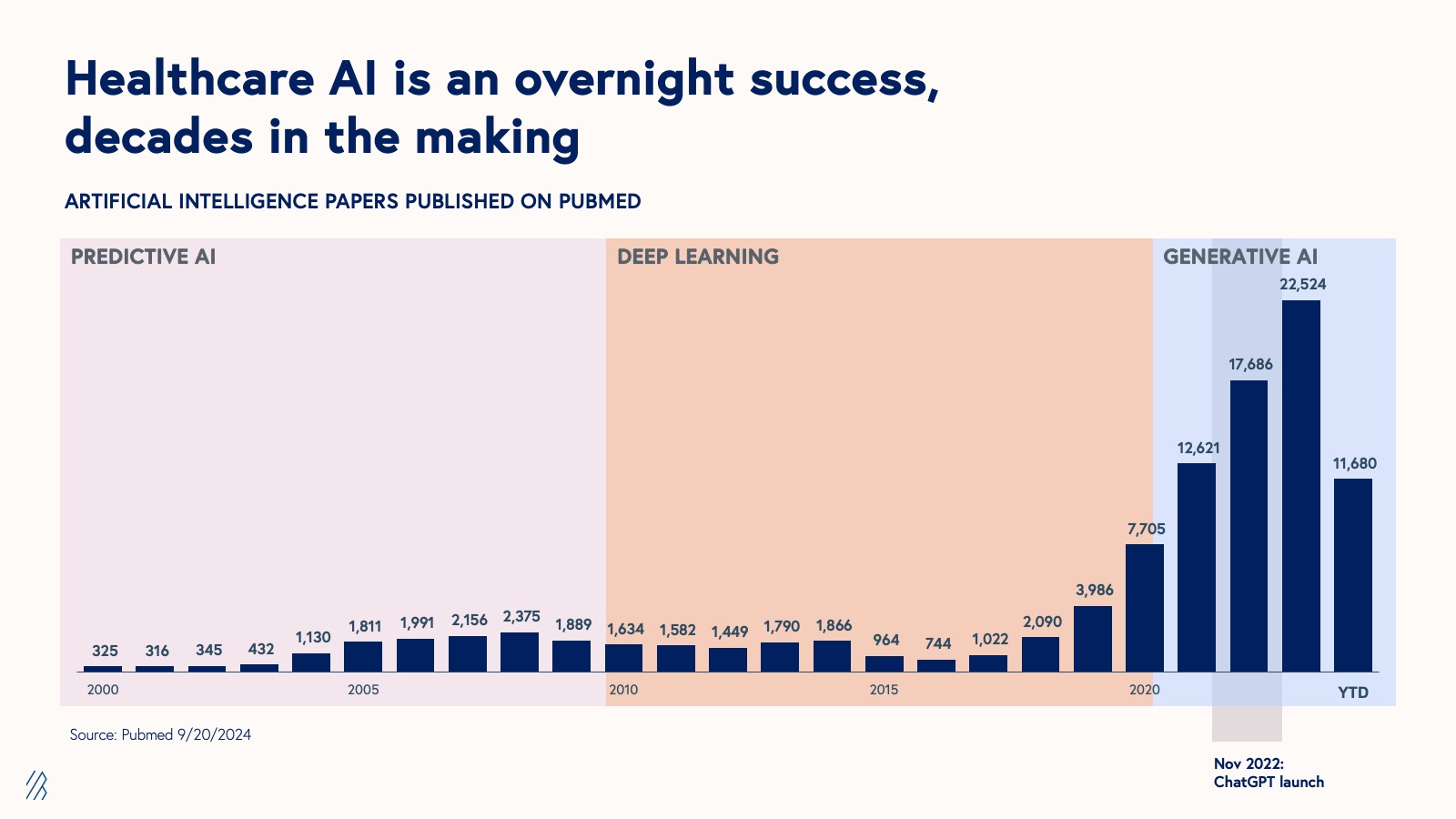
The healthcare industry stands on the precipice of a transformative era, driven by the integration of artificial intelligence (AI) into its core operations. This evolution is not a sudden phenomenon but the culmination of over eighty years of technological advancements and strategic innovations.
A recent article from Bessemer Venture Partners delves into this pivotal moment, highlighting how AI is reshaping markets and modern medicine. The demand for healthcare AI solutions is unprecedented, with a significant surge in interest from startups and established tech giants alike. This is not just hype; it’s a reflection of the tangible benefits AI brings to the table.
In a survey, 70% of healthcare providers and payers reported implementing generative AI, with expectations for continued investment growth. This trend underscores the sector’s readiness to embrace AI-driven efficiencies.
The groundwork for this AI revolution was laid through decades of investment in electronic health records (EHRs), which have digitized vast amounts of clinical and administrative data. This digital foundation is now fertile ground for AI applications, with nearly 40% of healthcare startups in 2024 focusing on AI technologies.
Healthcare AI’s potential extends from the micro-level, such as protein functions, to macro-level population health dynamics. As new data types emerge and AI research accelerates, the sector is poised for rapid evolution, aiming to solve real-world healthcare challenges.
However, this promising landscape is not without its challenges. Navigating complex regulations and market dynamics requires innovative solutions and strategic partnerships. Understanding these factors is crucial for startups aiming to thrive in this competitive environment.
The insights from the Bain Research and other sources suggest that both startups and incumbents stand to gain significantly as the market matures. This evolution promises not only economic growth but also enhanced patient care and systemic improvements in healthcare delivery.
Challenges and Opportunities
Despite the promising developments, AI startups in healthcare face numerous obstacles. The US healthcare system, bound by intricate regulations and misaligned incentives, presents a challenging landscape. Founders must be prepared for resistance to change, as innovation and pushback evolve in tandem.
Regulation, while a barrier to entry, also serves as an enduring moat for incumbents. The dense regulatory landscape creates obstacles for newcomers, but it also protects established players. Engaging in advocacy and lobbying work can help startups navigate this environment.
Moreover, the healthcare market is fragmented, with numerous smaller markets rather than a monolithic industry. Identifying and targeting the right sub-verticals is crucial for unlocking sufficient total addressable market (TAM).
The ongoing digital transformation and the advent of multimodal AI offer significant opportunities for healthcare. These technologies can diagnose diseases earlier, identify barriers to patient recovery, and enhance healthcare system efficiency.
Investment and Future Prospects
Bessemer Venture Partners has dedicated $1 billion to investments in AI companies, actively seeking promising new partners in this rapidly evolving field. The potential for AI to redefine healthcare is immense, with opportunities for startups to make a real difference for patients and healthcare professionals.
As the concept of a “learning healthcare system” becomes a reality, driven by AI, the industry is poised for a new era of continuous improvement and innovation. The journey from digital transformation to AI-driven healthcare is just beginning, and the best is yet to come.
More Articles
Getting licensed or staying ahead in your career can be a journey—but it doesn’t have to be overwhelming. Grab your favorite coffee or tea, take a moment to relax, and browse through our articles. Whether you’re just starting out or renewing your expertise, we’ve got tips, insights, and advice to keep you moving forward. Here’s to your success—one sip and one step at a time!
Financial analysis remains one of the strongest career paths for professionals seeking high earnings, steady growth, and long-term stability. With median salaries above $100K, expanding demand across industries, and clear promotion tracks leading to senior leadership roles, the field offers both opportunity and resilience—even as AI reshapes the workplace. This article breaks down what analysts do, salary expectations, job outlook, industry demand, and whether this career is the right fit for you.
After losing their home in the Los Angeles wildfires, Jessica and Matt Conkle expected their insurance policy to help them rebuild. Instead, they found themselves trapped in delays, lowball offers, and endless adjuster changes — a struggle now shared by thousands across California. Their experience highlights a nationwide problem: insurers pulling back from climate‑risk areas, soaring premiums, shrinking coverage, and regulators under fire. For professionals in real estate, mortgage, and insurance, this growing instability is reshaping transactions, lending, risk assessment, and the future of homeownership in America.
Kansas City’s housing market is finally gaining momentum heading into 2026 as falling interest rates, new construction, and a renewed focus on affordable homes open the door for first‑time buyers. Economists say improved supply and softer mortgage rates could shift the market after a challenging 2025, giving real estate professionals and buyers a promising window of opportunity.
Nevada has become the first state to allow insurers to sell homeowners policies without wildfire protection—a move aimed at lowering premiums but raising concerns about consumer risk and mortgage barriers. The law introduces new wildfire‑only policies and a regulatory sandbox for insurance innovation, potentially setting a precedent for other Western states.
Investment groups across the U.S. are rapidly expanding into tax‑deferred real estate programs as demand for Delaware Statutory Trusts (DSTs) accelerates. Major players like Blackstone, Brookfield, Denholtz, and PREP are launching new offerings fueled by stronger market certainty, a historic generational wealth transfer, and renewed confidence in 1031 exchange benefits. As DSTs move into the mainstream, real estate professionals are finding new opportunities to guide clients through advanced tax‑advantaged investment strategies.
Canada’s proptech sector is evolving fast as AI adoption accelerates and investor caution forces startups to mature. Funding has tightened, growth rounds have slowed, and companies are shifting from rapid expansion to profitability and real product‑market fit. AI‑driven platforms like Mave are gaining traction, consolidation is rising, and government housing initiatives may boost construction‑focused tech. For real estate professionals, these trends signal a new industry standard where AI tools and ongoing education are essential to staying competitive.