How the Biggest Players Shaped the 2025 Commercial Real Estate Market
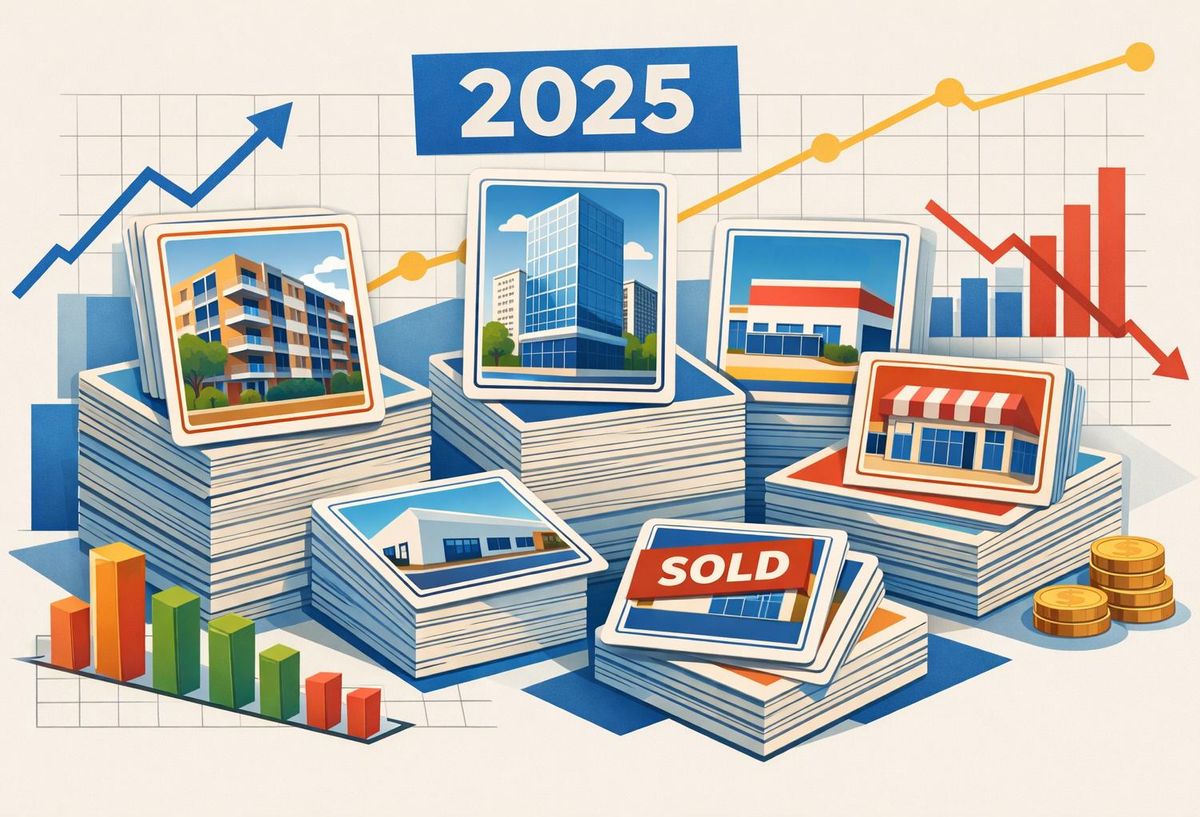
Commercial real estate finally thawed out in 2025. After years of sluggish deal volume and stubborn market uncertainty, investors pushed more than $255B into multifamily, industrial, office and retail assets. As major players recalibrated their strategies around interest rate shifts, political turbulence and evolving space demand, a clear theme emerged: opportunity waits for no one.
In today’s shifting professional landscape, understanding these market dynamics isn’t just valuable — it’s essential. Whether you’re deep in your real estate career or launching a new professional chapter through licensing programs, institutions like Cameron Academy help you stay sharp, agile and competitive.
According to a detailed analysis of CoStar data published by Bisnow, every major sector saw momentum build quarter after quarter in 2025. Interest rate cuts, moderating bond yields and a surprising willingness among investors to look past political and economic turbulence fueled this resurgence.
James Nelson of Avison Young described the landscape simply: “All asset classes are firing on all cylinders.” Despite trade disputes, AI concerns and geopolitical noise, investors weren’t waiting around. They moved decisively — and in enormous volume.
Multifamily: The Heavyweight Champion of 2025
With more than $115B in transactions, multifamily dominated 2025, representing nearly half of all CRE investment. The biggest mover? Harbor Group International, securing $2.5B in acquisitions spanning New England and the Sun Belt.
Competition tightened as institutional giants like FPA Multifamily, Cortland and CALSTRS fought for market share. Portfolio trades took center stage, signaling strong confidence in rental demand — particularly as homeownership affordability remains historically strained.
Even liquidation moves from firms such as Elme Communities and Aimco sent noticeable tremors through the sector, highlighting how quickly REIT strategies continue to evolve.
Industrial: Private Equity Takes the Wheel
Industrial real estate extended its winning streak into 2025, closing the year with nearly $62B in deals. EQT AB led the charge with $2.7B in acquisitions, showcasing widespread confidence in logistics and warehouse performance.
With four of the top 10 buyers focused exclusively on industrial assets, the sector remained a prime arena for private equity and global capital. Blackstone, Ares, Morgan Stanley and Norges Bank all made bold moves, further validating the resilience of logistics demand.
Blackstone alone offloaded $4.6B in assets — a striking figure reflecting its ongoing strategic rotation across markets like South Florida.
Office: Owner-Users Take the Stage
Office real estate saw an unexpected revival in 2025, driven largely by owner-user purchases. Total volume hit $47.2B as companies opted to buy, not lease, their spaces — a unique post-pandemic trend fueled by discounted pricing and widespread vacancy.
Apple topped all buyers with over $1B in Silicon Valley acquisitions, securing long-term control of several buildings it already occupied. Pacific Gas & Electric advanced its consolidation strategy with a $906M headquarters purchase in Oakland.
The State Teachers Retirement System of Ohio led all sellers with a massive $1.1B Manhattan disposition — bolstered by Elliott Investment Management and Apollo Global Management.
Retail: Resilient, Attractive and Investor-Friendly
Retail proved its durability in 2025, maintaining historically low vacancy levels despite major bankruptcies. Investors poured $5.4B into retail assets, driven by stable net lease opportunities and strong demand for grocery-anchored centers.
RCG Ventures closed the year’s largest retail deal — a $1.8B portfolio acquisition supported by Goldman Sachs, Koch Real Estate and Ares. Meanwhile, retail titan Simon Property Group invested $721M including a key Miami mall purchase.
Strategic Value Partners topped the seller charts with $1.4B in dispositions, spreading capital across a broad mix of buyers including Brixmor and Invesco.
The Bigger Picture for Professionals
The 2025 CRE narrative makes one thing clear: while headlines may highlight uncertainty, the professionals who understand market direction are the ones who win. Multifamily remains king, industrial continues its dominance, office redefines itself and retail demonstrates remarkable endurance.
For real estate agents, investors, mortgage professionals and specialists across countless industries, staying ahead of these shifts isn’t optional — it’s essential. That’s why institutions like Cameron Academy continue to play a critical role across Florida and the U.S., empowering professionals to upgrade, expand and elevate their careers.
As we move deeper into 2026, the market’s biggest players have already made their moves. Now the real question is: where will you plant your flag?
More Articles
Getting licensed or staying ahead in your career can be a journey—but it doesn’t have to be overwhelming. Grab your favorite coffee or tea, take a moment to relax, and browse through our articles. Whether you’re just starting out or renewing your expertise, we’ve got tips, insights, and advice to keep you moving forward. Here’s to your success—one sip and one step at a time!
Across the vast landscapes of rural America, a silent crisis brews—one that affects the mental well-being of millions. The shortage of mental health care providers, coupled with geographic isolation, has created a significant gap in mental health services. However, a glimmer of hope emerges through telehealth technology, promising to bridge this divide.
Artificial Intelligence (AI) is on the brink of revolutionizing the healthcare industry, promising to enhance patient care by making it more predictive, preventive, and personalized. Spearheading this transformation is Saeed Hassanpour, PhD, director of the Dartmouth Center for Precision Health and Artificial Intelligence (CPHAI). According to Hassanpour, AI's integration into healthcare will increase efficiency, accessibility, and diagnostic accuracy, fundamentally reshaping the landscape.
The housing market has been a rollercoaster of skyrocketing prices in recent years, leaving many potential homebuyers feeling overwhelmed. This surge in prices stems from the pandemic-driven migration to suburban areas and historically low interest rates.
AI is reshaping patient experience by making healthcare more accessible, efficient, and personalized. Through AI-assisted scheduling, virtual health assistants, and remote monitoring, patients receive care that is tailored to their specific needs, significantly reducing wait times and enhancing overall satisfaction.
The healthcare industry stands on the precipice of a transformative era, driven by the integration of artificial intelligence (AI) into its core operations.
The integration of visual technologies into healthcare heralds a new era of personalized medicine. These innovations offer unprecedented opportunities for investment and improvement in global health outcomes.