How the Biggest Players Shaped the 2025 Commercial Real Estate Market
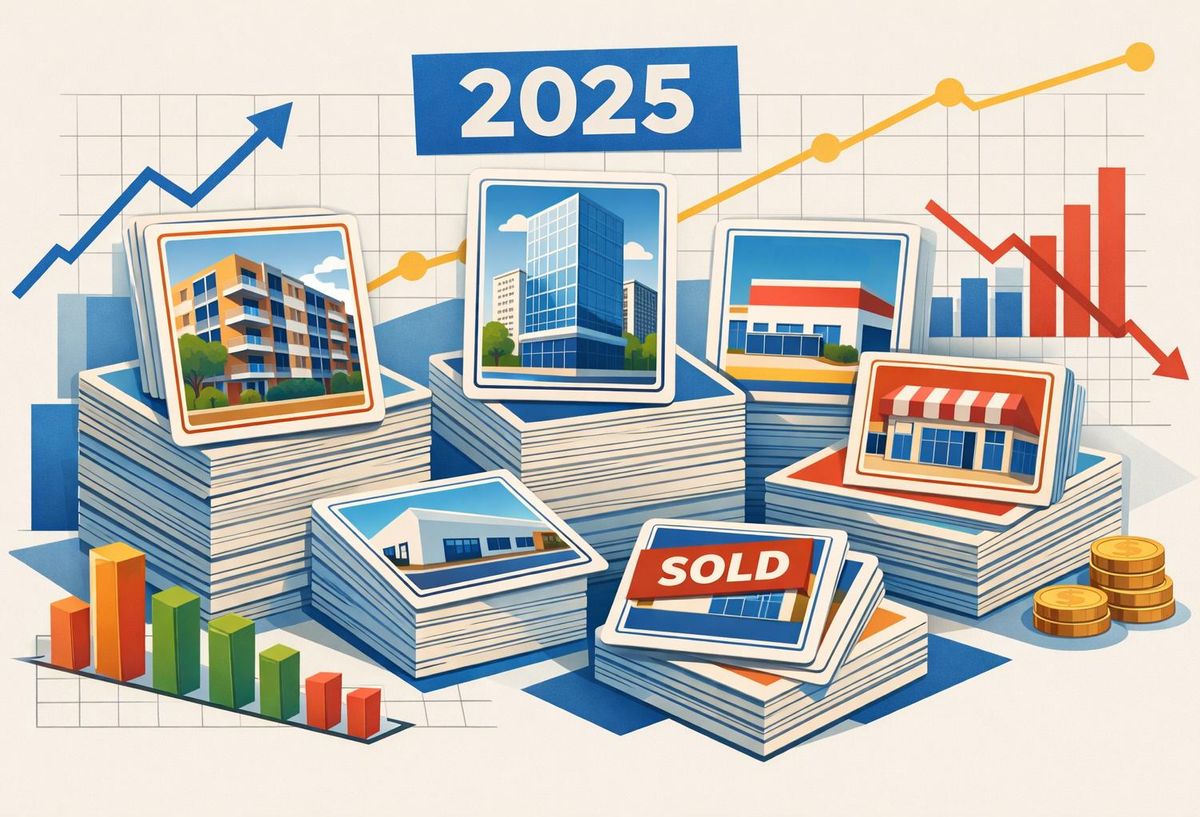
Commercial real estate finally thawed out in 2025. After years of sluggish deal volume and stubborn market uncertainty, investors pushed more than $255B into multifamily, industrial, office and retail assets. As major players recalibrated their strategies around interest rate shifts, political turbulence and evolving space demand, a clear theme emerged: opportunity waits for no one.
In today’s shifting professional landscape, understanding these market dynamics isn’t just valuable — it’s essential. Whether you’re deep in your real estate career or launching a new professional chapter through licensing programs, institutions like Cameron Academy help you stay sharp, agile and competitive.
According to a detailed analysis of CoStar data published by Bisnow, every major sector saw momentum build quarter after quarter in 2025. Interest rate cuts, moderating bond yields and a surprising willingness among investors to look past political and economic turbulence fueled this resurgence.
James Nelson of Avison Young described the landscape simply: “All asset classes are firing on all cylinders.” Despite trade disputes, AI concerns and geopolitical noise, investors weren’t waiting around. They moved decisively — and in enormous volume.
Multifamily: The Heavyweight Champion of 2025
With more than $115B in transactions, multifamily dominated 2025, representing nearly half of all CRE investment. The biggest mover? Harbor Group International, securing $2.5B in acquisitions spanning New England and the Sun Belt.
Competition tightened as institutional giants like FPA Multifamily, Cortland and CALSTRS fought for market share. Portfolio trades took center stage, signaling strong confidence in rental demand — particularly as homeownership affordability remains historically strained.
Even liquidation moves from firms such as Elme Communities and Aimco sent noticeable tremors through the sector, highlighting how quickly REIT strategies continue to evolve.
Industrial: Private Equity Takes the Wheel
Industrial real estate extended its winning streak into 2025, closing the year with nearly $62B in deals. EQT AB led the charge with $2.7B in acquisitions, showcasing widespread confidence in logistics and warehouse performance.
With four of the top 10 buyers focused exclusively on industrial assets, the sector remained a prime arena for private equity and global capital. Blackstone, Ares, Morgan Stanley and Norges Bank all made bold moves, further validating the resilience of logistics demand.
Blackstone alone offloaded $4.6B in assets — a striking figure reflecting its ongoing strategic rotation across markets like South Florida.
Office: Owner-Users Take the Stage
Office real estate saw an unexpected revival in 2025, driven largely by owner-user purchases. Total volume hit $47.2B as companies opted to buy, not lease, their spaces — a unique post-pandemic trend fueled by discounted pricing and widespread vacancy.
Apple topped all buyers with over $1B in Silicon Valley acquisitions, securing long-term control of several buildings it already occupied. Pacific Gas & Electric advanced its consolidation strategy with a $906M headquarters purchase in Oakland.
The State Teachers Retirement System of Ohio led all sellers with a massive $1.1B Manhattan disposition — bolstered by Elliott Investment Management and Apollo Global Management.
Retail: Resilient, Attractive and Investor-Friendly
Retail proved its durability in 2025, maintaining historically low vacancy levels despite major bankruptcies. Investors poured $5.4B into retail assets, driven by stable net lease opportunities and strong demand for grocery-anchored centers.
RCG Ventures closed the year’s largest retail deal — a $1.8B portfolio acquisition supported by Goldman Sachs, Koch Real Estate and Ares. Meanwhile, retail titan Simon Property Group invested $721M including a key Miami mall purchase.
Strategic Value Partners topped the seller charts with $1.4B in dispositions, spreading capital across a broad mix of buyers including Brixmor and Invesco.
The Bigger Picture for Professionals
The 2025 CRE narrative makes one thing clear: while headlines may highlight uncertainty, the professionals who understand market direction are the ones who win. Multifamily remains king, industrial continues its dominance, office redefines itself and retail demonstrates remarkable endurance.
For real estate agents, investors, mortgage professionals and specialists across countless industries, staying ahead of these shifts isn’t optional — it’s essential. That’s why institutions like Cameron Academy continue to play a critical role across Florida and the U.S., empowering professionals to upgrade, expand and elevate their careers.
As we move deeper into 2026, the market’s biggest players have already made their moves. Now the real question is: where will you plant your flag?
More Articles
Getting licensed or staying ahead in your career can be a journey—but it doesn’t have to be overwhelming. Grab your favorite coffee or tea, take a moment to relax, and browse through our articles. Whether you’re just starting out or renewing your expertise, we’ve got tips, insights, and advice to keep you moving forward. Here’s to your success—one sip and one step at a time!
Artificial intelligence has shifted from futuristic idea to everyday assistant for real estate professionals. Instead of replacing agents, AI now enhances their workflows—automating repetitive tasks, improving communication, strengthening branding, and turning complex market data into clear insights. From smarter CRMs to AI-powered marketing tools, today’s agents can focus more on relationships and client service while technology handles the busywork behind the scenes.
A Florida House committee is advancing a bill that would crack down on insurers shifting profits to affiliated companies — a practice highlighted by recent investigative reporting. With premiums soaring and options shrinking, the proposed oversight could reshape the state’s insurance landscape and create ripple effects across the real estate market, impacting buyers, agents, and investors statewide.
Proptech podcast *Tangent* marks its 100th episode with an inside look at Airbnb’s evolving role in multifamily housing. Featuring Airbnb Real Estate Marketing Leader Eliza Lochner, the episode explores the rapid growth of Airbnb‑friendly apartments, the rise of flexible‑living models, and why renters and property owners are increasingly embracing hosting as a way to balance affordability, transparency, and control. For today’s real estate professionals—especially in fast‑changing markets like Florida—the conversation highlights major shifts in tenant expectations, property management strategies, and the intersection of technology, hospitality, and residential development.
A Tampa Heights homeowner has joined the growing wave of Floridians dropping property insurance altogether after his 2026 renewal skyrocketed to $14,523. With up to 20% of residents now going bare, experts warn that soaring rates, shrinking coverage options, and post‑storm losses are pushing many to take risky measures — even as alternatives like liability‑only plans, dropped wind coverage, or home‑hardening upgrades may offer relief.
A major ERAS overhaul is coming in 2027, replacing the familiar “publications” field with a more rigorous category called “scholarly works.” Only peer‑reviewed submissions—such as manuscripts, abstracts, book chapters, and presentations—will qualify, shifting greater emphasis toward high‑quality research. While the change aims to give residency directors clearer insight into applicants’ academic contributions, many students worry that advocacy and policy work may lose visibility. As programs lean more heavily on research output in a post–Step 1 pass/fail era, future applicants will need to showcase not just what they’ve produced, but the depth and meaning behind it.
Mortgage rates have ticked back up to 6.25% after a brief dip, signaling a return to stability in the housing market. With rising inventory, moderating prices, and forecasts calling for steady rates through 2026, real estate and finance professionals can expect a more predictable environment ahead. This shift opens the door to smoother transactions, improved buyer confidence, and stronger opportunities for career growth across mortgage, real estate, insurance, and related fields.