Modernizing Medical Education: Embracing Public Health at the University of Dundee
In a world where healthcare and its education are undergoing seismic shifts, the University of Dundee is pioneering a transformative approach. The institution is integrating public health into its medical curriculum, responding to the rapid technological, political, and social changes reshaping the medical landscape. This initiative is detailed in a recent article published by Frontiers.
The article underscores the urgent need for medical education to evolve, highlighting the challenges posed by technological advancements, curriculum overload, and evolving medical practices. As non-communicable diseases rise, there’s a compelling economic argument for preventive medicine, which even corporations recognize. The University of Dundee’s curriculum overhaul aims to produce graduates ready for the demands of modern healthcare, emphasizing public health’s critical role.
The Role of Technology
Technological advancements, particularly in artificial intelligence and machine learning, are reshaping healthcare delivery. However, these innovations have yet to make a significant impact on medical education. The Topol review highlighted potential future changes, but current curricula lack comprehensive teaching on these topics. Dundee’s program addresses this gap, preparing students to navigate a tech-driven healthcare environment.
Curriculum Overload
Medical students face daunting amounts of information, with knowledge potentially doubling every few months. Standardized assessments and shared curricula are becoming more prevalent, emphasizing core scientific knowledge. Yet, there’s a growing recognition of the need for doctors to understand interpersonal communication, leadership, and teamwork. Dundee’s curriculum seeks to balance these elements, moving from a micro to a macro perspective.
Adapting to New Medical Practices
The role of doctors is changing, influenced by global health priorities and societal expectations. The COVID-19 pandemic highlighted the need for robust healthcare systems and the challenges of misinformation. Dundee’s curriculum aims to equip students with the skills to navigate these shifts, fostering adaptability and resilience.
Curriculum Review and Implementation
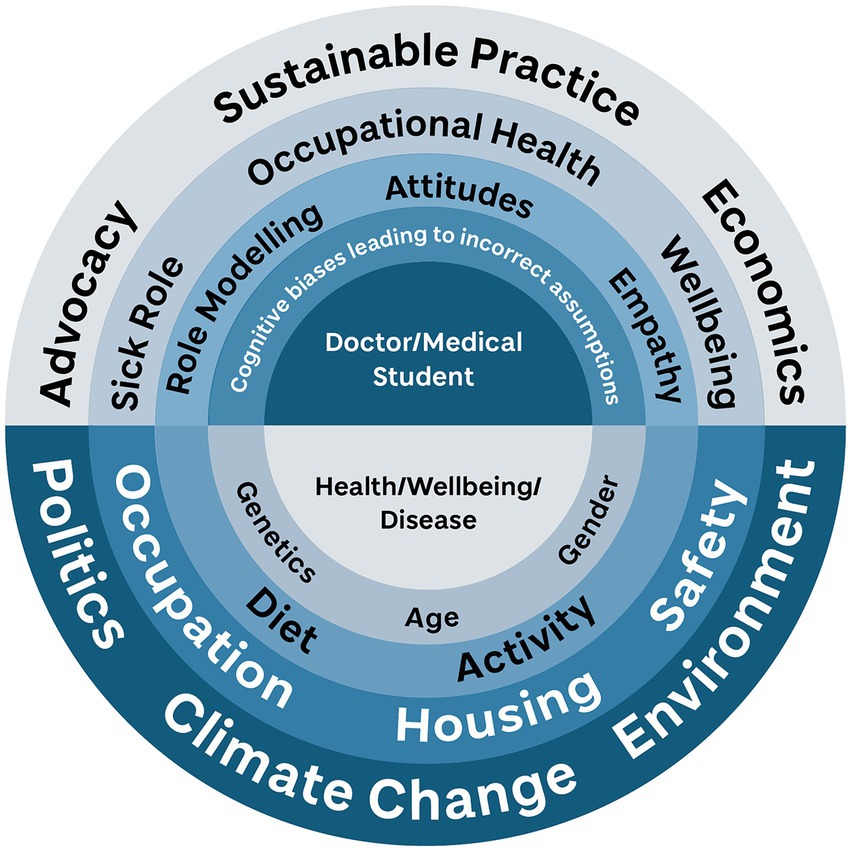
Dundee’s curriculum review, initiated before the pandemic, aims to facilitate transitions for learners, especially those from non-traditional backgrounds. Using the double diamond design methodology, the review involved stakeholders from various disciplines. The curriculum introduces two key strands: “The Bigger Picture” and “The Dundee Doctor.” The Bigger Picture emphasizes public health, encouraging students to understand social determinants of health and their role as healthcare providers. It integrates public health and behavioral sciences, fostering a deeper understanding of healthcare’s broader context. The Dundee Doctor represents the unique qualities of Dundee graduates, focusing on professional development and adaptability. It serves as a guiding framework for curriculum implementation, ensuring alignment with the institution’s values.
Challenges and Future Directions
Implementing changes in a constrained curriculum like medicine is challenging. Dundee’s approach aims for a “quiet revolution,” balancing core and elective elements to provide diverse learning opportunities. Formal evaluation of the new curriculum is underway, with anecdotal feedback indicating positive reception.
As healthcare continues to evolve, Dundee’s curriculum is designed to adapt, preparing students for future challenges. The article posits that medical education must continuously renew itself, fostering adaptable, socially conscious doctors.
More Articles
Getting licensed or staying ahead in your career can be a journey—but it doesn’t have to be overwhelming. Grab your favorite coffee or tea, take a moment to relax, and browse through our articles. Whether you’re just starting out or renewing your expertise, we’ve got tips, insights, and advice to keep you moving forward. Here’s to your success—one sip and one step at a time!
Palm Beach protests erupted as intensified immigration enforcement reached the heart of Trump’s hometown, while millions in Florida brace for rising health care costs as key subsidies near expiration. At the same time, state regulators boldly declare the long‑running property insurance crisis “over,” leaving homeowners and industry professionals questioning whether true stability has finally returned.
As 2025 comes to a close, the real estate industry is shifting from uncertainty to strategic expansion. According to DWS’s Year-End 2025 Outlook, property values are stabilizing after years of repricing, capital is concentrating on high-quality assets, and Sunbelt markets—especially Florida—continue to outperform. With technology enhancing rather than replacing professional expertise, 2026 is shaping up to reward professionals who stay informed, skilled, and strategically positioned for the next cycle.
Texas capital is pouring into San Francisco’s long‑struggling commercial real estate market, with Lone Star investors buying up discounted Union Square buildings and signaling what many experts believe is the city’s market bottom. As office activity and confidence begin to return, buyers from across the country are joining the rush, turning SF’s post‑pandemic slump into one of the nation’s hottest bargain opportunities.
With 2026 HousingWire Tech100 nominations closing on December 19, the housing tech sector is accelerating at full speed. AI‑powered data platforms, digital closing breakthroughs, embedded insurance growth, and next‑generation servicing automation are reshaping real estate, mortgage, insurance, and finance. From ATTOM’s AI‑ready property intelligence to Hapi Homes’ Martha Stewart design revival, Obie’s nationwide expansion, Outamation’s servicing automation, and ServiceLink’s next‑level borrower scheduling, this year’s standout innovators are defining the future of the housing economy.
Space Investment Partners has acquired the 123,402‑square‑foot Topanga Gateway retail center in Woodland Hills for $64 million, marking another significant move in the firm’s expanding grocery‑anchored investment strategy. Located at a high‑visibility intersection and 97% occupied at the time of sale, the property strengthens the company’s push toward $500 million to $1 billion in retail acquisitions for 2026, underscoring continued investor confidence in necessity‑based retail assets.
After the Federal Reserve’s final 2025 rate cut on December 10, mortgage markets are recalibrating, giving buyers and homeowners a glimmer of relief. Rates remain lower than earlier in the year, with 30-year fixed loans at 6.12% and refinances dipping as well. This shift may spark renewed activity for buyers, refinancers, and real estate professionals heading into 2026.