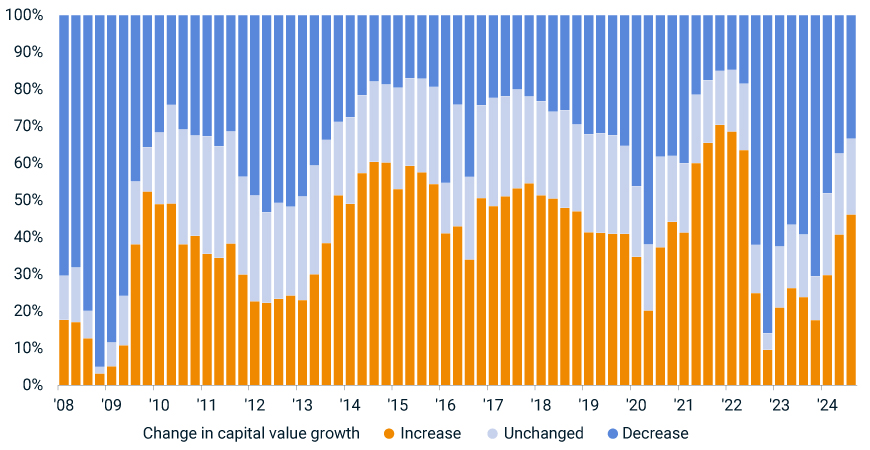
In the world of commercial real estate, optimism is cautiously building as we move further into 2025. The market correction that began in mid-2022 is showing signs of recovery, with interest rates declining and transactional activity stabilizing. This nascent recovery is not uniform, however, and varies across different segments of the market.
The recent downturn was driven by familiar cyclical factors such as rising rates and a reversal in overheated yield compression, compounded by structural changes like the shift in office use. As the market begins to recover, the pace will differ across sectors, presenting both opportunities and risks for investors.
Investors are increasingly focusing on emerging property types, driven by technological and demographic shifts, while others see value in traditional sectors at cyclical lows. The combination of debt-refinancing stress and the structural challenges of commodity-office assets is expected to continue influencing price discovery.
Active management and asset selection are becoming crucial as yield compression no longer provides a tailwind for returns. Understanding the key factors driving performance through attribution analysis will be vital in this environment.
Despite market-based risks, geopolitical and economic uncertainties persist, and climate risk remains a significant concern. The global economy’s drift away from net-zero targets raises fears of more frequent and severe climate-induced weather events, as highlighted by the multiple extreme-weather disasters of 2024.
Recovery — Not Everywhere All at Once
Two years after the slowdown began, the global property market is entering a recovery phase. Transaction volumes and values have bottomed out, and interest rates have peaked. In 2025, lower interest rates are expected to facilitate closer pricing alignment between buyers and sellers, improving liquidity.
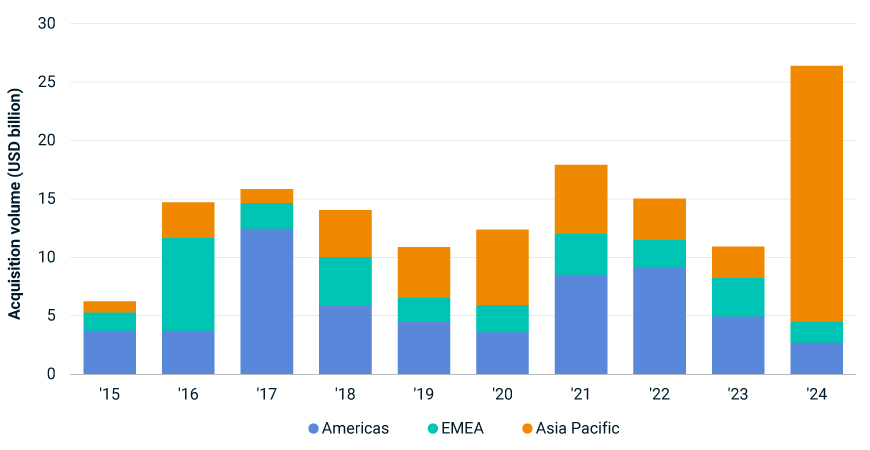
Investor preferences are shifting towards the living sector, industrial assets, and properties exposed to broader socioeconomic and technological changes. A notable transaction in 2024 was Blackstone Inc.’s $16 billion acquisition of data-center operator AirTrunk, underscoring the demand for data centers and new energy infrastructure.
Fundraising for property investment remains challenging, with low deal activity stalling distributions from closed-end funds. The emergence of private credit and the outperformance of debt versus equity funds have made debt a preferred route for many investors.
While the market has not experienced a major distress cycle like that of the 2008 financial crisis, distress levels are rising. This may aid recovery by providing opportunities for well-capitalized players to acquire assets at a discount.
Office and retail properties have suffered significant value destruction, deterring many investors. However, some players are returning, drawn by pockets of outperformance. Despite this, it is unlikely that aggregate deal volumes for these property types will return to long-term averages soon.
Investment Pendulum Swings Back to Asset Selection
As we enter a new investment cycle, the focus is increasingly on active asset selection and management. With evolving market conditions, the playbook for delivering returns is changing.
Selecting the right assets has always been crucial in commercial real estate. Unlike public equities, investors cannot simply buy the market. They must balance top-down allocation strategies with granular, bottom-up asset-selection and management decisions.
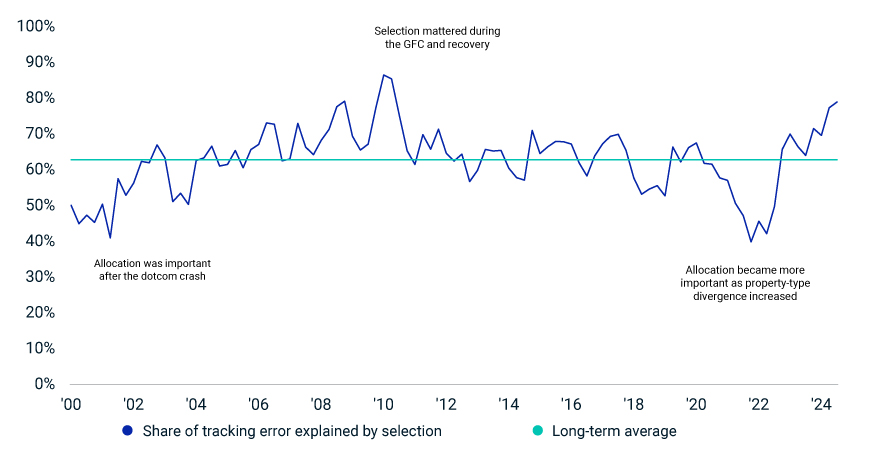
Attribution analysis can provide insights into the evolving nature of performance drivers. Evidence from the MSCI/PREA U.S. ACOE Quarterly Property Fund Index highlights this variability. Historically, selection accounted for around 63% of deviation from the benchmark among funds, but the influence of allocation and selection has shifted over time.
Underwater Assets Come to Light
Ongoing price declines and higher interest rates have cast doubt on some borrowers’ ability to repay or refinance commercial-property loans. In Europe, substantial corrections since mid-2022 have left many properties worth less than their acquisition prices, particularly those bought near the market’s peak in 2021.
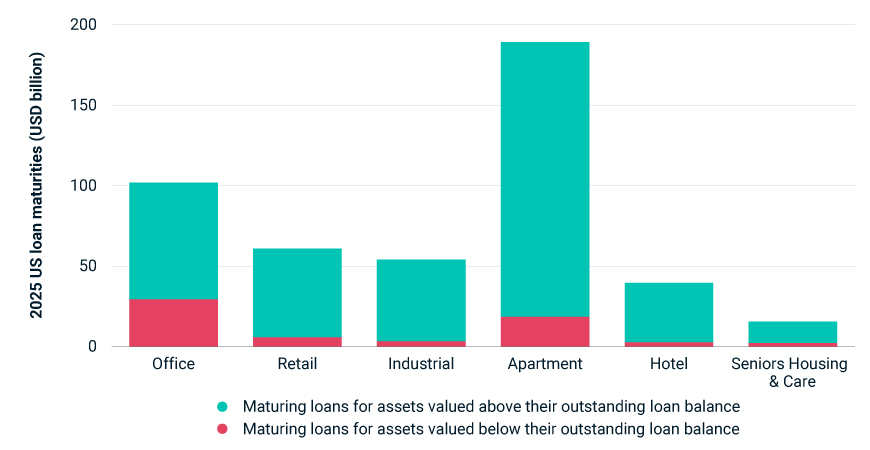
In the U.S., an estimated $500 billion of loans are set to mature in 2025. If these loans were to mature at Q3 2024 price levels, approximately 14% would be underwater, with asset values below outstanding loan balances.
U.S. offices face the bleakest refinancing prospects in 2025, with nearly 30% of maturing office loans associated with properties estimated to be worth less than the secured debt. The apartment market also faces challenges, with $19 billion worth of properties below loan values.
Investors Get to Grips with Physical Climate Risk
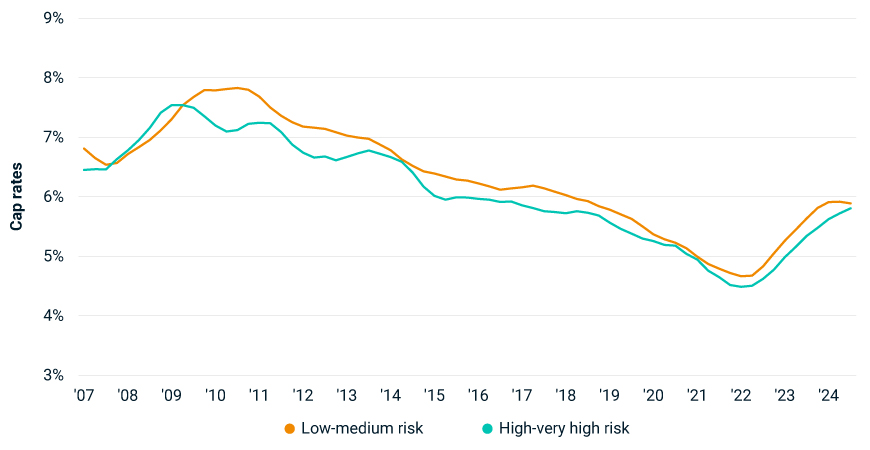
Extreme weather events are expected to become more common, potentially impacting real-estate values through higher insurance premiums and repair costs. The relationship between transaction yields and physical climate risk is being scrutinized, with higher-risk assets currently trading at a premium.
As climate risks intensify, pricing should adjust to reflect the increased threat to property values from extreme weather exposure. Investors can get a head start by considering climate-related risks in their portfolios.
Property Investors Seek a Ride on the AI Train
The rapid development of AI is driving demand for data centers. Blackstone’s acquisition of AirTrunk and other major investments highlight this trend. Data centers are seeing increased interest from generalist property investors, leading to a more diverse range of deal structures.
While the data-center market presents opportunities, it also carries unique risks. Operating a data center requires specific expertise, and data transparency is lower than for traditional property types. Investors with experience in the sector have a significant informational advantage.
For more detailed insights, you can refer to the original article on MSCI’s website.
More Articles
Getting licensed or staying ahead in your career can be a journey—but it doesn’t have to be overwhelming. Grab your favorite coffee or tea, take a moment to relax, and browse through our articles. Whether you’re just starting out or renewing your expertise, we’ve got tips, insights, and advice to keep you moving forward. Here’s to your success—one sip and one step at a time!
In a landmark decision, the court has preliminarily approved settlement agreements in the commission lawsuits involving real estate companies RE/MAX and Anywhere Real Estate. The agreements require RE/MAX to pay $55 million and Anywhere Real Estate to pay $83.5 million. As part of the settlements, both companies will implement significant policy and practice changes, including the elimination of the requirement for agents to be members of the National Association of Realtors. This change will provide agents with more flexibility and independence in their business practices. The settlements have far-reaching implications for the real estate industry, fostering a more dynamic and customer-centric real estate market.
The housing market saw a remarkable increase in housing starts and permits in October, pointing to a positive industry trend. This surge suggests a growing demand among Americans for homeownership, prompting builders to respond by ramping up their construction efforts. However, builder confidence has been somewhat dampened by elevated mortgage rates. The housing market's performance varied across different regions in the United States, highlighting the diverse nature of the housing market and the various factors influencing construction trends.
CUSO Home Lending has implemented Dark Matter Technologies' advanced Empower loan origination system, revolutionizing the credit union lending process. The Empower system streamlines loan applications, automates document collection and verification, and facilitates seamless communication between borrowers, loan officers, and underwriters. With robust security measures and full compliance with industry regulations, the system ensures the protection of sensitive information. This move highlights the importance of embracing digital transformation in the lending industry.
United Wholesale Mortgage (UWM), a leading wholesale lender in the mortgage industry, has launched a new initiative offering no-cost appraisals on 1-0 temporary rate buydowns. This strategic move aims to attract more brokers by covering up to $600 of the appraisal cost on all conventional and government-backed home loans. Temporary rate buydowns allow borrowers to pay a lower mortgage rate during the initial period of their loans, making homeownership more affordable. This limited-time opportunity until March 31 provides brokers with a unique value proposition for their clients. Ready to explore the benefits of UWM's temporary rate buydowns and no-cost appraisals? Connect with UWM today.
Mark Willis has made a significant leadership change by returning as the CEO of Keller Williams, a leading player in the real estate industry. This news marks a triumphant comeback for Willis, who previously served as the CEO of Keller Williams from 2005 to 2014. Armed with extensive experience and a proven track record, Willis aims to steer Keller Williams towards continued success and navigate the challenges facing the real estate industry. This article will delve into Willis' career history, the growth of Keller Williams under his leadership, and the current landscape of the real estate market.
A recent lawsuit in Texas has sent shockwaves through the real estate industry, shedding light on alleged collusion among individual brokers, real estate teams, and large corporate brokerages. The lawsuit, filed by the QJ Team and other plaintiffs, accuses these entities of artificially inflating real estate agent commissions. The real estate industry has been rocked by a series of commission lawsuits in recent years, but the QJ Team lawsuit stands out due to its comprehensive list of defendants. The QJ Team lawsuit alleges that the defendants engaged in collusion to artificially inflate real estate agent commissions, thereby restricting competition and harming consumers. The plaintiffs claim that these entities conspired to set and maintain high commission rates, limiting the ability of homebuyers and sellers to negotiate fair prices. If proven true, these allegations could have far-reaching consequences for the real estate industry in Texas.