Personalized Medicine Biomarker Market: A Billion-Dollar Revolution


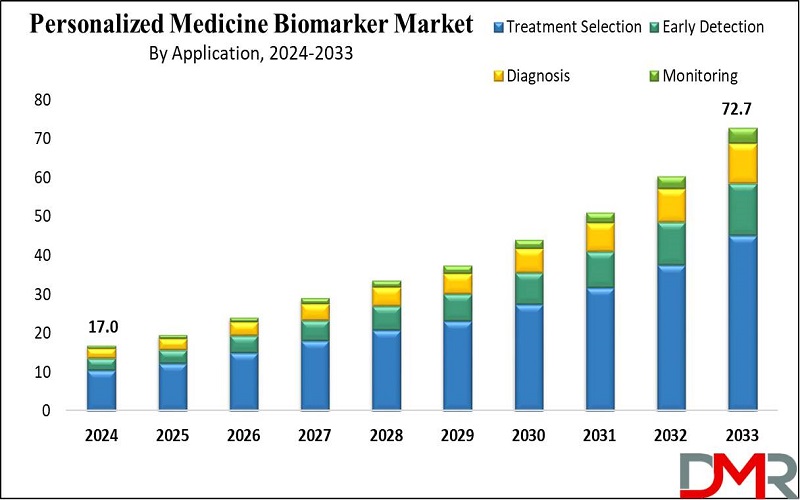
In a groundbreaking analysis released on July 1, 2024, GlobeNewswire sheds light on the transformative growth within the global personalized medicine biomarker sector. The report, curated by Dimension Market Research, forecasts the market to catapult from USD 17 billion in 2024 to a staggering USD 72.7 billion by 2033, marking a compound annual growth rate (CAGR) of 17.5%.
Global personalized medicine biomarker market growth

Market Dynamics and Projections


The personalized medicine biomarker market is a dynamic ecosystem, pivotal in tailoring treatments to individual patient characteristics. This approach optimizes therapeutic outcomes by leveraging genetic or molecular signatures to inform diagnosis and guide treatment decisions. The oncology sector is projected to dominate, commanding a significant 33.1% of the market share in 2024, driven by global cancer prevalence and advancements in genomic technologies.

Regional Insights


North America stands at the forefront, expected to hold 37.2% of the global market share in 2024. This dominance is attributed to the region’s robust biotech investments, advanced healthcare infrastructure, and a network of renowned research institutions. As North America leads, Europe and Asia-Pacific are not far behind, showing significant growth potential.

Technological Advancements


The report highlights several technological trends reshaping the market. Notably, advancements in genomic technologies like next-generation sequencing are driving biomarker identification, transforming personalized medicine globally. The rise of liquid biopsy technologies, particularly in oncology, offers non-invasive diagnostic methods, revolutionizing patient care.

Competitive Landscape


Key players such as Illumina, Roche Diagnostics, and Thermo Fisher Scientific are at the helm of this burgeoning market, leading in genomics, diagnostics, and biomarker discovery. Companies like Qiagen and Foundation Medicine enhance their market presence through strategic partnerships and collaborations, expanding their reach and forming alliances with healthcare providers and research institutions.

Challenges and Opportunities


Despite promising growth, the market faces challenges, including regulatory and ethical considerations that impact biomarker adoption. However, opportunities abound with the development of individualized therapeutic techniques and the integration of biomarkers into diagnostic algorithms, driving market expansion.

Recent Developments


Recent collaborations and innovations underscore the sector’s dynamic nature. For instance, in November 2023, Massive Bio partnered with Health in Code to advance personalized oncology treatments in Spain, emphasizing AI and genomic testing. Similarly, Ibex’s introduction of Galen™ Breast HER2 in September 2023, developed with AstraZeneca and Daiichi Sankyo, highlights the push towards precision in cancer pathology.

Conclusion


The personalized medicine biomarker market is poised for unprecedented growth, driven by technological advancements, strategic collaborations, and a global shift towards precision medicine. As the market evolves, it promises to redefine healthcare, offering tailored solutions that enhance patient outcomes across the globe.

More Articles

Getting licensed or staying ahead in your career can be a journey—but it doesn’t have to be overwhelming. Grab your favorite coffee or tea, take a moment to relax, and browse through our articles. Whether you’re just starting out or renewing your expertise, we’ve got tips, insights, and advice to keep you moving forward. Here’s to your success—one sip and one step at a time!

Real Estate Agents Embrace AI — But Confidence and Training Lag Behind

A new national survey shows that while most real estate agents now use AI for everyday tasks like writing listing descriptions and social posts, many remain uneasy trusting the technology with higher‑stakes responsibilities. Agents report major time savings and better communication thanks to AI, but lingering concerns about accuracy, compliance and data interpretation reveal a growing skills gap. The industry’s next big need: stronger AI tools, clearer standards and hands‑on training — a gap education providers like Cameron Academy are poised to fill.

Florida’s Property Insurance Crisis Is Spiraling—and Lawmakers Are Looking the Other Way

Florida homeowners and real estate professionals are being crushed by skyrocketing insurance premiums, shrinking coverage, and a claims system stacked against consumers. While residents face the highest insurance costs in the nation, meaningful reform bills are being ignored in Tallahassee, leaving families, businesses, and the entire real estate market exposed.

AI Forces Real Estate to Finally Fix Its Broken Data Systems

Artificial intelligence is exposing the real estate industry's biggest weakness: fragmented, inconsistent data scattered across disconnected systems. Unlike finance and e‑commerce, real estate never built a unified digital foundation—and now AI can’t function without one. As companies scramble to standardize information, organizations like OSCRE are pushing shared data models that could transform everything from leasing to property management. The result may be the industry’s most collaborative era yet, where clean, interoperable data becomes the key to unlocking AI’s full power.

Off‑Market Deals and Investor Demand Are Rewriting Residential Real Estate

Off‑market networks, rising small‑investor buying, regulatory shifts, and intensifying portal competition are reshaping how homes are found and sold. With inventory tight and traditional listings declining, agents who understand investor behavior, private deal flow, and evolving rules are gaining a major edge in today’s fast‑changing housing landscape.

Florida Homeowners Insurance Hits a “New Normal” as Costs Stay Painfully High

Despite state leaders celebrating stabilization, Florida homeowners continue to face some of the highest insurance premiums in the country. Local experts say rates have stopped skyrocketing but have settled at levels that feel permanently elevated—especially for older or coastal homes. With insurers still avoiding high‑risk areas and demanding costly home upgrades, many Floridians are questioning whether this expensive reality is here to stay.

New California Bill Would Require Insurers to Cover Homes Built to Wildfire‑Safety Standards

California is pushing a landmark proposal that would force insurers to offer coverage to homeowners who meet state‑approved wildfire‑mitigation standards. The new SB 1076, known as the Insurance Coverage for Fire‑Safe Homes Act, aims to stabilize the state’s distressed insurance market by guaranteeing coverage for fire‑hardened homes starting in 2028—backed by strict penalties for insurers who refuse. As supporters rally and critics warn of market strain, the bill could reshape real estate, insurance, and lending practices across wildfire‑prone regions.