Premium U.S. Properties Surge While Smaller Assets Struggle: Inside the New Two-Tier CRE Market
The U.S. commercial real estate landscape is entering a dramatic new phase—one where high-value, premium properties are steadily rising, while smaller assets in secondary markets are confronting stronger headwinds. Fresh numbers from the CoStar Commercial Repeat Sale Indices (CCRSI) reveal a market split in two, forming what analysts now call a two-tier commercial recovery.
Institutional investors continue to target major office towers, large-scale industrial sites and substantial retail centers, pushing top-tier properties to their sixth consecutive month of price increases with a 0.4% jump in November. Meanwhile, small investors and independent property owners are navigating falling valuations and softer demand in lower-tier markets.
This upward trend in premium assets is supported by the latest CoStar CCRSI monthly report, one of the industry’s most trusted repeat-sale indicators.
A Market Defined by Divide
The widening contrast between asset classes is largely due to the most constrained construction environment in over a decade. CoStar reports that commercial development has slowed to its lowest level since 2013, tightening supply even as demand softens. Forecasts indicate a net loss of 100 million square feet in occupied space for 2025—marking the toughest decline since the Great Recession.
The value-weighted U.S. Composite Index, which captures high-value trades, rose 1.1% this quarter. Meanwhile, the equal-weighted index—used to track smaller deals—fell 0.9% in November, underscoring the sharp divide in market performance.
Lower Rates Fuel Premium Sales
Interest rate cuts are reshaping investor behavior. With the U.S. Federal Reserve reducing rates three times since September, borrowing is now at its most affordable level in years. This shift particularly benefits institutional buyers who act quickly when financing conditions improve.
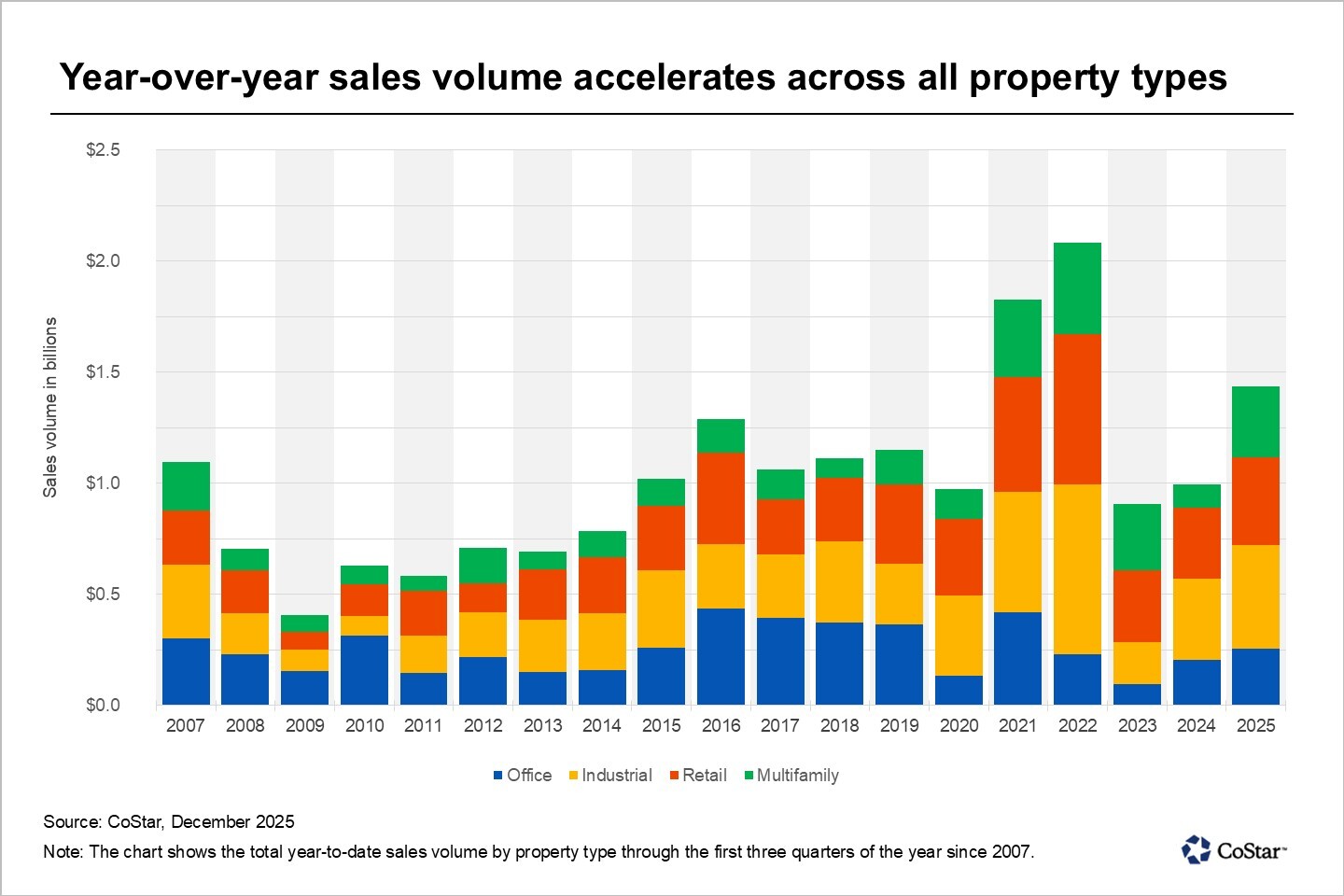
“Total sales volume for November was up more than 10% year over year,” said Chad Littell, CoStar’s national director of U.S. capital markets analytics. “We expect even more deals to surface by late December, with the full picture emerging in January.”
Construction Slowdown and Space Givebacks
For the first time since 2013, new property openings in Q4 have fallen below 100 million square feet. Looking ahead, completions across office, retail and industrial sectors are projected to decline 34.2% in 2025—dropping to 486.3 million square feet.
Net absorption is also expected to shrink by 100 million square feet next year, marking the most significant setback since 2009. Still, gradual demand improvements through late 2024 suggest that recovery could eventually extend beyond premium assets.
This month’s CCRSI findings were drawn from 1,049 repeat-sale pairs in November and a dataset of more than 335,000 tracked sales since 1996—one of the richest in the commercial real estate world.
What This Means for Real Estate Professionals
For real estate agents, investors and professionals entering the industry, these changes highlight the importance of understanding market cycles, capital flows and asset-tier performance. Premium properties might be gaining momentum, but transitional markets often hold the greatest long-term opportunity.
If you’re pursuing real estate licensing, continuing education or expanding your investment knowledge, platforms like Cameron Academy offer modern, flexible pathways to stay ahead of the industry. With commercial real estate shifting rapidly, staying informed isn’t just beneficial—it’s essential.
More Articles
Getting licensed or staying ahead in your career can be a journey—but it doesn’t have to be overwhelming. Grab your favorite coffee or tea, take a moment to relax, and browse through our articles. Whether you’re just starting out or renewing your expertise, we’ve got tips, insights, and advice to keep you moving forward. Here’s to your success—one sip and one step at a time!
In 2026, financial advisors are no longer just experimenting with AI — they’re relying on it. Once confined to back-office duties, AI now supports meeting prep, portfolio analysis, and even early-stage financial planning. Advisors say the tech is strengthening client relationships by freeing them from administrative overload, though entry-level roles like paraplanners may feel the squeeze as automation accelerates.
Cybercriminals are weaponizing AI to launch highly convincing email scams and system breaches across the mortgage industry, overwhelming lenders and servicers whose cybersecurity measures can’t keep up. With major companies already hit and regulation lagging behind, experts warn the sector—now considered critical infrastructure—must rapidly upgrade protections, collaborate on threat intelligence, and improve AI governance before the risks escalate further.
Escrow payments are quietly surging across the country as property taxes and insurance premiums spike—pushing many homeowners toward delinquencies and even foreclosure. New data from Cotality shows the sharpest increases hitting the South and Midwest, with Florida among the hardest‑hit states. Even with fixed mortgage rates, rising escrow requirements are driving monthly payments higher and threatening affordability heading into 2026.
Milwaukee entered 2025 with renewed momentum, posting its strongest commercial real estate sales volume in three years. After a period of uncertainty and high capital costs, investors are returning with a sharper focus on quality assets, realistic pricing, and reliable cash flow. Activity is increasing across industrial, office, multifamily, and retail sectors, signaling a broad-based recovery fueled by stabilizing interest rates and improved market confidence.
As 2026 approaches, the title insurance industry is navigating a complex mix of market recovery, rising fraud threats, and sweeping regulatory changes. Industry leaders say the path forward centers on smarter technology, leaner operations, and stronger support for title agents. With AI-driven workflows, enhanced fraud prevention, and new compliance demands—including FinCEN’s expanded Geographic Targeting Orders—companies like Stewart and First American are reshaping how title work gets done. For real estate and mortgage professionals, the year ahead promises more automation, heightened standards, and major opportunities for those who stay ahead of the curve.
The real estate industry is undergoing a major transformation in 2025 as advancements in AI, proptech, blockchain, and data intelligence redefine how properties are marketed, valued, financed, and experienced. From instant digital valuations and immersive virtual tours to tokenized investments and predictive analytics, technology is reshaping every stage of the real estate lifecycle. Professionals who embrace these innovations—while maintaining the human expertise clients still rely on—will lead the next era of the industry.