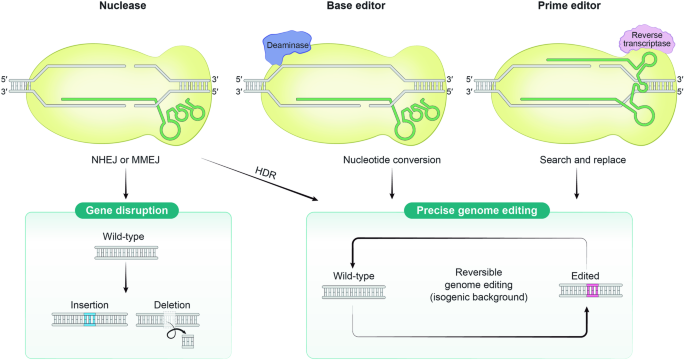
In the ever-evolving world of genetic research, the spotlight is now firmly on the groundbreaking capabilities of CRISPR-Cas technology. As highlighted in a recent Nature article, the integration of CRISPR-based genome editing with high-throughput sequencing technologies is revolutionizing our understanding of disease-associated genetic variants.
Unlocking the Secrets of Genetic Variants
For years, scientists have grappled with the challenge of deciphering the role of genetic mutations, particularly those classified as variants of unknown significance (VUSs). These mutations, often linked to human diseases, have remained elusive due to limited knowledge about their impact on cellular phenotypes. However, the advent of CRISPR-Cas technology is changing the game.
CRISPR-Cas, a precise genome editing tool, allows researchers to manipulate specific DNA sequences with unprecedented accuracy. As noted by Wang and Doudna, this technology is not just a tool but a gateway to understanding the genetic influences on diseases. By facilitating the study of both protein-coding and noncoding regions of the genome, CRISPR-Cas offers a comprehensive approach to unraveling the genetic underpinnings of various conditions.
The Power of High-Throughput Sequencing
The marriage of CRISPR technology with high-throughput sequencing has opened new avenues for functional genomics research. Techniques like Illumina and Oxford Nanopore Technology (ONT) are enabling the detailed analysis of genetic mutations on a massive scale. This integration allows scientists to conduct high-throughput screens, analyzing the functions of numerous genetic mutations simultaneously.
Moreover, advancements in single-cell sequencing are enhancing the granularity of genetic studies. By examining individual cells, researchers can gain deeper insights into the specific effects of genetic knockouts and the global changes in gene expression they induce.
CRISPR’s Role in Precision Medicine
The implications of these advancements are profound, particularly in the realm of precision medicine. By providing a detailed understanding of genetic variants, CRISPR-Cas technology holds the potential to transform diagnostic and therapeutic approaches. Researchers are now able to create isogenic disease models, facilitating the accurate analysis of phenotypic changes resulting from specific genetic mutations.
Furthermore, the ability to study noncoding regions and regulatory elements expands the scope of genetic research, offering new possibilities for therapeutic interventions targeting genetic disorders at their root.
Challenges and Future Directions
Despite its promise, CRISPR technology is not without challenges. The efficiency of gene editing varies, and the risk of unintended genomic alterations remains a concern. However, ongoing research and technological advancements continue to address these limitations, paving the way for broader applications in various fields.
As the scientific community delves deeper into the world of CRISPR-based functional genomics, the potential for groundbreaking discoveries is immense. With each new development, we move closer to a future where precision medicine is not just a possibility but a reality.
More Articles
Getting licensed or staying ahead in your career can be a journey—but it doesn’t have to be overwhelming. Grab your favorite coffee or tea, take a moment to relax, and browse through our articles. Whether you’re just starting out or renewing your expertise, we’ve got tips, insights, and advice to keep you moving forward. Here’s to your success—one sip and one step at a time!
Florida’s property insurance market is finally showing signs of recovery after years of soaring premiums, litigation chaos, and insurer withdrawals. With rate increases now the lowest in the nation, Citizens Insurance shrinking, and new carriers re‑entering the state, Insurance Commissioner Michael Yaworsky says the market is turning a corner. But while stabilization is underway, many homeowners are still asking why premiums haven’t dropped—and the answer lies in skyrocketing replacement costs, not rates. As reforms continue and AI, transparency rules, and mitigation incentives expand, real estate and insurance professionals should prepare for an evolving landscape that directly impacts affordability, buyer behavior, and long‑term market confidence.
In a candid conversation with Mortgage Professional America, NAMB president Kimber White lays out a series of structural reforms aimed at restoring homeownership access for millions of Americans. From revitalizing down payment assistance to rethinking loan-level price adjustments and incentivizing builders, White argues that meaningful affordability relief is achievable—but only through coordinated policy changes that address both costs and inventory shortages.
Artificial intelligence is rapidly transforming the insurance world, but a major power struggle is unfolding over who gets to regulate it. As insurers adopt AI at record speed, state regulators and the federal government are clashing over oversight authority—especially after a new executive order aims to put Washington in charge. With states pushing back and new evaluation tools on the horizon, the future of AI in insurance is becoming one of the biggest regulatory battles professionals need to watch.
A new CBRE Investor Intentions Survey shows that 2026 is shaping up to be a strong year for commercial real estate, with 95 percent of investors planning to buy more assets and over half increasing their capital allocation. Stabilizing pricing, improving market fundamentals, and expectations of cooling debt costs are driving renewed optimism as investors target high‑growth markets like Dallas, Atlanta, Tampa, and Charlotte, while doubling down on multifamily, industrial, and value‑add strategies.
Lofty has introduced Lofty AOS, the first agentic AI operating system built to autonomously manage real estate workflows—from lead engagement to marketing, transactions, and website creation. Unlike traditional AI that waits for prompts, Lofty’s system operates like a full digital workforce, coordinating tasks across specialized AI agents. As this technology transforms daily operations for agents and brokerages, professionals with strong training and licensing will become even more essential.
The Federal Reserve has started 2026 by keeping interest rates unchanged, despite political pressure, stubborn inflation, and a cooling job market. While consumers don’t pay the federal funds rate directly, its effects ripple through mortgages, credit cards, auto loans, and savings accounts. Mortgage affordability remains tight, credit card APRs are easing slowly, auto loan balances are climbing, and savings yields are one of the few bright spots. For real estate, mortgage, and finance professionals, understanding these shifts is essential as the market braces for another complex year.