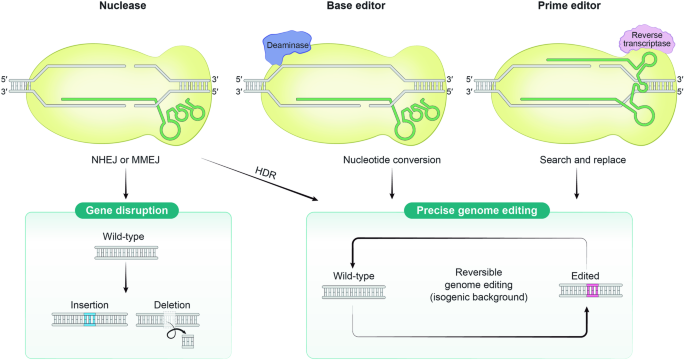
In the ever-evolving world of genetic research, the spotlight is now firmly on the groundbreaking capabilities of CRISPR-Cas technology. As highlighted in a recent Nature article, the integration of CRISPR-based genome editing with high-throughput sequencing technologies is revolutionizing our understanding of disease-associated genetic variants.
Unlocking the Secrets of Genetic Variants
For years, scientists have grappled with the challenge of deciphering the role of genetic mutations, particularly those classified as variants of unknown significance (VUSs). These mutations, often linked to human diseases, have remained elusive due to limited knowledge about their impact on cellular phenotypes. However, the advent of CRISPR-Cas technology is changing the game.
CRISPR-Cas, a precise genome editing tool, allows researchers to manipulate specific DNA sequences with unprecedented accuracy. As noted by Wang and Doudna, this technology is not just a tool but a gateway to understanding the genetic influences on diseases. By facilitating the study of both protein-coding and noncoding regions of the genome, CRISPR-Cas offers a comprehensive approach to unraveling the genetic underpinnings of various conditions.
The Power of High-Throughput Sequencing
The marriage of CRISPR technology with high-throughput sequencing has opened new avenues for functional genomics research. Techniques like Illumina and Oxford Nanopore Technology (ONT) are enabling the detailed analysis of genetic mutations on a massive scale. This integration allows scientists to conduct high-throughput screens, analyzing the functions of numerous genetic mutations simultaneously.
Moreover, advancements in single-cell sequencing are enhancing the granularity of genetic studies. By examining individual cells, researchers can gain deeper insights into the specific effects of genetic knockouts and the global changes in gene expression they induce.
CRISPR’s Role in Precision Medicine
The implications of these advancements are profound, particularly in the realm of precision medicine. By providing a detailed understanding of genetic variants, CRISPR-Cas technology holds the potential to transform diagnostic and therapeutic approaches. Researchers are now able to create isogenic disease models, facilitating the accurate analysis of phenotypic changes resulting from specific genetic mutations.
Furthermore, the ability to study noncoding regions and regulatory elements expands the scope of genetic research, offering new possibilities for therapeutic interventions targeting genetic disorders at their root.
Challenges and Future Directions
Despite its promise, CRISPR technology is not without challenges. The efficiency of gene editing varies, and the risk of unintended genomic alterations remains a concern. However, ongoing research and technological advancements continue to address these limitations, paving the way for broader applications in various fields.
As the scientific community delves deeper into the world of CRISPR-based functional genomics, the potential for groundbreaking discoveries is immense. With each new development, we move closer to a future where precision medicine is not just a possibility but a reality.
More Articles
Getting licensed or staying ahead in your career can be a journey—but it doesn’t have to be overwhelming. Grab your favorite coffee or tea, take a moment to relax, and browse through our articles. Whether you’re just starting out or renewing your expertise, we’ve got tips, insights, and advice to keep you moving forward. Here’s to your success—one sip and one step at a time!
In a landmark decision, the court has preliminarily approved settlement agreements in the commission lawsuits involving real estate companies RE/MAX and Anywhere Real Estate. The agreements require RE/MAX to pay $55 million and Anywhere Real Estate to pay $83.5 million. As part of the settlements, both companies will implement significant policy and practice changes, including the elimination of the requirement for agents to be members of the National Association of Realtors. This change will provide agents with more flexibility and independence in their business practices. The settlements have far-reaching implications for the real estate industry, fostering a more dynamic and customer-centric real estate market.
The housing market saw a remarkable increase in housing starts and permits in October, pointing to a positive industry trend. This surge suggests a growing demand among Americans for homeownership, prompting builders to respond by ramping up their construction efforts. However, builder confidence has been somewhat dampened by elevated mortgage rates. The housing market's performance varied across different regions in the United States, highlighting the diverse nature of the housing market and the various factors influencing construction trends.
CUSO Home Lending has implemented Dark Matter Technologies' advanced Empower loan origination system, revolutionizing the credit union lending process. The Empower system streamlines loan applications, automates document collection and verification, and facilitates seamless communication between borrowers, loan officers, and underwriters. With robust security measures and full compliance with industry regulations, the system ensures the protection of sensitive information. This move highlights the importance of embracing digital transformation in the lending industry.
United Wholesale Mortgage (UWM), a leading wholesale lender in the mortgage industry, has launched a new initiative offering no-cost appraisals on 1-0 temporary rate buydowns. This strategic move aims to attract more brokers by covering up to $600 of the appraisal cost on all conventional and government-backed home loans. Temporary rate buydowns allow borrowers to pay a lower mortgage rate during the initial period of their loans, making homeownership more affordable. This limited-time opportunity until March 31 provides brokers with a unique value proposition for their clients. Ready to explore the benefits of UWM's temporary rate buydowns and no-cost appraisals? Connect with UWM today.
Mark Willis has made a significant leadership change by returning as the CEO of Keller Williams, a leading player in the real estate industry. This news marks a triumphant comeback for Willis, who previously served as the CEO of Keller Williams from 2005 to 2014. Armed with extensive experience and a proven track record, Willis aims to steer Keller Williams towards continued success and navigate the challenges facing the real estate industry. This article will delve into Willis' career history, the growth of Keller Williams under his leadership, and the current landscape of the real estate market.
A recent lawsuit in Texas has sent shockwaves through the real estate industry, shedding light on alleged collusion among individual brokers, real estate teams, and large corporate brokerages. The lawsuit, filed by the QJ Team and other plaintiffs, accuses these entities of artificially inflating real estate agent commissions. The real estate industry has been rocked by a series of commission lawsuits in recent years, but the QJ Team lawsuit stands out due to its comprehensive list of defendants. The QJ Team lawsuit alleges that the defendants engaged in collusion to artificially inflate real estate agent commissions, thereby restricting competition and harming consumers. The plaintiffs claim that these entities conspired to set and maintain high commission rates, limiting the ability of homebuyers and sellers to negotiate fair prices. If proven true, these allegations could have far-reaching consequences for the real estate industry in Texas.