Smart Home Energy Management Devices: A Market Poised for Growth
The Global Smart Home Energy Management Device Market is on the brink of a significant transformation, driven by escalating demands for energy-efficient solutions and the increasing adoption of smart home technologies. As consumers become more conscious of the importance of energy conservation, fueled by environmental concerns and rising energy costs, the market is set for a promising trajectory.
Government initiatives play a crucial role in promoting sustainable practices and integrating renewable energy sources, further accelerating the market’s expansion. Technological advancements, particularly in artificial intelligence and IoT connectivity, have enhanced these devices’ capabilities, making them more intuitive and user-friendly.
North America: Leading the Charge
North America has emerged as the dominant region in the Global Smart Home Energy Management Device Market, a position it is expected to maintain. This strong market presence is attributed to high consumer awareness about energy conservation, widespread adoption of smart home technologies, and supportive government initiatives. The region’s well-established IoT infrastructure and prevalent home automation systems have significantly contributed to the widespread adoption of these devices.
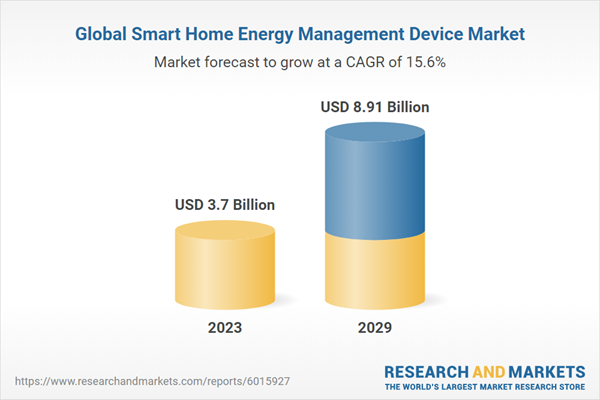
Despite the promising growth, challenges such as integration complexities, data security concerns, and high initial costs persist. However, the future looks bright as innovations continue to shape the industry. According to a report, the market value is expected to rise from $3.7 billion in 2023 to $8.91 billion by 2029, marking a compound annual growth rate of 15.6%.
Key Market Drivers and Challenges
Drivers: Increasing consumer awareness, advancements in IoT technology, government initiatives, and the integration of renewable energy sources.
Challenges: Interoperability and integration complexity, data security and privacy concerns, limited consumer awareness, and high initial costs.
Looking Ahead
As the market continues to evolve with innovative product offerings and increasing consumer demand, North America is expected to maintain its leadership position. This growth will drive the Global Smart Home Energy Management Device Market in the coming years, contributing significantly to the global shift towards sustainable living.
For more information, visit the original report.
More Articles
Getting licensed or staying ahead in your career can be a journey—but it doesn’t have to be overwhelming. Grab your favorite coffee or tea, take a moment to relax, and browse through our articles. Whether you’re just starting out or renewing your expertise, we’ve got tips, insights, and advice to keep you moving forward. Here’s to your success—one sip and one step at a time!
A Leon County judge has ordered Florida’s administrative courts to restart arbitration on more than 400 stalled Citizens Insurance cases, reigniting a legal showdown over whether the state’s insurer of last resort can force policyholders out of traditional courtrooms. The ruling directly conflicts with a separate Hillsborough County injunction that called Citizens’ arbitration system “likely unconstitutional,” setting up a rare judicial clash that could reshape how Floridians fight denied or underpaid property claims.
Inhabit has launched a powerful new suite of AI‑driven tools designed to modernize leasing, strengthen fraud prevention, and simplify compliance for property managers nationwide. From advanced leasing assistants and NYC‑specific regulatory AI to instant income verification and upcoming identity‑screening tech, these innovations aim to solve some of the industry’s toughest challenges. Real estate professionals—especially in multifamily—can expect faster operations, stronger safeguards, and a more efficient workflow as these technologies roll out.
A growing body of demographic research suggests that today’s housing shortage may give way to a future surplus as millions of Baby Boomer–owned homes return to the market over the next two decades. With affordability at historic lows and inventory still tight, this long‑term shift could eventually cool prices and transform the landscape for real estate professionals. The analysis draws parallels to aging populations abroad and highlights why understanding demographic cycles is becoming essential knowledge for agents, brokers, and mortgage professionals preparing for the next era of the housing market.
Griffin Funding has appointed John Jones as Senior Vice President of Growth and EOS Integrator, a move aimed at accelerating the lender’s push toward $3 billion in annual non‑QM loan volume by 2030. Jones, previously the company’s fractional integrator and COO, will lead expansion strategies, operational optimization, and leadership development as the lender strengthens its position in the increasingly competitive non‑QM market.
A new report shows Tampa outperforming the national real estate slowdown with a 6.5 percent annualized multifamily return, nearly 20 percent higher than the U.S. average. While many metros face oversupply or regulatory drag, Tampa’s balanced development pipeline, strong population growth, and investor confidence continue to fuel resilient performance heading into 2026.
A new Colliers outlook reveals that global capital is picking up momentum again, with investors shifting toward more active, hands‑on strategies. Data centers are surging, offices are rebounding, and value‑add plays like adaptive reuse are defining the next wave of opportunity. Regional markets—from the U.S. to APAC—are seeing renewed demand as fundraising spreads across continents and investors seek speed, control, and scale. This snapshot helps today’s real estate and finance professionals stay aligned with where global money is moving next.