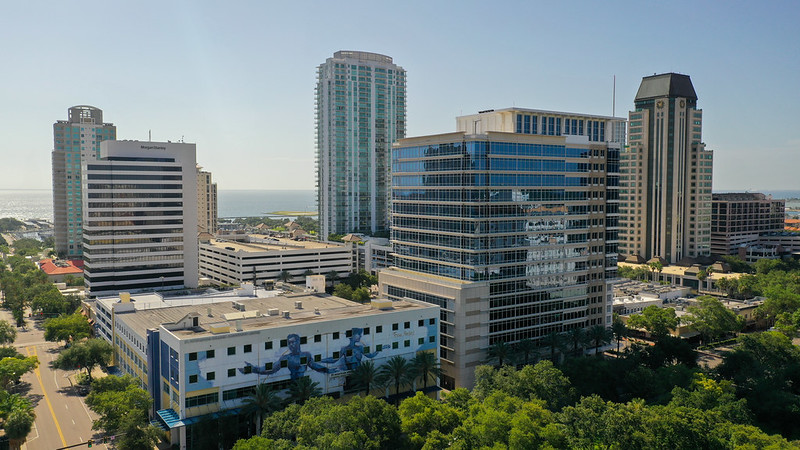
Tampa Bay’s Office Market Closes 2025 with Power Moves and Rising Demand
If you’ve been wondering whether the Tampa Bay office market still has momentum after the last few years of national uncertainty, JLL’s newest Q4 2025 analysis has a clear answer: absolutely. Tampa Bay just wrapped its strongest performance since before the pandemic, marking one of the most impressive post‑recovery surges in the country.
The report — published by global real estate leader JLL and highlighted by the St. Pete Catalyst — reveals a powerful combination of rising demand, shrinking inventory, and firming rents. While many U.S. cities continue battling stubborn vacancies, Tampa Bay appears to be accelerating.
Record Absorption, Falling Vacancy & a Tightening Market
The headline number is stunning: Tampa Bay recorded 600,400 square feet of positive net absorption in 2025 — the highest total since 2016. This pushed the overall vacancy rate down 130 basis points to 15.7%.
Momentum snowballed throughout the year, with more than 150,000 square feet absorbed in each of the final three quarters. This performance places Tampa Bay among the top U.S. office markets for year‑end absorption.
The Plot Twist: Inventory Is Shrinking
Even though developers delivered 176,400 square feet of new office product, the region’s total inventory actually declined by more than 750,000 square feet in 2025. Older buildings were demolished or converted, tightening the pipeline and boosting competition for modern space.
By year’s end, total available space had dipped below 8.6 million square feet, reflecting a significant year‑over‑year contraction.
Big Leases Set the Stage for 2026
Two major commitments dominated headlines: Fisher Investments leased 322,000 square feet at Renaissance Office Park, while GEICO claimed 189,000 square feet at Corporate Oaks Office Park.
Neither tenant has fully occupied their space yet — meaning early 2026 could show even stronger absorption numbers.
Flight to Quality Reshapes the Region
Across Tampa CBD, Westshore, and downtown St. Pete, tenants continue gravitating toward modern, amenity‑rich offices. Trophy and Class A vacancy fell to 14.7% — the strongest since 2022 — with six of seven submarkets posting year‑over‑year improvements.
Absorption in top‑tier buildings reached roughly 368,000 square feet, driving vacancy down to just 12.9%. Rents followed, rising 7.1% to an average of $45.46 per square foot.
What It Means for Tenants, Investors & Professionals
Tenants are increasingly willing to pay premium rates for newer buildings, better amenities, and stronger locations. With downtown St. Pete offering limited inventory, competition is expected to sharpen.
For investors and landlords, rising rents and shrinking supply signal a long‑awaited swing toward leverage.
Looking Ahead: Rising Confidence in 2026
JLL’s outlook for 2026 is cautiously optimistic. With economic diversity, strong employers, and limited new construction, Tampa Bay’s office market seems poised for continued strength — and potentially higher rents.
Put simply, Tampa Bay isn’t just recovering — it’s redefining its trajectory.
If this momentum inspires you to elevate your real estate career, consider sharpening your skills with Cameron Academy — Florida’s trusted hub for professional licensing education.
More Articles
Getting licensed or staying ahead in your career can be a journey—but it doesn’t have to be overwhelming. Grab your favorite coffee or tea, take a moment to relax, and browse through our articles. Whether you’re just starting out or renewing your expertise, we’ve got tips, insights, and advice to keep you moving forward. Here’s to your success—one sip and one step at a time!
After years of sharp increases and shrinking coverage options, Florida’s home insurance market is showing its strongest signs of recovery yet. Multiple insurers are proposing significant premium cuts for 2026 — some in the double digits — as storm‑loss data improves and private carriers re‑enter the state. Citizens Insurance is also seeking its first broad rate reduction in a decade, potentially lowering costs for millions of homeowners. This shift could boost affordability and confidence across Florida’s real estate and mortgage markets heading into the new year.
An AI company that began in a bedroom is now shaking the foundations of the lending industry. Salient, led by CEO Ari Malik, has skyrocketed to a $500 million valuation by fixing one of finance’s messiest problems: debt servicing. With zero customer churn, 100% pilot-to-contract conversions, and AI agents reportedly 30 times more compliant than humans, Salient is redefining how lenders manage loans. Its rapid rise highlights a new era where trust, regulation‑ready AI, and deep industry understanding are becoming essential for professionals across real estate, mortgage, finance, and insurance.
Redmond, Washington is tackling its housing crisis with Prisma, a six‑story, transit‑oriented development built on discounted surplus land from Sound Transit. The project will deliver 328 deeply affordable units—most reserved for households earning 50 percent of AMI or less, including families and people with disabilities. Enabled by a rare cross‑sector funding partnership, Prisma showcases how cities can combine transit investment, public resources, and private support to create long‑term, equitable housing solutions.
Citizens Property Insurance Corp. is recommending rate decreases for millions of Florida homeowners in 2026, marking the first potential premium drop in over a decade. If approved by state regulators, personal-line policies would fall an average of 2.6%, with some homeowners seeing reductions up to 11.5%. The shift reflects growing market stability driven by recent insurance reforms and increased private‑sector participation, though not all counties will benefit equally.
Despite alarming headlines, experts say AI isn’t the true driver behind Wall Street job cuts. Major banks like JPMorgan and Goldman Sachs are trimming staff, but economists point to post‑pandemic overhiring and economic uncertainty—not robots—as the real cause. While banks are investing heavily in AI tools, actual AI‑driven layoffs remain minimal. Instead, AI is slowing new hiring, reshaping roles, and pushing professionals across finance, real estate, and other industries to upskill rather than fear replacement.
Artificial intelligence is reshaping the real estate industry in 2025, powering a new surge of growth and maturity in the proptech sector. AI tools once considered experimental—such as predictive analytics, automated valuations, and digital transaction platforms—are now becoming essential to real estate, mortgage, insurance, and finance workflows. With rising investor confidence and widespread professional adoption, AI‑driven proptech is transforming how the industry operates and what skills modern professionals need to stay competitive.