Tampa Bay’s Office Market Closes 2025 with Power Moves and Rising Demand
If you’ve been wondering whether the Tampa Bay office market still has momentum after the last few years of national uncertainty, JLL’s newest Q4 2025 analysis has a clear answer: absolutely. Tampa Bay just wrapped its strongest performance since before the pandemic, marking one of the most impressive post‑recovery surges in the country.
The report — published by global real estate leader JLL and highlighted by the St. Pete Catalyst — reveals a powerful combination of rising demand, shrinking inventory, and firming rents. While many U.S. cities continue battling stubborn vacancies, Tampa Bay appears to be accelerating.
Record Absorption, Falling Vacancy & a Tightening Market
The headline number is stunning: Tampa Bay recorded 600,400 square feet of positive net absorption in 2025 — the highest total since 2016. This pushed the overall vacancy rate down 130 basis points to 15.7%.
Momentum snowballed throughout the year, with more than 150,000 square feet absorbed in each of the final three quarters. This performance places Tampa Bay among the top U.S. office markets for year‑end absorption.
The Plot Twist: Inventory Is Shrinking
Even though developers delivered 176,400 square feet of new office product, the region’s total inventory actually declined by more than 750,000 square feet in 2025. Older buildings were demolished or converted, tightening the pipeline and boosting competition for modern space.
By year’s end, total available space had dipped below 8.6 million square feet, reflecting a significant year‑over‑year contraction.
Big Leases Set the Stage for 2026
Two major commitments dominated headlines: Fisher Investments leased 322,000 square feet at Renaissance Office Park, while GEICO claimed 189,000 square feet at Corporate Oaks Office Park.
Neither tenant has fully occupied their space yet — meaning early 2026 could show even stronger absorption numbers.
Flight to Quality Reshapes the Region
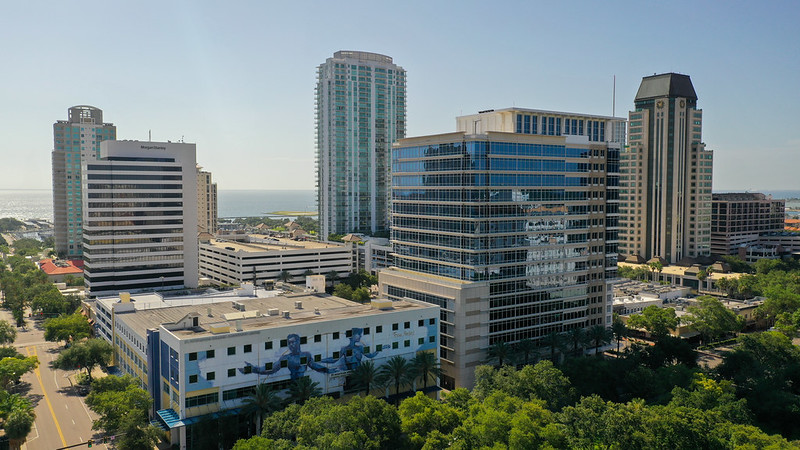
Across Tampa CBD, Westshore, and downtown St. Pete, tenants continue gravitating toward modern, amenity‑rich offices. Trophy and Class A vacancy fell to 14.7% — the strongest since 2022 — with six of seven submarkets posting year‑over‑year improvements.
Absorption in top‑tier buildings reached roughly 368,000 square feet, driving vacancy down to just 12.9%. Rents followed, rising 7.1% to an average of $45.46 per square foot.
What It Means for Tenants, Investors & Professionals
Tenants are increasingly willing to pay premium rates for newer buildings, better amenities, and stronger locations. With downtown St. Pete offering limited inventory, competition is expected to sharpen.
For investors and landlords, rising rents and shrinking supply signal a long‑awaited swing toward leverage.
Looking Ahead: Rising Confidence in 2026
JLL’s outlook for 2026 is cautiously optimistic. With economic diversity, strong employers, and limited new construction, Tampa Bay’s office market seems poised for continued strength — and potentially higher rents.
Put simply, Tampa Bay isn’t just recovering — it’s redefining its trajectory.
If this momentum inspires you to elevate your real estate career, consider sharpening your skills with Cameron Academy — Florida’s trusted hub for professional licensing education.
More Articles
Getting licensed or staying ahead in your career can be a journey—but it doesn’t have to be overwhelming. Grab your favorite coffee or tea, take a moment to relax, and browse through our articles. Whether you’re just starting out or renewing your expertise, we’ve got tips, insights, and advice to keep you moving forward. Here’s to your success—one sip and one step at a time!
At the 2025 Florida Chamber Insurance Summit, Insurance Commissioner Mike Yaworsky announced that Florida’s long‑volatile insurance market has at last regained stability. After a decade marked by runaway litigation, inflated claims, and insurer exits, the sweeping tort and insurance reforms passed in 2022 and 2023 have reversed the decline. Litigation has fallen to pre‑2019 levels, new carriers and reinsurers are entering the state, and consumers now have more options than they’ve seen in years. Yaworsky cautioned, however, that rolling back these reforms would undo the progress and impose massive costs on Floridians.
Driving with an expired license is illegal in nearly every state, and in 2025 the consequences are more serious than most people realize. From fines and potential jail time to denied insurance claims and professional repercussions, even a simple lapse can create a ripple effect—especially for licensed professionals in real estate, insurance, mortgage, and finance. This quick morning read breaks down the real penalties, why professionals should pay attention, and how to renew your license before it becomes a costly mistake.
A new wave of chat‑based AI tools is reshaping how quickly real estate professionals can prepare and enhance listing photos. By simply describing changes—like brightening a kitchen, removing clutter, or fully staging a room—agents and property managers can produce high‑impact images in minutes. This technology not only speeds up market readiness but also boosts renter and buyer engagement by presenting spaces at their full potential from the very first glance.
The rental market is gearing up for major shifts in 2026, from rising compliance demands and surging insurance costs to the rapid adoption of AI‑powered property management tools. Tenants’ expectations are evolving just as quickly, pushing owners to deliver lifestyle‑driven communities rather than simple lease agreements. Investors and operators who embrace technology, stay ahead of regulatory changes and prioritize renter experience will be best positioned to thrive in the coming year.
Artificial intelligence is transforming real estate at lightning speed, turning days of manual work into minutes of automated insight. With the AI real estate market projected to soar from $222.65B in 2024 to over $975B by 2029, professionals who understand this technology now will lead the industry tomorrow. From smarter valuations to automated workflows and predictive analytics, AI is redefining how agents, investors, and property managers operate—making today the perfect time to embrace the tools shaping the future of real estate.
As AI takes over the repetitive tasks that slow agents down, industry expert Matt Britton says the future of real estate belongs to professionals who combine intelligent automation with irreplaceable human trust. Speaking to thousands at NAR NXT 2025, Britton emphasized that the next wave of success will come from agents who embrace AI workflows while doubling down on what technology can’t replicate: empathy, creativity, and meaningful client relationships.