The 2024 Housing Shortage: Why America Is Still Millions of Homes Behind
If you’ve been wondering why listings disappear in minutes, rent keeps climbing, or why your buyers are still battling bidding wars in 2024—well, there’s a simple answer: we’re still not building enough homes. According to new data highlighted by Eye On Housing and the National Association of Home Builders (NAHB), the U.S. remains structurally undersupplied by approximately 1.2 million housing units. And yes, that means both renters and homeowners are feeling the squeeze.
Vacancy Rates Reveal the Real Story
Vacancy rates are the pulse of the housing market, and right now that pulse is racing. In 2022, rental vacancies plummeted to 5.1%, the lowest level in decades. Even after a surge in multifamily construction in 2024 pushed vacancies up slightly to 5.7%, the rate remains well below the long‑term average of 6.6%.
On the homeowner side, things are even tighter. Owner vacancy rates dropped to a historic low of 0.8% in 2023 and still sit below 1% today—far below the post‑2005 norm of 1.8%. This shortage of for-sale homes is a major driver behind rising prices and fierce competition.
Why Builders Can’t Keep Up
Multifamily development may be growing, but single‑family construction continues to be held back by long-standing obstacles:
Restrictive zoning regulations
Limited land availability
Persistent labor shortages
These barriers leave builders unable to keep pace with demand, especially in fast‑growing regions where population churn and new household formation are increasing rapidly.
Which Areas Are Feeling It the Most?
Not all metro areas are created equal. Some markets naturally have higher vacancy rates—particularly those with strong seasonal tourism or mobile workforces. For example, rental vacancies in Panama City, FL, and Sebastian‑Vero Beach, FL, have hovered around 20% for nearly two decades. Myrtle Beach goes even higher, averaging about 28%.
By contrast, several California metros, including Santa Barbara, San Jose, and Los Angeles, often report vacancy rates below 4%—a clear sign of long-term supply pressure.
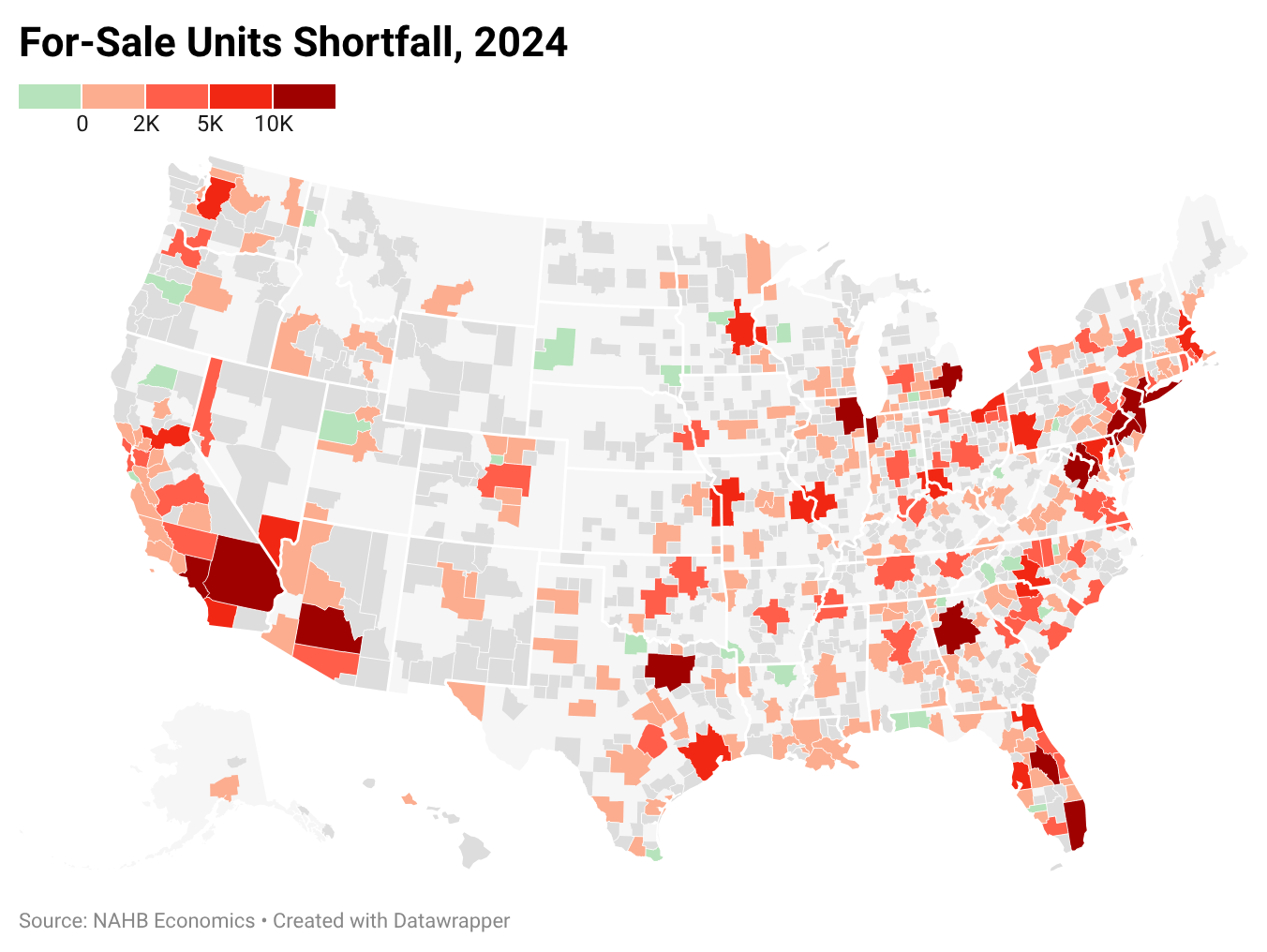
But when it comes to the biggest raw shortages, the largest metro areas dominate. Chicago‑Naperville‑Elgin alone needs nearly 40,000 rental units just to return to normal vacancy levels. New York and Philadelphia each require roughly 20,000 additional rentals.
For for‑sale homes, markets like Chicago, Atlanta, New York, and Phoenix show some of the steepest deficits—areas where returning to equilibrium would require tens of thousands of additional homes.
The True Shortage May Be Even Bigger
While NAHB’s estimate of 1.2 million missing units is substantial, it’s actually a conservative figure. It doesn’t account for:
Young adults living with parents
Overcrowded or shared households
Obsolete homes needing replacement
Taking these factors into account would push the real shortfall even higher, underscoring the continued national need for new construction. NAHB forecasts that rebalancing could occur between 2026 and 2030, but that depends heavily on sustained building.
What This Means for Real Estate Professionals
For agents, brokers, mortgage specialists, appraisers, and investors, this shortage presents both challenges and opportunities. Tight inventory means increased competition—but it also means long‑term demand for new listings, new builds, and educated professionals who understand today’s complex market landscape.
At Cameron Academy, we proudly help students and seasoned professionals across Florida and the U.S. enter, grow, and excel in real estate careers. Whether you’re beginning your license journey or advancing your expertise, understanding trends like these keeps you ahead of the curve.
This article is based on reporting from Eye On Housing and NAHB’s latest national analysis.
More Articles
Getting licensed or staying ahead in your career can be a journey—but it doesn’t have to be overwhelming. Grab your favorite coffee or tea, take a moment to relax, and browse through our articles. Whether you’re just starting out or renewing your expertise, we’ve got tips, insights, and advice to keep you moving forward. Here’s to your success—one sip and one step at a time!
The Real Estate Board of New York (REBNY) has announced a new policy requiring sellers to directly pay the buyer's agent, effective from January 1. This significant shift aims to enhance transparency and address potential conflicts of interest in real estate transactions. The policy comes amidst ongoing lawsuits related to commission sharing and allegations of unethical practices. The implementation of this policy is expected to impact the real estate industry significantly, with sellers needing to factor in the cost of the buyer's agent commission when pricing their properties.
In a significant development, the U.S. Senate has voted to block the implementation of the Consumer Financial Protection Bureau's (CFPB) small business lending rule. This decision has sparked a heated debate over the impact it may have on small businesses across the country. President Biden, in response, has threatened to veto the Senate's decision, emphasizing his commitment to fair lending practices and supporting small businesses. The CFPB's rule, implemented in October 2020, requires lenders to collect and report data on small business lending. This includes information on the race, sex, and ethnicity of borrowers, with the aim of identifying and addressing potential disparities in access to credit for minority-owned and women-owned small businesses. The Senate's decision to block the CFPB's rule has been celebrated by small business advocates and industry groups critical of the CFPB's regulatory approach. However, the implications of this decision remain uncertain, as President Biden's threatened veto looms large.
The world of real estate has recently been shaken by a wave of class-action commission lawsuits, sparking a contentious debate. These lawsuits demand scrutiny to understand their implications and validity. A primary counter-argument is the freedom of consumer choice. In today's digital age, potential buyers and sellers have access to a wealth of online resources, enabling them to undertake real estate transactions independently. Another critical factor is the negotiability of commissions in the real estate sector. Commission rates are not fixed, they are subject to negotiation between the agent and the client. This flexibility allows for open discussions, leading to mutually agreeable terms. Despite the emergence of discount brokerage firms, consumers continue to place their trust in traditional real estate agents. This preference stems not only from cost considerations but also from the value of expertise, guidance, and personalized service that agents offer. Real estate transactions are complex and often involve significant financial investments. Trusted agents provide invaluable insights, market knowledge, and negotiation skills, helping clients make informed decisions and navigate potential challenges confidently.
In the last two years, the housing market has seen a dramatic shift. Soaring mortgage rates and rising home prices have led to the fastest erosion in housing market affordability in modern history, with first-time homebuyers feeling the impact the most. The housing market has undergone significant changes over the past two years, leading to a substantial increase in the income required to purchase a median-priced home. According to recent data from Redfin, a homebuyer must now earn $114,627 to afford the typical U.S. home. This is a 15% increase from the previous year and more than 50% higher than pre-pandemic levels.
The housing market has shown remarkable resilience in the face of rising mortgage rates. Despite rates reaching 8%, new listings data remains steady, indicating a healthy supply of homes for sale. This stability is a positive sign for both buyers and sellers, demonstrating the strength of the housing market. Despite the increase in mortgage rates, sellers in the housing market have maintained their confidence. This confidence is reflected in the steady new listing data, as sellers continue to list their properties without hesitation. It indicates that sellers believe there is still strong demand from buyers and that the potential financial impact of higher mortgage rates does not outweigh the benefits of selling their homes.
The Real Estate Board of New York (REBNY) has introduced a groundbreaking requirement for sellers to directly compensate buyers' agents. This significant change has the potential to transform the real estate industry, eliminating conflicts of interest and promoting a more client-centric approach. This shift in the compensation landscape aims to create a more transparent and trustworthy environment for buyers. Moreover, this shift towards a client-centric approach aligns with the mission and values of Cameron Academy. As a leading provider of real estate education, Cameron Academy is committed to empowering professionals to navigate the evolving industry landscape and prioritize the best interests of their clients.