The 2024 Housing Shortage: Why America Is Still Millions of Homes Behind
If you’ve been wondering why listings disappear in minutes, rent keeps climbing, or why your buyers are still battling bidding wars in 2024—well, there’s a simple answer: we’re still not building enough homes. According to new data highlighted by Eye On Housing and the National Association of Home Builders (NAHB), the U.S. remains structurally undersupplied by approximately 1.2 million housing units. And yes, that means both renters and homeowners are feeling the squeeze.
Vacancy Rates Reveal the Real Story
Vacancy rates are the pulse of the housing market, and right now that pulse is racing. In 2022, rental vacancies plummeted to 5.1%, the lowest level in decades. Even after a surge in multifamily construction in 2024 pushed vacancies up slightly to 5.7%, the rate remains well below the long‑term average of 6.6%.
On the homeowner side, things are even tighter. Owner vacancy rates dropped to a historic low of 0.8% in 2023 and still sit below 1% today—far below the post‑2005 norm of 1.8%. This shortage of for-sale homes is a major driver behind rising prices and fierce competition.
Why Builders Can’t Keep Up
Multifamily development may be growing, but single‑family construction continues to be held back by long-standing obstacles:
Restrictive zoning regulations
Limited land availability
Persistent labor shortages
These barriers leave builders unable to keep pace with demand, especially in fast‑growing regions where population churn and new household formation are increasing rapidly.
Which Areas Are Feeling It the Most?
Not all metro areas are created equal. Some markets naturally have higher vacancy rates—particularly those with strong seasonal tourism or mobile workforces. For example, rental vacancies in Panama City, FL, and Sebastian‑Vero Beach, FL, have hovered around 20% for nearly two decades. Myrtle Beach goes even higher, averaging about 28%.
By contrast, several California metros, including Santa Barbara, San Jose, and Los Angeles, often report vacancy rates below 4%—a clear sign of long-term supply pressure.
But when it comes to the biggest raw shortages, the largest metro areas dominate. Chicago‑Naperville‑Elgin alone needs nearly 40,000 rental units just to return to normal vacancy levels. New York and Philadelphia each require roughly 20,000 additional rentals.
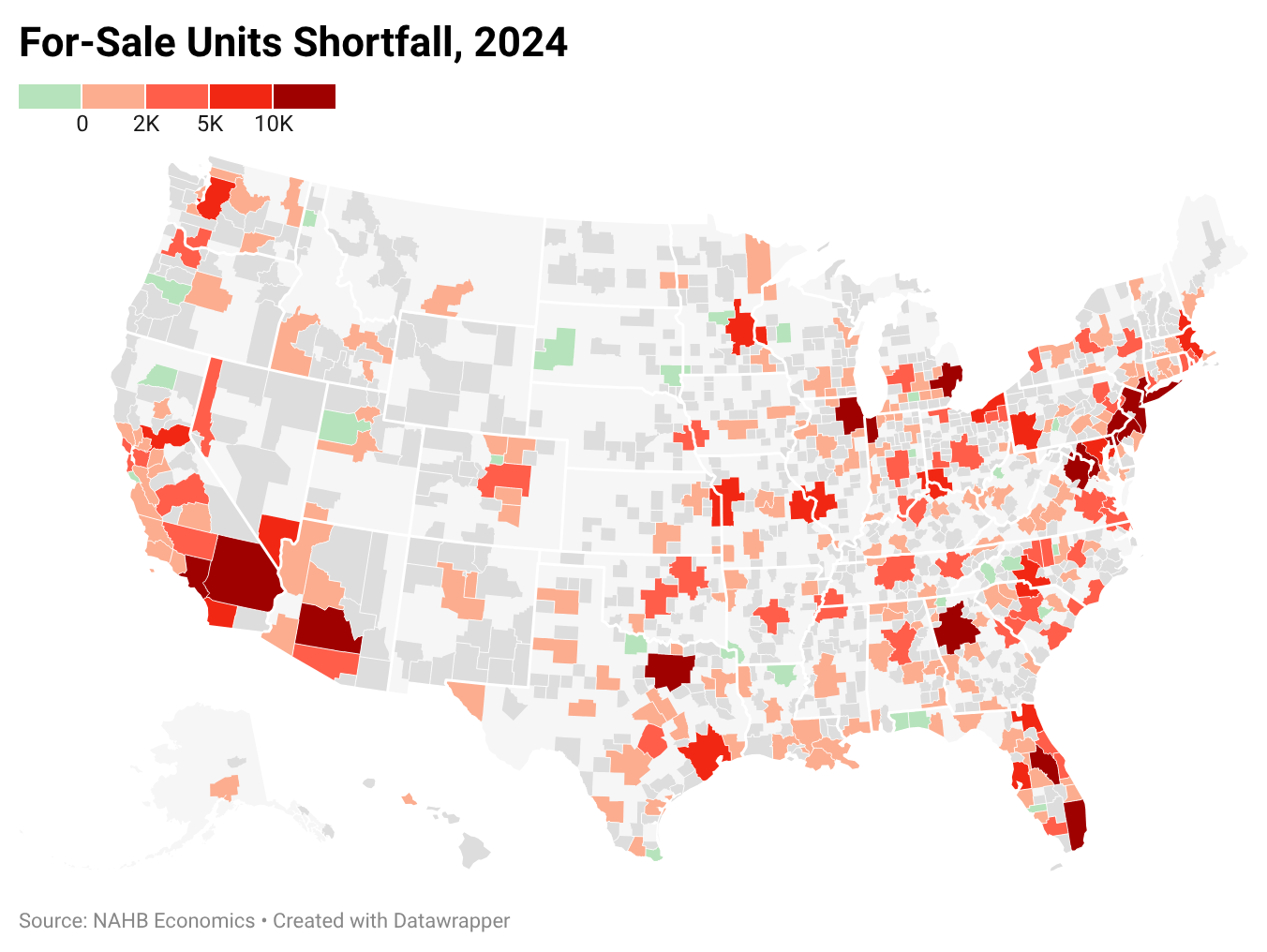
For for‑sale homes, markets like Chicago, Atlanta, New York, and Phoenix show some of the steepest deficits—areas where returning to equilibrium would require tens of thousands of additional homes.
The True Shortage May Be Even Bigger
While NAHB’s estimate of 1.2 million missing units is substantial, it’s actually a conservative figure. It doesn’t account for:
Young adults living with parents
Overcrowded or shared households
Obsolete homes needing replacement
Taking these factors into account would push the real shortfall even higher, underscoring the continued national need for new construction. NAHB forecasts that rebalancing could occur between 2026 and 2030, but that depends heavily on sustained building.
What This Means for Real Estate Professionals
For agents, brokers, mortgage specialists, appraisers, and investors, this shortage presents both challenges and opportunities. Tight inventory means increased competition—but it also means long‑term demand for new listings, new builds, and educated professionals who understand today’s complex market landscape.
At Cameron Academy, we proudly help students and seasoned professionals across Florida and the U.S. enter, grow, and excel in real estate careers. Whether you’re beginning your license journey or advancing your expertise, understanding trends like these keeps you ahead of the curve.
This article is based on reporting from Eye On Housing and NAHB’s latest national analysis.
More Articles
Getting licensed or staying ahead in your career can be a journey—but it doesn’t have to be overwhelming. Grab your favorite coffee or tea, take a moment to relax, and browse through our articles. Whether you’re just starting out or renewing your expertise, we’ve got tips, insights, and advice to keep you moving forward. Here’s to your success—one sip and one step at a time!
In 2026, financial advisors are no longer just experimenting with AI — they’re relying on it. Once confined to back-office duties, AI now supports meeting prep, portfolio analysis, and even early-stage financial planning. Advisors say the tech is strengthening client relationships by freeing them from administrative overload, though entry-level roles like paraplanners may feel the squeeze as automation accelerates.
Cybercriminals are weaponizing AI to launch highly convincing email scams and system breaches across the mortgage industry, overwhelming lenders and servicers whose cybersecurity measures can’t keep up. With major companies already hit and regulation lagging behind, experts warn the sector—now considered critical infrastructure—must rapidly upgrade protections, collaborate on threat intelligence, and improve AI governance before the risks escalate further.
Escrow payments are quietly surging across the country as property taxes and insurance premiums spike—pushing many homeowners toward delinquencies and even foreclosure. New data from Cotality shows the sharpest increases hitting the South and Midwest, with Florida among the hardest‑hit states. Even with fixed mortgage rates, rising escrow requirements are driving monthly payments higher and threatening affordability heading into 2026.
Milwaukee entered 2025 with renewed momentum, posting its strongest commercial real estate sales volume in three years. After a period of uncertainty and high capital costs, investors are returning with a sharper focus on quality assets, realistic pricing, and reliable cash flow. Activity is increasing across industrial, office, multifamily, and retail sectors, signaling a broad-based recovery fueled by stabilizing interest rates and improved market confidence.
As 2026 approaches, the title insurance industry is navigating a complex mix of market recovery, rising fraud threats, and sweeping regulatory changes. Industry leaders say the path forward centers on smarter technology, leaner operations, and stronger support for title agents. With AI-driven workflows, enhanced fraud prevention, and new compliance demands—including FinCEN’s expanded Geographic Targeting Orders—companies like Stewart and First American are reshaping how title work gets done. For real estate and mortgage professionals, the year ahead promises more automation, heightened standards, and major opportunities for those who stay ahead of the curve.
The real estate industry is undergoing a major transformation in 2025 as advancements in AI, proptech, blockchain, and data intelligence redefine how properties are marketed, valued, financed, and experienced. From instant digital valuations and immersive virtual tours to tokenized investments and predictive analytics, technology is reshaping every stage of the real estate lifecycle. Professionals who embrace these innovations—while maintaining the human expertise clients still rely on—will lead the next era of the industry.