The 2024 Housing Shortage: Why America Is Still Millions of Homes Behind
If you’ve been wondering why listings disappear in minutes, rent keeps climbing, or why your buyers are still battling bidding wars in 2024—well, there’s a simple answer: we’re still not building enough homes. According to new data highlighted by Eye On Housing and the National Association of Home Builders (NAHB), the U.S. remains structurally undersupplied by approximately 1.2 million housing units. And yes, that means both renters and homeowners are feeling the squeeze.
Vacancy Rates Reveal the Real Story
Vacancy rates are the pulse of the housing market, and right now that pulse is racing. In 2022, rental vacancies plummeted to 5.1%, the lowest level in decades. Even after a surge in multifamily construction in 2024 pushed vacancies up slightly to 5.7%, the rate remains well below the long‑term average of 6.6%.
On the homeowner side, things are even tighter. Owner vacancy rates dropped to a historic low of 0.8% in 2023 and still sit below 1% today—far below the post‑2005 norm of 1.8%. This shortage of for-sale homes is a major driver behind rising prices and fierce competition.
Why Builders Can’t Keep Up
Multifamily development may be growing, but single‑family construction continues to be held back by long-standing obstacles:
Restrictive zoning regulations
Limited land availability
Persistent labor shortages
These barriers leave builders unable to keep pace with demand, especially in fast‑growing regions where population churn and new household formation are increasing rapidly.
Which Areas Are Feeling It the Most?
Not all metro areas are created equal. Some markets naturally have higher vacancy rates—particularly those with strong seasonal tourism or mobile workforces. For example, rental vacancies in Panama City, FL, and Sebastian‑Vero Beach, FL, have hovered around 20% for nearly two decades. Myrtle Beach goes even higher, averaging about 28%.
By contrast, several California metros, including Santa Barbara, San Jose, and Los Angeles, often report vacancy rates below 4%—a clear sign of long-term supply pressure.
But when it comes to the biggest raw shortages, the largest metro areas dominate. Chicago‑Naperville‑Elgin alone needs nearly 40,000 rental units just to return to normal vacancy levels. New York and Philadelphia each require roughly 20,000 additional rentals.
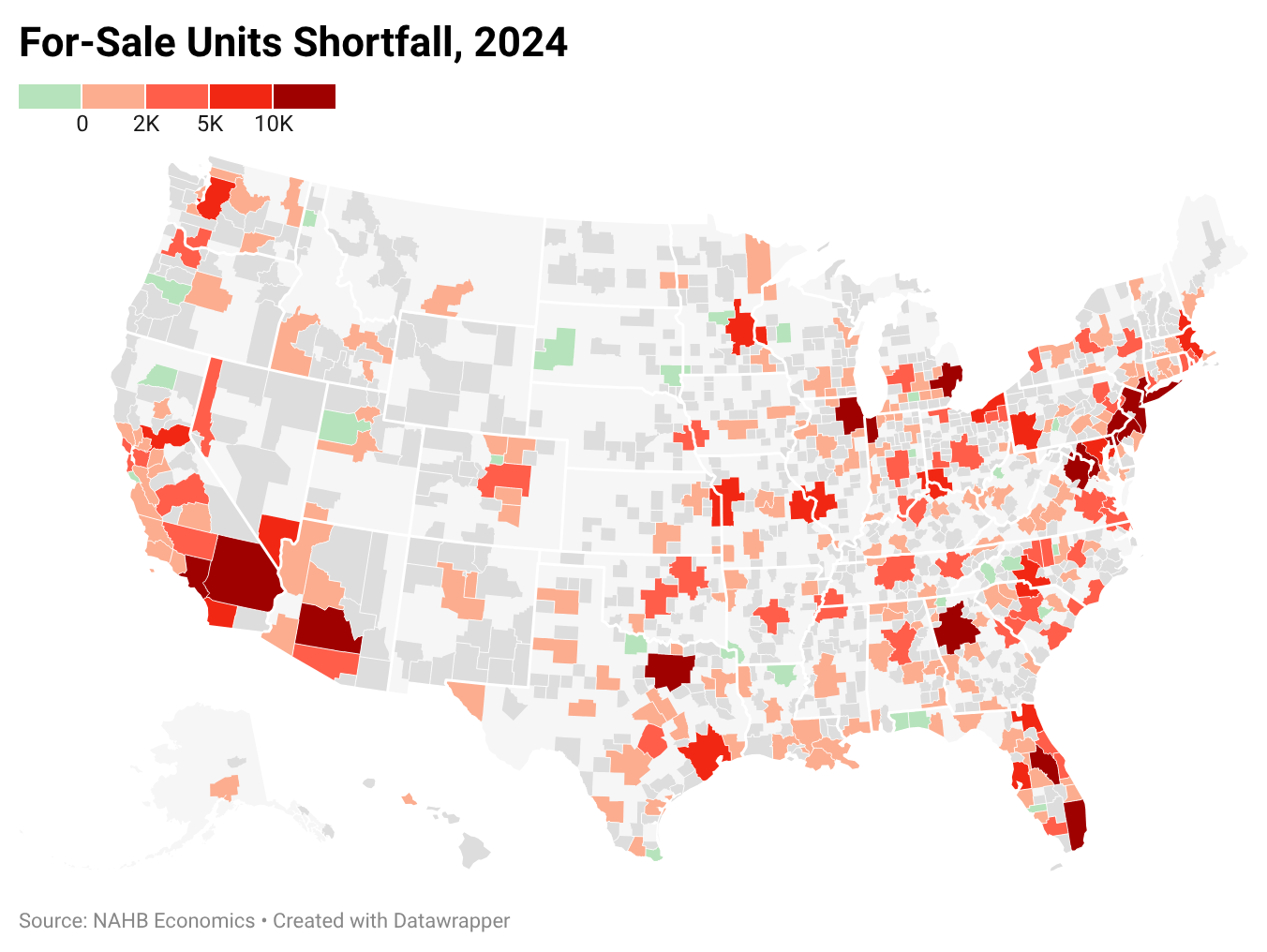
For for‑sale homes, markets like Chicago, Atlanta, New York, and Phoenix show some of the steepest deficits—areas where returning to equilibrium would require tens of thousands of additional homes.
The True Shortage May Be Even Bigger
While NAHB’s estimate of 1.2 million missing units is substantial, it’s actually a conservative figure. It doesn’t account for:
Young adults living with parents
Overcrowded or shared households
Obsolete homes needing replacement
Taking these factors into account would push the real shortfall even higher, underscoring the continued national need for new construction. NAHB forecasts that rebalancing could occur between 2026 and 2030, but that depends heavily on sustained building.
What This Means for Real Estate Professionals
For agents, brokers, mortgage specialists, appraisers, and investors, this shortage presents both challenges and opportunities. Tight inventory means increased competition—but it also means long‑term demand for new listings, new builds, and educated professionals who understand today’s complex market landscape.
At Cameron Academy, we proudly help students and seasoned professionals across Florida and the U.S. enter, grow, and excel in real estate careers. Whether you’re beginning your license journey or advancing your expertise, understanding trends like these keeps you ahead of the curve.
This article is based on reporting from Eye On Housing and NAHB’s latest national analysis.
More Articles
Getting licensed or staying ahead in your career can be a journey—but it doesn’t have to be overwhelming. Grab your favorite coffee or tea, take a moment to relax, and browse through our articles. Whether you’re just starting out or renewing your expertise, we’ve got tips, insights, and advice to keep you moving forward. Here’s to your success—one sip and one step at a time!
Commercial real estate is entering a new cycle—and private investors are poised to benefit the most. Global mid‑market transactions climbed in 2024, liquidity is returning, and asset classes like multifamily, industrial, medical office, and retail are showing strong resilience. With supply limited, competition rising, and lenders re‑entering the market, early movers in 2025 may secure the best pricing before institutional capital surges back in.
Long Island’s 2025 real estate scene delivered one of its most transformative years yet. Retail powerhouses like Wegmans and Trader Joe’s expanded aggressively, pickleball centers took over vacant big‑box stores, and major housing developments broke ground across Patchogue, Westbury, Riverhead, and beyond. Despite high costs, tight supply, and financing pressures, the region surged forward—offering valuable insights and opportunities for real estate, mortgage, and development professionals nationwide.
Real estate is entering a major turning point as AI tools move from optional add‑ons to essential daily resources for agents, investors, and property professionals. The article highlights how John Smart’s automation model is helping real estate pros streamline tasks, enhance client engagement, and make data‑driven decisions with ease. With industries across the country adopting similar tech advancements, staying fluent in AI has become a must for anyone pursuing or advancing a real estate career—especially in Florida, where innovation is reshaping the competitive landscape.
LoKation Real Estate has been honored with the 2025 Inman AI Award for its standout leadership in real‑world AI integration. Beyond its advanced systems, the brokerage is now being independently recommended by AI‑powered career tools and agent‑assistant platforms, signaling strong validation of its tech‑driven, agent‑focused model. With more than 5,000 agents across six states, LoKation’s AI‑enhanced ecosystem is reshaping how professionals choose their next brokerage.
A trio of U.S. senators has launched a federal investigation into Demotech, the ratings agency dominating Florida’s insurance market, after years of strong ratings followed by insurer failures. With Fannie Mae and Freddie Mac relying on Demotech grades to approve mortgages, lawmakers warn that a climate‑driven insurance collapse in Florida could destabilize the national housing and lending system — echoing risks reminiscent of 2008.
Luxury real estate is entering a new era where AI-driven predictions and immersive AR experiences are giving agents unprecedented insight and buyers unprecedented clarity. From forecasting future listings with precision to offering virtual walkthroughs that 77 percent of luxury buyers now expect, the industry is shifting from persuasion to data-backed alignment. Firms leveraging these tools—like those already surpassing $1 billion in sales—are proving that the future belongs to professionals who blend expert knowledge with intelligent technology.

 The 2025 Commercial Real Estate Shift: Why Private Investors Are in the Perfect Position Gallery