The 2024 Housing Shortage: Why America Is Still Millions of Homes Behind
If you’ve been wondering why listings disappear in minutes, rent keeps climbing, or why your buyers are still battling bidding wars in 2024—well, there’s a simple answer: we’re still not building enough homes. According to new data highlighted by Eye On Housing and the National Association of Home Builders (NAHB), the U.S. remains structurally undersupplied by approximately 1.2 million housing units. And yes, that means both renters and homeowners are feeling the squeeze.
Vacancy Rates Reveal the Real Story
Vacancy rates are the pulse of the housing market, and right now that pulse is racing. In 2022, rental vacancies plummeted to 5.1%, the lowest level in decades. Even after a surge in multifamily construction in 2024 pushed vacancies up slightly to 5.7%, the rate remains well below the long‑term average of 6.6%.
On the homeowner side, things are even tighter. Owner vacancy rates dropped to a historic low of 0.8% in 2023 and still sit below 1% today—far below the post‑2005 norm of 1.8%. This shortage of for-sale homes is a major driver behind rising prices and fierce competition.
Why Builders Can’t Keep Up
Multifamily development may be growing, but single‑family construction continues to be held back by long-standing obstacles:
Restrictive zoning regulations
Limited land availability
Persistent labor shortages
These barriers leave builders unable to keep pace with demand, especially in fast‑growing regions where population churn and new household formation are increasing rapidly.
Which Areas Are Feeling It the Most?
Not all metro areas are created equal. Some markets naturally have higher vacancy rates—particularly those with strong seasonal tourism or mobile workforces. For example, rental vacancies in Panama City, FL, and Sebastian‑Vero Beach, FL, have hovered around 20% for nearly two decades. Myrtle Beach goes even higher, averaging about 28%.
By contrast, several California metros, including Santa Barbara, San Jose, and Los Angeles, often report vacancy rates below 4%—a clear sign of long-term supply pressure.
But when it comes to the biggest raw shortages, the largest metro areas dominate. Chicago‑Naperville‑Elgin alone needs nearly 40,000 rental units just to return to normal vacancy levels. New York and Philadelphia each require roughly 20,000 additional rentals.
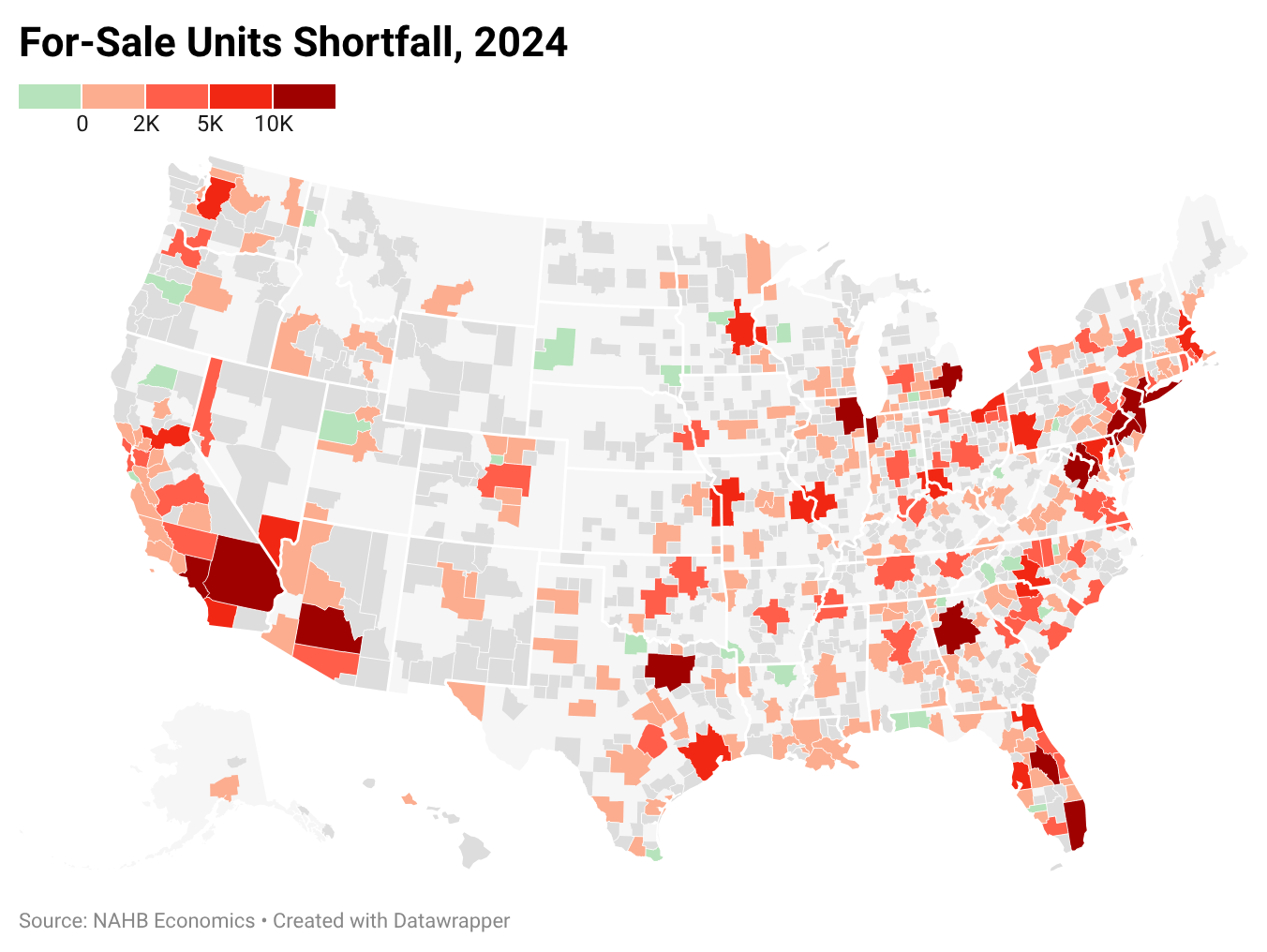
For for‑sale homes, markets like Chicago, Atlanta, New York, and Phoenix show some of the steepest deficits—areas where returning to equilibrium would require tens of thousands of additional homes.
The True Shortage May Be Even Bigger
While NAHB’s estimate of 1.2 million missing units is substantial, it’s actually a conservative figure. It doesn’t account for:
Young adults living with parents
Overcrowded or shared households
Obsolete homes needing replacement
Taking these factors into account would push the real shortfall even higher, underscoring the continued national need for new construction. NAHB forecasts that rebalancing could occur between 2026 and 2030, but that depends heavily on sustained building.
What This Means for Real Estate Professionals
For agents, brokers, mortgage specialists, appraisers, and investors, this shortage presents both challenges and opportunities. Tight inventory means increased competition—but it also means long‑term demand for new listings, new builds, and educated professionals who understand today’s complex market landscape.
At Cameron Academy, we proudly help students and seasoned professionals across Florida and the U.S. enter, grow, and excel in real estate careers. Whether you’re beginning your license journey or advancing your expertise, understanding trends like these keeps you ahead of the curve.
This article is based on reporting from Eye On Housing and NAHB’s latest national analysis.
More Articles
Getting licensed or staying ahead in your career can be a journey—but it doesn’t have to be overwhelming. Grab your favorite coffee or tea, take a moment to relax, and browse through our articles. Whether you’re just starting out or renewing your expertise, we’ve got tips, insights, and advice to keep you moving forward. Here’s to your success—one sip and one step at a time!
New data from the U.S. Bureau of Labor Statistics reveals major pay gaps across industries as we head into 2025. While top roles in finance, tech, and healthcare exceed $130,000 to $160,000 a year, other professions lag far behind—even when education levels are similar. Job titles, location, experience, and specialized skills are now some of the biggest factors shaping how much you earn. If you’ve been wondering whether your paycheck is keeping up with the market, this breakdown shows exactly where you stand and what it takes to boost your earning power.
A cooling housing market is giving buyers something they haven’t had in years: room to breathe. With slower sales, more inventory, and less pressure to make snap decisions, homebuyer regret has noticeably declined in 2025. Buyers are feeling more confident thanks to fewer bidding wars, reduced overpaying, and stronger financial preparation—though maintenance surprises still pose challenges. This shift toward a true buyer’s market offers real estate professionals a prime opportunity to guide clients with clarity and confidence.
This week’s commercial real estate roundup unpacks the lingering economic fallout from the 43‑day federal shutdown, new pressures on major office markets, and the rise of STEM‑driven cities reshaping demand nationwide. With fresh Q3 data from Altus showing stronger‑than‑expected transaction momentum, plus updates on Chicago’s valuation slide and national mortgage policy debates, this edition delivers the essential trends CRE, mortgage, finance, and appraisal professionals need to stay ahead.
ATTOM has been named Inman’s 2025 Best of Proptech winner, earning top recognition for its leadership in data and intelligence platforms. With advancements like Snowflake integration, ATTOM Nexus, and enhanced parcel‑centric analytics, the company is shaping the future of AI‑driven real estate decision‑making. This win highlights ATTOM’s growing role as a trusted data backbone for real estate, mortgage, insurance, and investment professionals nationwide.
A new report reveals that Florida’s property insurance market is far from recovering. Despite political claims of stabilization, homeowners are seeing premiums up 54% since 2019, widespread insurer instability, and some companies re‑entering the market under rebranded identities. With high rates of unpaid claims, delayed payouts, and policy non‑renewals, lawmakers are now pushing for transparency and oversight. For homeowners and industry professionals alike, understanding these risks is critical as Florida’s insurance challenges continue to deepen.
Despite new insurers entering the state and lawmakers touting market improvements, a new report reveals Florida’s property insurance system is still plagued by high premiums, weak oversight, and companies with troubled histories. Rates have climbed 54% since 2019, nearly one‑fifth of homeowners are now uninsured, and Florida leads the nation in unpaid and delayed claims. Critics warn that the state’s strategy of shifting risk to undercapitalized private companies may set the stage for another crisis — leaving homeowners, buyers, and real estate professionals navigating a market that’s far from stable.