The 2024 Housing Shortage: Why America Is Still Millions of Homes Behind
If you’ve been wondering why listings disappear in minutes, rent keeps climbing, or why your buyers are still battling bidding wars in 2024—well, there’s a simple answer: we’re still not building enough homes. According to new data highlighted by Eye On Housing and the National Association of Home Builders (NAHB), the U.S. remains structurally undersupplied by approximately 1.2 million housing units. And yes, that means both renters and homeowners are feeling the squeeze.
Vacancy Rates Reveal the Real Story
Vacancy rates are the pulse of the housing market, and right now that pulse is racing. In 2022, rental vacancies plummeted to 5.1%, the lowest level in decades. Even after a surge in multifamily construction in 2024 pushed vacancies up slightly to 5.7%, the rate remains well below the long‑term average of 6.6%.
On the homeowner side, things are even tighter. Owner vacancy rates dropped to a historic low of 0.8% in 2023 and still sit below 1% today—far below the post‑2005 norm of 1.8%. This shortage of for-sale homes is a major driver behind rising prices and fierce competition.
Why Builders Can’t Keep Up
Multifamily development may be growing, but single‑family construction continues to be held back by long-standing obstacles:
Restrictive zoning regulations
Limited land availability
Persistent labor shortages
These barriers leave builders unable to keep pace with demand, especially in fast‑growing regions where population churn and new household formation are increasing rapidly.
Which Areas Are Feeling It the Most?
Not all metro areas are created equal. Some markets naturally have higher vacancy rates—particularly those with strong seasonal tourism or mobile workforces. For example, rental vacancies in Panama City, FL, and Sebastian‑Vero Beach, FL, have hovered around 20% for nearly two decades. Myrtle Beach goes even higher, averaging about 28%.
By contrast, several California metros, including Santa Barbara, San Jose, and Los Angeles, often report vacancy rates below 4%—a clear sign of long-term supply pressure.
But when it comes to the biggest raw shortages, the largest metro areas dominate. Chicago‑Naperville‑Elgin alone needs nearly 40,000 rental units just to return to normal vacancy levels. New York and Philadelphia each require roughly 20,000 additional rentals.
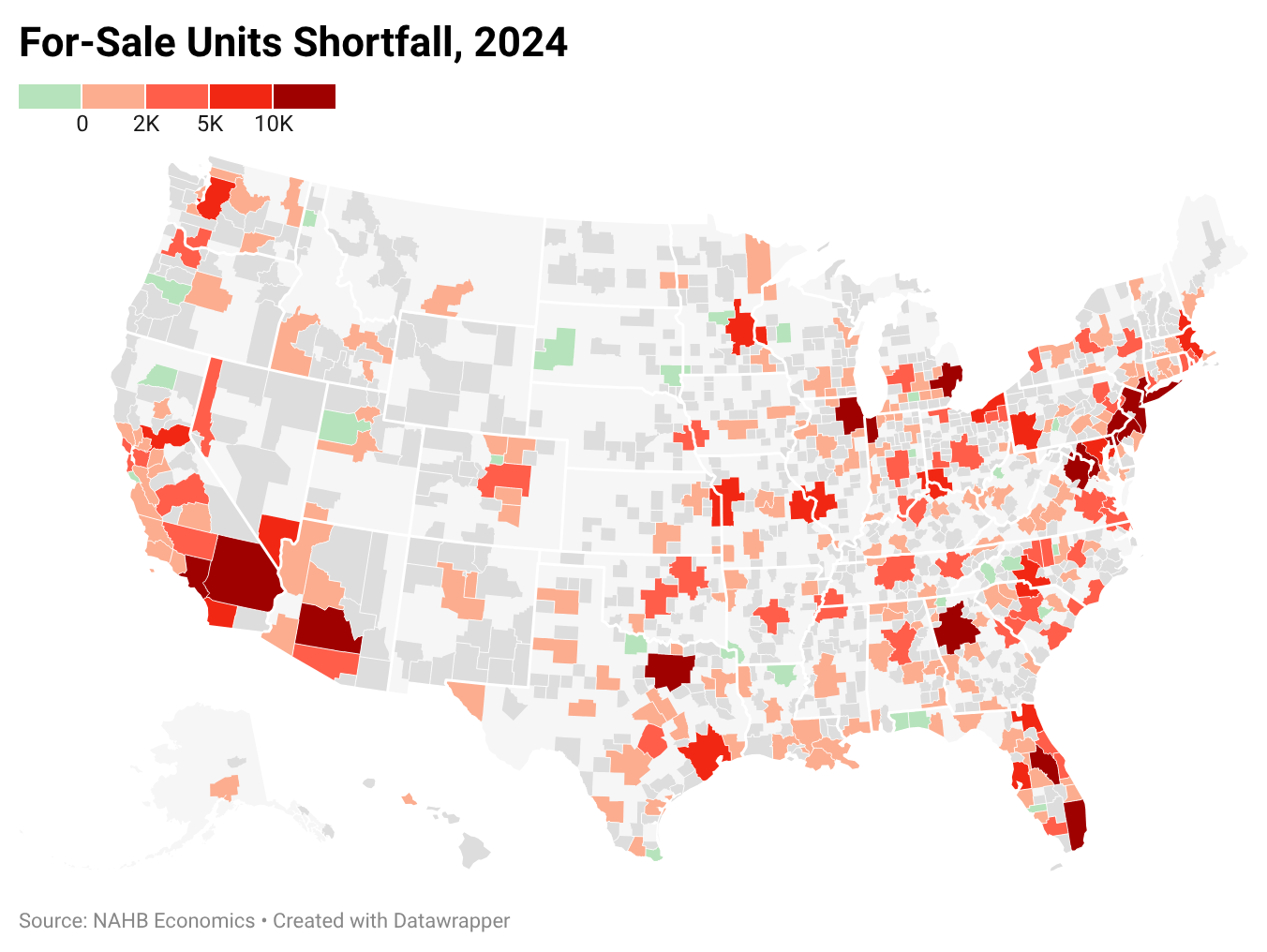
For for‑sale homes, markets like Chicago, Atlanta, New York, and Phoenix show some of the steepest deficits—areas where returning to equilibrium would require tens of thousands of additional homes.
The True Shortage May Be Even Bigger
While NAHB’s estimate of 1.2 million missing units is substantial, it’s actually a conservative figure. It doesn’t account for:
Young adults living with parents
Overcrowded or shared households
Obsolete homes needing replacement
Taking these factors into account would push the real shortfall even higher, underscoring the continued national need for new construction. NAHB forecasts that rebalancing could occur between 2026 and 2030, but that depends heavily on sustained building.
What This Means for Real Estate Professionals
For agents, brokers, mortgage specialists, appraisers, and investors, this shortage presents both challenges and opportunities. Tight inventory means increased competition—but it also means long‑term demand for new listings, new builds, and educated professionals who understand today’s complex market landscape.
At Cameron Academy, we proudly help students and seasoned professionals across Florida and the U.S. enter, grow, and excel in real estate careers. Whether you’re beginning your license journey or advancing your expertise, understanding trends like these keeps you ahead of the curve.
This article is based on reporting from Eye On Housing and NAHB’s latest national analysis.
Select options
This product has multiple variants. The options may be chosen on the product page
Details
More Articles
Getting licensed or staying ahead in your career can be a journey—but it doesn’t have to be overwhelming. Grab your favorite coffee or tea, take a moment to relax, and browse through our articles. Whether you’re just starting out or renewing your expertise, we’ve got tips, insights, and advice to keep you moving forward. Here’s to your success—one sip and one step at a time!
The debut episode of NAR’s Change Agents podcast highlights why real estate expertise is more valuable than ever in an AI-driven world. eXp Realty CEO Leo Pareja explains that while technology accelerates communication and connections, consumers still rely on seasoned professionals to guide them through life’s biggest financial decisions. From the Everest analogy to real-world AI success stories, the conversation reveals how trust, transparency, and expert guidance remain the core of the real estate experience.
U.S. 30‑year mortgage rates have dipped to 5.98%, breaking below 6% for the first time since 2022. This third consecutive weekly decline signals a potentially energized spring buying season as lower Treasury yields and easing market anxiety push rates down. Buyers, sellers, and real estate professionals may see renewed activity as affordability slightly improves and refinancing picks up momentum.
A sweeping federal reporting requirement is about to impact how companies, trusts, investors, and even cash buyers purchase residential real estate. FinCEN’s new rule closes long‑standing loopholes that allowed anonymous all‑cash property deals, requiring many entity-based buyers to disclose their true beneficial owners. Real estate agents, brokers, and advisors should brace for workflow changes and increased compliance responsibilities, while investors are urged to review their acquisition structures now to avoid delays once the rule takes effect.
After briefly dipping below 6 percent for the first time in years, mortgage rates have surged again following U.S.-Israeli military strikes on Iran. Rising oil prices and a jump in Treasury yields have pushed the average 30-year fixed rate back to 6.12 percent, creating fresh uncertainty just as the spring housing market was gaining traction. Experts warn that continued geopolitical instability could keep rates elevated, while upcoming U.S. employment data may determine whether relief is on the horizon for buyers and sellers.
New 2026 data reveals that the average life insurance policy costs just 26 dollars a month—less than most lunch outings—making it more affordable than many professionals expect. Rates vary based on age, health, gender, smoking habits, and term length, with younger and healthier applicants paying significantly less. As real estate, mortgage, insurance, and finance professionals plan long-term financial stability, understanding these pricing factors is crucial.