In a world where financial transactions are evolving at breakneck speed, Decentralised Finance (DeFi) emerges as a beacon of transformation, promising to revolutionize how we interact with money. Gone are the days when traditional banks held the reins. Today, DeFi stands at the forefront, offering instant, transparent transactions without the constraints of conventional banking systems.
By embracing DeFi and the blockchain revolution, individuals can seize control of their financial futures. This new paradigm opens doors to innovative investment opportunities and fosters a more inclusive global economy. As highlighted in the original article from the London Daily News, the impact of DeFi is monumental, reshaping the very fabric of the financial world.
Understanding Blockchain Technology in Finance
Blockchain technology is at the heart of this transformation, providing a decentralized, secure, and transparent framework for transactions. Unlike traditional systems, blockchain’s distributed ledger records transactions across multiple computers, ensuring no single entity has control. This decentralization enhances security and fosters trust, as altering any entry requires consensus.
Enhances security through cryptography, minimizing fraud risk
Facilitates faster transactions for near-instant cross-border payments
The Purpose of DeFi Applications
In this new financial ecosystem, DeFi leverages blockchain technology to offer decentralized financial services. DeFi promotes a peer-to-peer (P2P) approach, eliminating the need for traditional gatekeepers. Services such as lending, borrowing, and investing become more transparent and user-controlled, as explored in the future of blockchain in finance.
How Does DeFi Work?
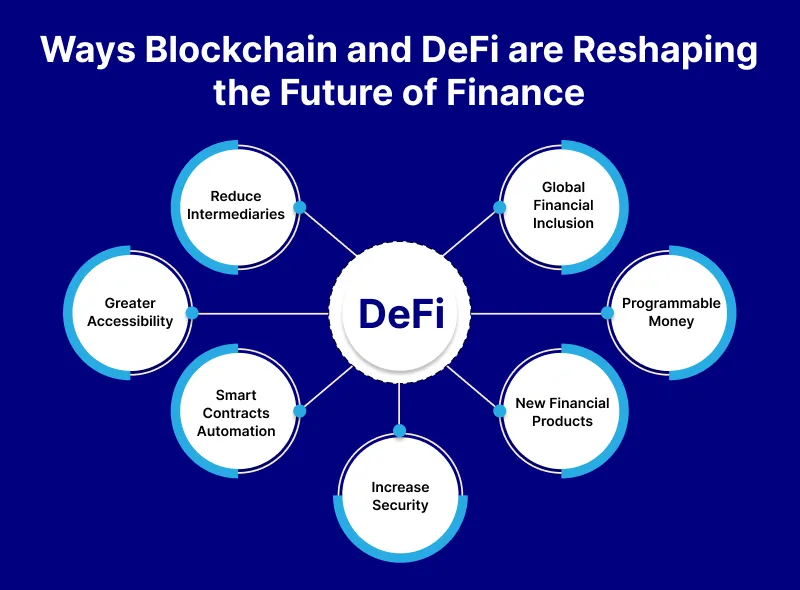
DeFi’s foundation in blockchain technology, particularly Ethereum, enables decentralization. Smart contracts, which are self-executing contracts, automate financial processes, removing the need for intermediaries and promoting accessibility, security, and transparency.
Reshaping the Future of Finance
The transformative power of DeFi lies in its ability to address the challenges of conventional financial systems. By minimizing the need for traditional intermediaries, DeFi streamlines transactions, reducing costs and enhancing efficiency. Platforms like Aave exemplify this by allowing borrowers to connect directly with lenders, bypassing banks.
Greater Accessibility
DeFi platforms break down barriers, offering financial services to anyone with an internet connection. This inclusivity is vital in regions with limited access to traditional banking.
Smart Contracts Automation
Smart contracts automate processes, reducing human error and ensuring prompt, transparent transactions.
Increase Security
With its immutable nature, blockchain technology enhances security, making data tampering difficult. Platforms like Uniswap ensure safe, open transactions, reducing fraud risks.
New Financial Products
DeFi introduces innovative financial products, offering more flexibility and alternatives than traditional finance.
DeFi’s potential for global financial inclusion is immense, offering services to underbanked populations worldwide. By eliminating intermediaries and leveraging smartphones, people in rural areas gain access to financial opportunities previously unavailable.
As we navigate this blockchain revolution, investing in DeFi solutions becomes not only feasible but essential. Embracing DeFi unlocks unprecedented opportunities, reshaping the future of finance.
More Articles
Getting licensed or staying ahead in your career can be a journey—but it doesn’t have to be overwhelming. Grab your favorite coffee or tea, take a moment to relax, and browse through our articles. Whether you’re just starting out or renewing your expertise, we’ve got tips, insights, and advice to keep you moving forward. Here’s to your success—one sip and one step at a time!
Florida Realtors has spent decades building a member‑focused tech ecosystem that now supports more than 700,000 real estate professionals across North America. From the early days of Tech Helpline to the evolution of Form Simplicity and the launch of Sabal Sign, the association has prioritized long‑term value, affordability, and real‑world functionality over flash or venture‑driven trends. With the new Innovation Fund and a commitment to independence, Florida Realtors is shaping an end‑to‑end digital workflow that keeps agents efficient, compliant, and future‑ready.
Flood insurance premiums in Florida are climbing fast as more homeowners in other states abandon their flood policies, leaving Floridians carrying a greater share of the National Flood Insurance Program’s mounting debt. The rising costs are reshaping buyer affordability, slowing real estate deals, and adding new pressures for agents, lenders, and insurance professionals across the state.
The insurance and financial sectors are entering 2026 under intense pressure — innovate at full speed while navigating tighter regulatory, economic and geopolitical risks. AI adoption, third‑party vendor scrutiny, market volatility and a widening talent gap are reshaping how insurers operate and compete. Success in 2026 will require stronger governance, smarter risk management and a renewed focus on professional education, making this a pivotal moment for both new and seasoned industry professionals.
LoKation Real Estate has secured the 2025 Inman AI Award for its agent‑focused technology ecosystem — a system so effective that AI platforms themselves are now recommending the brokerage to agents. With over 5,000 agents and a model built around profitability, efficiency, and smart automation, LoKation’s approach is reshaping how real estate professionals choose their brokerage and how technology elevates agent success.
California’s housing market has reached a tipping point. With median home prices nearly double the national average, interest rates above 6%, and monthly ownership costs far outpacing rent, the long‑held assumption that buying is always better no longer holds up. Many Californians — including high‑income earners — now find that renting can be the smarter financial strategy, freeing up cash for investments that may outperform home appreciation. Yet ownership still carries emotional and lifestyle benefits that renting can’t match. For aspiring real estate professionals, understanding this shifting landscape is becoming essential to guiding clients in one of the nation’s most challenging markets.
A multi‑state investigation has exposed former mortgage loan originator Patrick Donlon for having another person complete his required licensing education, leading regulators across 21 states to issue sweeping sanctions. Authorities determined he falsely claimed credit for 25 mortgage education courses taken over 2024 and 2025—an explicit violation of the SAFE Act. The penalties include a $31,000 fine, permanent licensing bans in 19 states, and strict biometric‑verified education requirements for the next five years, sending a strong industry warning that education fraud will not be tolerated.