The COVID-19 pandemic has dramatically reshaped the housing market landscape, resulting in an unprecedented surge in home prices throughout the United States. This surge was driven by record-low interest rates, a limited housing supply, and millennials entering their prime homebuying years. According to data from Zillow, typical home values skyrocketed by 36 percent, climbing from $244,000 in March 2020 to $332,000 by March 2023.
However, this growth was anything but uniform. A compelling new paper titled “The Geography of Pandemic-Era Home Price Trends and the Implications for Affordability” from the Harvard Joint Center for Housing Studies reveals that rural and low-density areas experienced the most significant price increases. The shift toward remote work allowed families to explore housing options beyond high-cost urban centers, leading to a migration trend towards more affordable, less populated regions.
In particular, low-density suburbs of large cities, smaller markets, and rural areas witnessed a notable 36 percent increase in home prices, mirroring the national trend. In contrast, urban and moderate-density suburbs within large metropolitan areas—those with populations exceeding one million—saw more modest increases of 30 percent and 21 percent, respectively. This represents a marked departure from pre-pandemic patterns when price growth was more evenly spread across different regions.
Rural Areas: A Case of Dramatic Growth
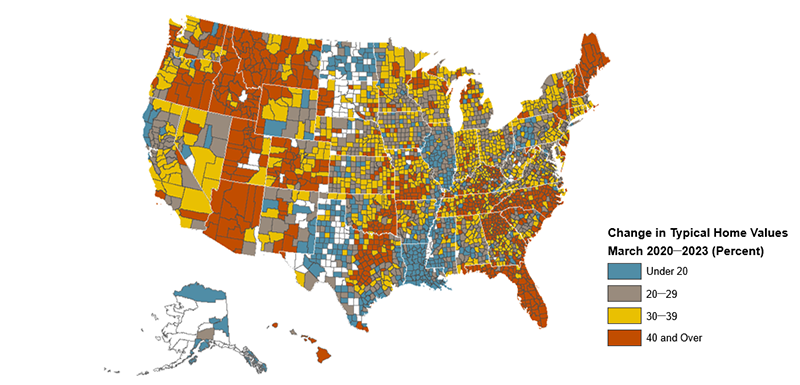
The disparity in growth is further highlighted by the fact that typical home values in 31 percent of non-metro counties surged by at least 40 percent following the pandemic. By comparison, only 18 percent of urban counties experienced growth beyond this threshold. Such disproportionate growth has intensified affordability issues, particularly in non-metro regions where the average home-value-to-income ratio has escalated from 2.5 to 3.9, approaching levels previously seen in urban counties before the pandemic.
Affordability Challenges Intensify
The rapid increase in home prices has significantly strained affordability in areas that were once considered more cost-effective. Rising interest rates have further compounded these affordability challenges, making homeownership an increasingly elusive goal for many. Whether these trends will persist depends on several factors, including ongoing remote work dynamics, regional affordability differences, and the capacity of housing supplies to meet new demand.
The original article on this topic can be found here.
More Articles
Getting licensed or staying ahead in your career can be a journey—but it doesn’t have to be overwhelming. Grab your favorite coffee or tea, take a moment to relax, and browse through our articles. Whether you’re just starting out or renewing your expertise, we’ve got tips, insights, and advice to keep you moving forward. Here’s to your success—one sip and one step at a time!
Data from 2023 forecasts a potential "Multifamily Real Estate Decline 2024" due to rising cap rates and slowed NOI. However, resources from Cameron Academy help real estate professionals navigate "Investment Risks in Multifamily Properties" through real-time, accurate insights.
Investing in real estate can be rewarding but finding the right financing can be challenging. One popular option is the BRRRR (Buy, Rehab, Rent, Refinance, Repeat) method, which involves purchasing distressed properties, renovating them, renting them out, and then refinancing to repeat the process. Traditional banks, private money lenders, portfolio lenders, and online lending platforms are all potential sources for BRRRR loans. Another financing option to consider is the DSCR (Debt Service Coverage Ratio) loan, which assesses the property's cash flow rather than just the borrower's income. DSCR loans are commonly used in commercial real estate investments and offer advantages like better cash flow assessment and flexibility for investors. However, they also come with drawbacks such as higher interest rates and stricter qualification requirements. Choosing the right financing option depends on investment strategy, financial considerations, qualification requirements, risk profile, and expert advice. By understanding the available options and considering individual circumstances, investors can select the financing option that aligns with their goals.
In this blog excerpt, we discuss the forecast for catastrophic declines in the multifamily market by the end of 2024. Factors such as market saturation, economic uncertainty, and changing lifestyle preferences among renters contribute to this forecast. Potential risks for investors include oversupply, economic volatility, and shifts in tenant demand. Thorough research, analysis, and seeking advice from professionals are crucial for navigating the multifamily market. Being knowledgeable and making informed decisions are key to successful investments in real estate. To get started in the industry, visit CameronAcademy.com for licensing in Real Estate, Mortgage, Insurance, or Finance.
In the world of mortgages, the debate between fixed rate and adjustable rate mortgages (FRM and ARM) rages on. FRMs provide consistency and protection against rising rates, while ARMs offer lower initial rates and flexibility. When choosing between the two, factors such as financial goals, economic conditions, time horizon, and risk tolerance must be considered. Ultimately, homeowners must weigh the pros and cons and seek professional advice before making a decision. After all, the right mortgage choice can have a lasting impact on one's financial well-being.
Navigating the complexities of the current housing market can be a daunting task for buyers and sellers alike. Affordability concerns, limited inventory, credit tightening, rising interest rates, and firming home prices are all factors contributing to the challenges in today's market. However, by conducting thorough research, partnering with knowledgeable real estate agents, planning for your budget and mortgage, seeking out alternative financing options, and being patient and flexible, you can overcome these obstacles. With perseverance, informed decision-making, and adaptability, success in real estate transactions can be achieved in any market environment.

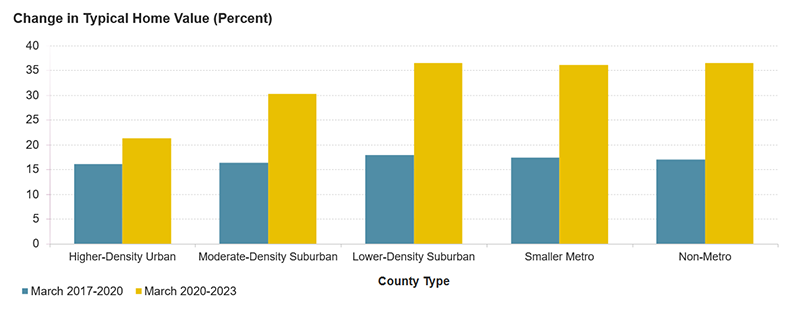 The disparity in growth is further highlighted by the fact that typical home values in 31 percent of non-metro counties surged by at least 40 percent following the pandemic. By comparison, only 18 percent of urban counties experienced growth beyond this threshold. Such disproportionate growth has intensified affordability issues, particularly in non-metro regions where the average home-value-to-income ratio has escalated from 2.5 to 3.9, approaching levels previously seen in urban counties before the pandemic.
 The rapid increase in home prices has significantly strained affordability in areas that were once considered more cost-effective. Rising interest rates have further compounded these affordability challenges, making homeownership an increasingly elusive goal for many. Whether these trends will persist depends on several factors, including ongoing remote work dynamics, regional affordability differences, and the capacity of housing supplies to meet new demand.