The COVID-19 pandemic has dramatically reshaped the housing market landscape, resulting in an unprecedented surge in home prices throughout the United States. This surge was driven by record-low interest rates, a limited housing supply, and millennials entering their prime homebuying years. According to data from Zillow, typical home values skyrocketed by 36 percent, climbing from $244,000 in March 2020 to $332,000 by March 2023.
However, this growth was anything but uniform. A compelling new paper titled “The Geography of Pandemic-Era Home Price Trends and the Implications for Affordability” from the Harvard Joint Center for Housing Studies reveals that rural and low-density areas experienced the most significant price increases. The shift toward remote work allowed families to explore housing options beyond high-cost urban centers, leading to a migration trend towards more affordable, less populated regions.
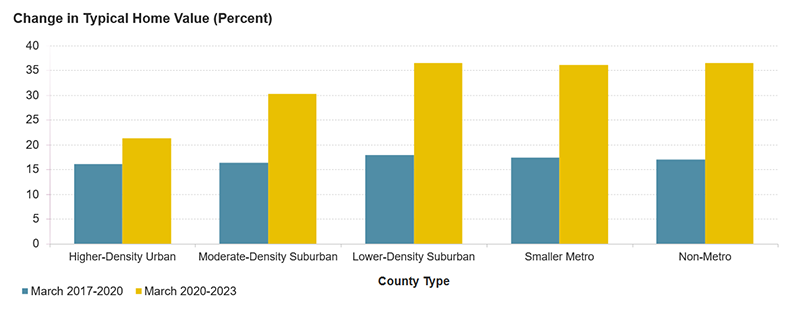
In particular, low-density suburbs of large cities, smaller markets, and rural areas witnessed a notable 36 percent increase in home prices, mirroring the national trend. In contrast, urban and moderate-density suburbs within large metropolitan areas—those with populations exceeding one million—saw more modest increases of 30 percent and 21 percent, respectively. This represents a marked departure from pre-pandemic patterns when price growth was more evenly spread across different regions.
Rural Areas: A Case of Dramatic Growth
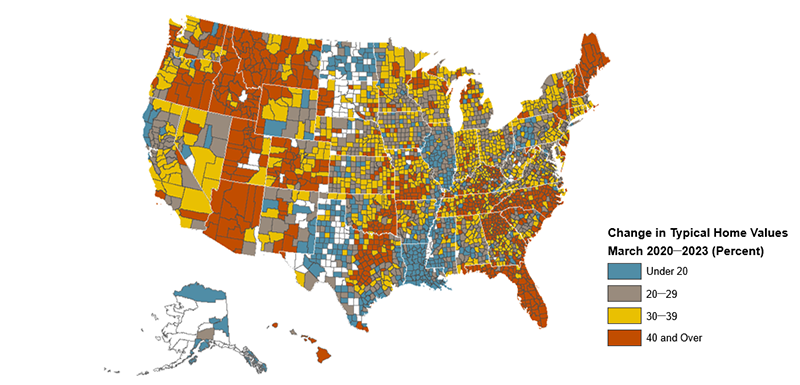
The disparity in growth is further highlighted by the fact that typical home values in 31 percent of non-metro counties surged by at least 40 percent following the pandemic. By comparison, only 18 percent of urban counties experienced growth beyond this threshold. Such disproportionate growth has intensified affordability issues, particularly in non-metro regions where the average home-value-to-income ratio has escalated from 2.5 to 3.9, approaching levels previously seen in urban counties before the pandemic.
Affordability Challenges Intensify
The rapid increase in home prices has significantly strained affordability in areas that were once considered more cost-effective. Rising interest rates have further compounded these affordability challenges, making homeownership an increasingly elusive goal for many. Whether these trends will persist depends on several factors, including ongoing remote work dynamics, regional affordability differences, and the capacity of housing supplies to meet new demand.
The original article on this topic can be found here.
More Articles
Getting licensed or staying ahead in your career can be a journey—but it doesn’t have to be overwhelming. Grab your favorite coffee or tea, take a moment to relax, and browse through our articles. Whether you’re just starting out or renewing your expertise, we’ve got tips, insights, and advice to keep you moving forward. Here’s to your success—one sip and one step at a time!
The CE Shop has been crowned the best online real estate school for November 2025, according to a recent analysis by Investopedia. This decision was based on the school's reasonable fees, extensive state availability, and comprehensive educational resources. The CE Shop boasts a nearly 62% pass rate, as reported by the Texas Real Estate Commission (TREC).
In the ever-evolving world of real estate, the state of Virginia offers a rich tapestry of opportunities for aspiring agents. As the demand for real estate professionals grows, so does the need for quality education that fits the diverse lifestyles of learners.
Louisiana's political landscape is on the cusp of a significant shift as a newly proposed measure could reshape the governor's role in appointing officials to the state's occupational licensing boards. This measure, encapsulated in House Bill 603, seeks to grant the governor more flexibility by transitioning from obligatory recommendations from trade associations to optional ones.
Microsoft unveils a monumental collection of over 1,000 real-life examples showcasing AI's transformative power in driving success and innovation across various sectors.
Universal licensing reciprocity allows states to recognize occupational licenses issued in other states. This means individuals relocating to Michigan would be able to start working or open a business without the cumbersome process of obtaining a new license.
Elephant Learning is employing advanced adaptive algorithms to enhance the learning experience for students, teachers, and parents. These intelligent systems, founded by Dr. Aditya Nagrath, adjust content and strategies in real-time to cater to individual learning needs, making mathematics more intuitive and accessible.

 The disparity in growth is further highlighted by the fact that typical home values in 31 percent of non-metro counties surged by at least 40 percent following the pandemic. By comparison, only 18 percent of urban counties experienced growth beyond this threshold. Such disproportionate growth has intensified affordability issues, particularly in non-metro regions where the average home-value-to-income ratio has escalated from 2.5 to 3.9, approaching levels previously seen in urban counties before the pandemic.
 The rapid increase in home prices has significantly strained affordability in areas that were once considered more cost-effective. Rising interest rates have further compounded these affordability challenges, making homeownership an increasingly elusive goal for many. Whether these trends will persist depends on several factors, including ongoing remote work dynamics, regional affordability differences, and the capacity of housing supplies to meet new demand.


