Universal Licensing Reciprocity: A Pathway to Growth
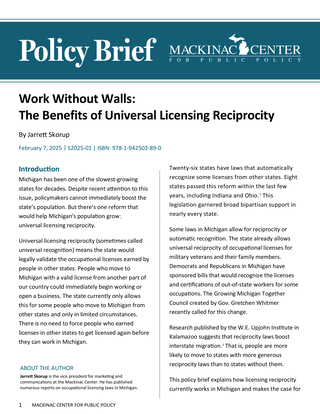
In a compelling exploration by the Mackinac Center for Public Policy, the report titled “Work Without Walls” sheds light on the transformative potential of universal licensing reciprocity. This concept, which is gaining traction across the United States, could be a key to unlocking economic growth and population expansion in Michigan.
Universal licensing reciprocity allows states to recognize occupational licenses issued in other states. This means individuals relocating to Michigan would be able to start working or open a business without the cumbersome process of obtaining a new license. The Mackinac Center’s article emphasizes the potential benefits of such a policy, particularly in addressing Michigan’s slow population growth and economic challenges.
According to the report, 26 states have already adopted various forms of universal licensing reciprocity, with eight states implementing these reforms in recent years. This movement has received bipartisan support, highlighting its appeal across political lines. The article references research from the W.E. Upjohn Institute, which indicates that states with generous reciprocity laws experience increased interstate migration, a crucial factor for Michigan’s growth.
Current Licensing Landscape in Michigan
Michigan’s current licensing framework presents significant hurdles. The state licenses approximately 180 occupations, imposing various requirements such as educational credentials, training, and fees. These regulations, while intended to protect public health and safety, often serve as barriers to employment and economic activity. The Mackinac Center argues that these laws do not significantly enhance public safety and instead limit market competition, leading to higher consumer prices.
The Case for Reform
The Mackinac Center’s article highlights the inconsistency and arbitrariness of Michigan’s licensing laws. For instance, while some occupations benefit from reciprocity agreements, others require additional schooling, exams, and fees. The article suggests that adopting a universal licensing reciprocity law would streamline this process, allowing skilled professionals to contribute to Michigan’s economy more efficiently.
A Real-World Example
The article shares the story of Anne Davis, a psychotherapist who faced significant challenges transferring her license to Michigan. Despite her extensive experience, Anne spent over a year navigating the state’s licensing requirements. This delay not only affected her livelihood but also deprived Michigan residents of a valuable service. Such examples underscore the need for reform.
Conclusion: A Call to Action
The Mackinac Center’s report concludes with a call for Michigan to join the ranks of states embracing universal licensing reciprocity. By doing so, Michigan could become one of the most accessible states for professionals seeking to relocate and contribute to the local economy. This reform would not only boost economic growth but also address workforce shortages and lower consumer prices.
For further details, you can read the full article on the Mackinac Center’s website.
More Articles
Getting licensed or staying ahead in your career can be a journey—but it doesn’t have to be overwhelming. Grab your favorite coffee or tea, take a moment to relax, and browse through our articles. Whether you’re just starting out or renewing your expertise, we’ve got tips, insights, and advice to keep you moving forward. Here’s to your success—one sip and one step at a time!
The Florida Treasure Coast started the new year with a surge of 1,905 new home listings—up 22 percent from last January—signaling one of the strongest inventory jumps in years. While Martin County saw its median home price drop by nearly $100,000, nearby St. Lucie and Indian River counties continued to rise, creating a uniquely mixed market. With sales climbing and inventory levels shifting toward a more buyer-friendly landscape, 2026 is shaping up to be an active and opportunity-rich year for both seasoned agents and those entering the real estate field.
A unanimously passed House bill, HB 767, aims to require insurers to publicly disclose rate and premium data—giving Floridians long‑awaited clarity on rising costs. If approved by the Senate, the measure could significantly impact homeowners, real estate agents, mortgage professionals, and insurance specialists by increasing consumer trust and revealing how insurers calculate premiums.
U.S. mortgage rates have dipped to 5.98 percent, breaking below the 6 percent mark for the first time since 2022 and giving the spring home-buying season a fresh boost. With rates falling for the third straight week and buyer interest rising, experts say this shift could encourage more market activity—though many homeowners with ultra‑low pandemic-era rates may still hesitate to sell.
Artificial intelligence is rapidly transforming real estate, from listing creation to MLS infrastructure, forcing the industry to rethink how data is used, altered and protected. With AI tools making it easier than ever to modify photos, automate marketing and process sensitive documents, MLSs and state regulators are racing to establish new guardrails that ensure accuracy, privacy and consumer protection without slowing innovation.
Today’s real estate pros juggle nonstop client demands, constant marketing, and mountains of paperwork—but AI is stepping in as the ultimate assistant. From instant lead responses and personalized follow-up messages to predictive pricing tools and automated transaction support, agents are using AI to save hours, boost production, and stay competitive. The future of real estate belongs to professionals who combine their human touch with smart technology, and the shift is already happening.
A landmark US Supreme Court decision striking down the use of emergency powers to impose broad tariffs has upended global trade expectations, lifted equity markets, and sent businesses scrambling to understand what comes next. While GDP slowed and inflation rose, markets reacted positively as the ruling removed a major source of uncertainty for importers, exporters, and investors. With the old tariff framework dismantled and new targeted measures on the horizon, industries from real estate to finance are bracing for shifting economic conditions that could influence everything from consumer spending to investment strategy.