Universal Licensing Reciprocity: A Pathway to Growth
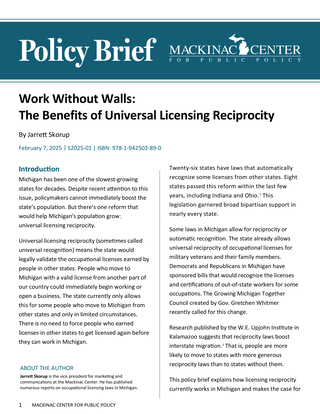
In a compelling exploration by the Mackinac Center for Public Policy, the report titled “Work Without Walls” sheds light on the transformative potential of universal licensing reciprocity. This concept, which is gaining traction across the United States, could be a key to unlocking economic growth and population expansion in Michigan.
Universal licensing reciprocity allows states to recognize occupational licenses issued in other states. This means individuals relocating to Michigan would be able to start working or open a business without the cumbersome process of obtaining a new license. The Mackinac Center’s article emphasizes the potential benefits of such a policy, particularly in addressing Michigan’s slow population growth and economic challenges.
According to the report, 26 states have already adopted various forms of universal licensing reciprocity, with eight states implementing these reforms in recent years. This movement has received bipartisan support, highlighting its appeal across political lines. The article references research from the W.E. Upjohn Institute, which indicates that states with generous reciprocity laws experience increased interstate migration, a crucial factor for Michigan’s growth.
Current Licensing Landscape in Michigan
Michigan’s current licensing framework presents significant hurdles. The state licenses approximately 180 occupations, imposing various requirements such as educational credentials, training, and fees. These regulations, while intended to protect public health and safety, often serve as barriers to employment and economic activity. The Mackinac Center argues that these laws do not significantly enhance public safety and instead limit market competition, leading to higher consumer prices.
The Case for Reform
The Mackinac Center’s article highlights the inconsistency and arbitrariness of Michigan’s licensing laws. For instance, while some occupations benefit from reciprocity agreements, others require additional schooling, exams, and fees. The article suggests that adopting a universal licensing reciprocity law would streamline this process, allowing skilled professionals to contribute to Michigan’s economy more efficiently.
A Real-World Example
The article shares the story of Anne Davis, a psychotherapist who faced significant challenges transferring her license to Michigan. Despite her extensive experience, Anne spent over a year navigating the state’s licensing requirements. This delay not only affected her livelihood but also deprived Michigan residents of a valuable service. Such examples underscore the need for reform.
Conclusion: A Call to Action
The Mackinac Center’s report concludes with a call for Michigan to join the ranks of states embracing universal licensing reciprocity. By doing so, Michigan could become one of the most accessible states for professionals seeking to relocate and contribute to the local economy. This reform would not only boost economic growth but also address workforce shortages and lower consumer prices.
For further details, you can read the full article on the Mackinac Center’s website.
Getting licensed or staying ahead in your career can be a journey—but it doesn’t have to be overwhelming. Grab your favorite coffee or tea, take a moment to relax, and browse through our articles. Whether you’re just starting out or renewing your expertise, we’ve got tips, insights, and advice to keep you moving forward. Here’s to your success—one sip and one step at a time!
Florida homeowners are getting long‑awaited relief this spring as insurance premiums drop across the state, with some counties seeing reductions of up to 14 percent. After years of skyrocketing rates and insurer withdrawals, a series of legislative reforms has attracted new companies, reduced lawsuits, and restored competition—leading to lower costs for more than 330,000 Citizens policyholders and multiple private‑market rate cuts. This shift is boosting not only homeowners, but also Florida’s broader economy and real estate market, offering valuable insights for professionals in real estate, insurance, mortgage, and finance.
Artificial intelligence has transformed real estate marketing by making it easy to generate polished, digitally enhanced listing photos. But as AI tools increasingly replace reality with idealized versions of homes, a new issue has emerged: housefishing. Buyers and renters are showing up to properties that look nothing like the online images, leading regulators to step in and require transparency. With laws like California’s newly enacted Assembly Bill 723, the industry is being pushed toward clearer labeling and ethical use of AI. As trust becomes a growing concern, real estate professionals must balance innovation with accuracy to stay compliant and credible.
Massachusetts has unanimously advanced bill S.2947, a major push to curb housing discrimination by expanding fair housing education requirements for real estate agents. The proposal increases training hours for both current and future licensees and doubles penalties for violations, marking a significant shift toward stronger consumer protections and higher professional standards across the state’s housing market.
Energy costs have moved from a background expense to a major force influencing affordability, property values, and development across the Hudson Valley. Aging housing stock, grid constraints, and rising utility bills are reshaping both residential and commercial real estate decisions—rewarding energy‑efficient properties and pressuring households already struggling to balance essential expenses.
AI is transforming the daily workflow of real estate pros by speeding up marketing, simplifying client communication, and sharpening pricing strategies. As highlighted in an NBC 6 feature, agents are using AI to draft listing descriptions, generate social media content, organize inquiries, and analyze market data in minutes. Whether you're new to the industry or an experienced agent, AI is quickly becoming an essential tool for working smarter and staying competitive.