Universal Licensing Reciprocity: A Pathway to Growth
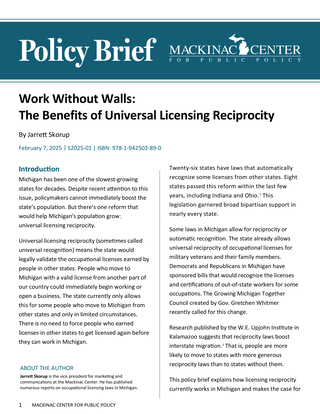
In a compelling exploration by the Mackinac Center for Public Policy, the report titled “Work Without Walls” sheds light on the transformative potential of universal licensing reciprocity. This concept, which is gaining traction across the United States, could be a key to unlocking economic growth and population expansion in Michigan.
Universal licensing reciprocity allows states to recognize occupational licenses issued in other states. This means individuals relocating to Michigan would be able to start working or open a business without the cumbersome process of obtaining a new license. The Mackinac Center’s article emphasizes the potential benefits of such a policy, particularly in addressing Michigan’s slow population growth and economic challenges.
According to the report, 26 states have already adopted various forms of universal licensing reciprocity, with eight states implementing these reforms in recent years. This movement has received bipartisan support, highlighting its appeal across political lines. The article references research from the W.E. Upjohn Institute, which indicates that states with generous reciprocity laws experience increased interstate migration, a crucial factor for Michigan’s growth.
Current Licensing Landscape in Michigan
Michigan’s current licensing framework presents significant hurdles. The state licenses approximately 180 occupations, imposing various requirements such as educational credentials, training, and fees. These regulations, while intended to protect public health and safety, often serve as barriers to employment and economic activity. The Mackinac Center argues that these laws do not significantly enhance public safety and instead limit market competition, leading to higher consumer prices.
The Case for Reform
The Mackinac Center’s article highlights the inconsistency and arbitrariness of Michigan’s licensing laws. For instance, while some occupations benefit from reciprocity agreements, others require additional schooling, exams, and fees. The article suggests that adopting a universal licensing reciprocity law would streamline this process, allowing skilled professionals to contribute to Michigan’s economy more efficiently.
A Real-World Example
The article shares the story of Anne Davis, a psychotherapist who faced significant challenges transferring her license to Michigan. Despite her extensive experience, Anne spent over a year navigating the state’s licensing requirements. This delay not only affected her livelihood but also deprived Michigan residents of a valuable service. Such examples underscore the need for reform.
Conclusion: A Call to Action
The Mackinac Center’s report concludes with a call for Michigan to join the ranks of states embracing universal licensing reciprocity. By doing so, Michigan could become one of the most accessible states for professionals seeking to relocate and contribute to the local economy. This reform would not only boost economic growth but also address workforce shortages and lower consumer prices.
For further details, you can read the full article on the Mackinac Center’s website.
More Articles
Getting licensed or staying ahead in your career can be a journey—but it doesn’t have to be overwhelming. Grab your favorite coffee or tea, take a moment to relax, and browse through our articles. Whether you’re just starting out or renewing your expertise, we’ve got tips, insights, and advice to keep you moving forward. Here’s to your success—one sip and one step at a time!
"The challenges faced by the PropTech industry are vast, ranging from data security and regulatory compliance to the implementation of sustainable practices. Yet, technologies such as Artificial Intelligence (AI), Virtual Reality (VR), Internet of Things (IoT), and Blockchain are pivotal in addressing these hurdles."
The commercial real estate sector is poised to emerge from recent tumultuous years, armed with insights and strategies to better position itself for the future. According to a detailed analysis by Deloitte, the 2025 outlook offers a roadmap for industry leaders to navigate the evolving landscape.
The IRS is ushering in a new era of tax reporting that will significantly affect freelancers, small business owners, and anyone who earns income through third-party payment apps like Venmo or PayPal. These changes are embodied in the form of adjusted thresholds for the Form 1099-K, a tax document used to report income from such platforms. Previously, this form was only required for those earning at least $20,000 annually through these services. However, new phased-in rules will reduce this threshold to $600 by 2026, starting with earnings over $5,000 in 2024.
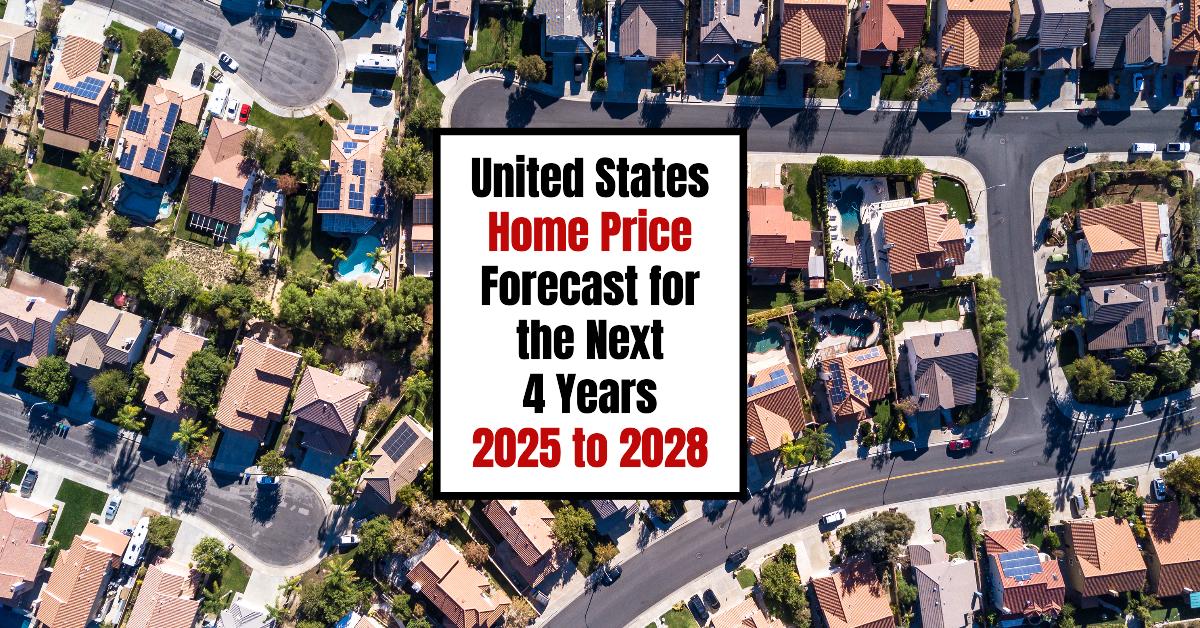
As we look to the horizon of the U.S. housing market, Fannie Mae's Home Price Expectations Survey offers a crucial glimpse into the coming years. Compiled from the insights of over 100 housing experts, this survey predicts notable changes in home prices from 2025 to 2028. The analysis, originally detailed by Norada Real Estate Investments, suggests a shift in market dynamics that could impact homeowners and investors alike.