Universal Licensing Reciprocity: A Pathway to Growth
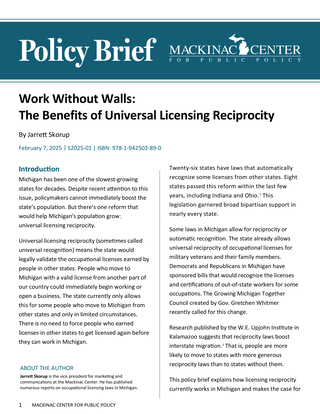
In a compelling exploration by the Mackinac Center for Public Policy, the report titled “Work Without Walls” sheds light on the transformative potential of universal licensing reciprocity. This concept, which is gaining traction across the United States, could be a key to unlocking economic growth and population expansion in Michigan.
Universal licensing reciprocity allows states to recognize occupational licenses issued in other states. This means individuals relocating to Michigan would be able to start working or open a business without the cumbersome process of obtaining a new license. The Mackinac Center’s article emphasizes the potential benefits of such a policy, particularly in addressing Michigan’s slow population growth and economic challenges.
According to the report, 26 states have already adopted various forms of universal licensing reciprocity, with eight states implementing these reforms in recent years. This movement has received bipartisan support, highlighting its appeal across political lines. The article references research from the W.E. Upjohn Institute, which indicates that states with generous reciprocity laws experience increased interstate migration, a crucial factor for Michigan’s growth.
Current Licensing Landscape in Michigan
Michigan’s current licensing framework presents significant hurdles. The state licenses approximately 180 occupations, imposing various requirements such as educational credentials, training, and fees. These regulations, while intended to protect public health and safety, often serve as barriers to employment and economic activity. The Mackinac Center argues that these laws do not significantly enhance public safety and instead limit market competition, leading to higher consumer prices.
The Case for Reform
The Mackinac Center’s article highlights the inconsistency and arbitrariness of Michigan’s licensing laws. For instance, while some occupations benefit from reciprocity agreements, others require additional schooling, exams, and fees. The article suggests that adopting a universal licensing reciprocity law would streamline this process, allowing skilled professionals to contribute to Michigan’s economy more efficiently.
A Real-World Example
The article shares the story of Anne Davis, a psychotherapist who faced significant challenges transferring her license to Michigan. Despite her extensive experience, Anne spent over a year navigating the state’s licensing requirements. This delay not only affected her livelihood but also deprived Michigan residents of a valuable service. Such examples underscore the need for reform.
Conclusion: A Call to Action
The Mackinac Center’s report concludes with a call for Michigan to join the ranks of states embracing universal licensing reciprocity. By doing so, Michigan could become one of the most accessible states for professionals seeking to relocate and contribute to the local economy. This reform would not only boost economic growth but also address workforce shortages and lower consumer prices.
For further details, you can read the full article on the Mackinac Center’s website.
More Articles
Getting licensed or staying ahead in your career can be a journey—but it doesn’t have to be overwhelming. Grab your favorite coffee or tea, take a moment to relax, and browse through our articles. Whether you’re just starting out or renewing your expertise, we’ve got tips, insights, and advice to keep you moving forward. Here’s to your success—one sip and one step at a time!
Commercial real estate is entering a decade of major transformation driven by interest rate pressures, evolving work culture, rapid proptech innovation, and growing demand for AI-focused infrastructure. While the global CRE market is projected to reach $133.5 trillion by 2028, rising rates, shifting office demand, and increasing sustainability requirements are reshaping how professionals invest, manage, and develop properties. By 2030, the biggest opportunities will center on mixed‑use conversions, data center growth, premium office spaces, and ESG‑driven upgrades.
The National Association of Realtors’ landmark antitrust settlement is transforming how real estate agents negotiate compensation, work with buyers, and handle transparency in transactions. With MLS‑posted buyer‑broker commissions eliminated and written buyer agreements now required, both consumers and professionals are navigating a new, more transparent landscape. While commission levels have only dipped slightly, the real shift is in how openly compensation is discussed and negotiated—creating new challenges and opportunities for agents who adapt quickly.
Artificial intelligence is no longer a novelty in real estate — 2025 marks its breakthrough year as a dependable pillar of the proptech industry. With investors pouring capital into AI‑powered forecasting, security, automation, and property management tools, the sector is shifting from experimentation to full‑scale adoption. Brokerages, developers, and institutional players now rely on AI to streamline due diligence, enhance market modeling, reduce risk, and optimize building operations. As adoption accelerates, professionals who understand and leverage these technologies are gaining a decisive competitive edge in fast‑moving markets like Florida.
A new episode of Current Account breaks down why the insurance industry is heading into 2026 with more uncertainty — and more opportunity — than ever. From shifting global regulations and rising catastrophe risks to FSOC’s evolving role in the U.S., industry leaders Jérôme Haegeli and Philippe Brahin explain how insurers are being pushed to rethink strategy in real time. With global premium growth expected to slow and regulatory pressures rising, professionals in insurance and financial services are turning to education and new skills to stay ahead in a rapidly changing market.
New Jersey is quietly becoming one of the hottest commercial real estate markets in the nation, with Jersey City and North Jersey breaking into the top 10 in PwC’s 2026 Emerging Trends report. Fueled by redevelopment momentum, data‑center demand, mixed‑use transformations and a surge in health‑care projects, the state is drawing major investors while still battling rising construction costs and municipal fatigue. For real estate professionals, the Garden State’s evolution signals fresh opportunity—and a market worth watching closely heading into 2026.
The National Council of Insurance Legislators is pushing back against President Trump’s new executive order on artificial intelligence, arguing that it threatens decades of state‑based insurance oversight. NCOIL leaders say federal attempts to centralize AI authority could disrupt markets, weaken consumer protections, and limit states’ ability to innovate—setting the stage for a significant legal and political battle with major implications for insurance professionals who rely on AI‑driven tools and regulatory clarity.